Tolkien Gleanings #123

Tolkien Gleanings #123.

* Video from the recent Oxonmoot 50 – Day 3. Four talks are covered by the three-hour video. Including two with titles which had previously made me interested, “Dyeing in Middle-earth” and “The Animals That Are Not There”. In the Questions, the “Dyeing” presenter later has a superb put-down of a “…but what about the TV series?” question.

* Been and gone, a Civic Society public talk on “Tolkien’s Connections with Malvern”. This was on 8th September 2023…

Dr. Bradley Wells will talk about J.R.R. Tolkien, the twentieth-century literary genius and famous author in the realm of fantasy novels The Hobbit and The Lord Of The Rings and his understated connections with the Malvern Hills and Great Malvern.

The talk was part of a surprisingly rich selection of cultural festivals and events being held in the town during autumn 2023. I note that Auden was also in the town, in his younger days as a teacher at Malvern school. Like Tolkien he had grown up in Birmingham, in his case in the slightly more southerly suburb of Harborne, from 1919-1939. Thus the Malvern Hills were very much ‘on the doorstep’ in Auden’s youth, as they were for Tolkien. Like Tolkien he retained few ties to the city after he left, although in Auden’s case there was at least one early ‘on the Malvern Hills’ poem and a rather sad Larkin-esque ‘farewell’ 1937 poem which evoked the urban topography and voices of the city. His “the most lovely country that I know” poem doesn’t really count, as that was about the view from the train “from Birmingham to Wolverhampton” and thus mostly evoking the eastern part of the Black Country. But that was the way of it, in those industrial and industrious days. The clever kids in smoky cities such as Birmingham or Stoke-on-Trent worked hard at school, assiduously avoided picking up the heavy local accent, noticed the industrial views from the train, and then… they mostly left as soon as they were able — never to look back.

* Catholic World Report has a short musing this week on “The magnanimous faith of J.R.R. Tolkien”. The author suggests that Tolkien’s feeling for magnanimity comes through in his writing, and this may be something that many readers find subtly appealing.

* And finally, the presumably new stage play Lewis and Tolkien is set for its premiere run in the USA…

Set in Oxford, England in the autumn of 1963 at the ‘Rabbit Room’ of the Eagle and Child Pub, [the events of this play are] something of ‘a return to the familiar’ for Lewis and Tolkien. Filled with humour, rousing debate, and reconciliation, the two men learn the true value of their friendship with a little help from a few pints of beer and the energetically curious barmaid, Veronica.

This is a Los Angeles theatre production, billed as a “world premiere”. It is not to be confused with the still-forthcoming Web series which filmed in London last year.

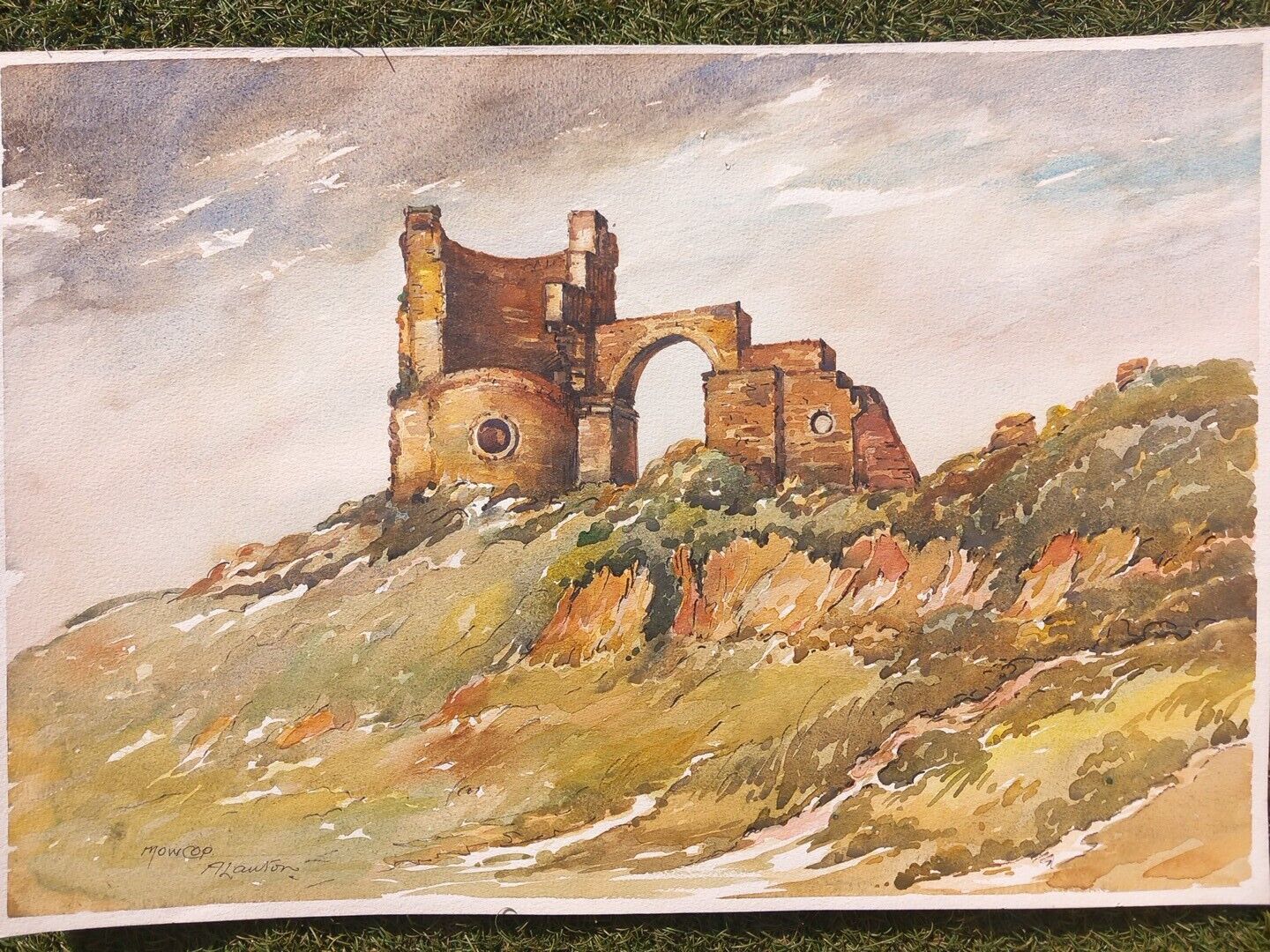
Mow Cop in water

Currently on eBay (not from me) is a simple but pleasing lively watercolour of the summit of Mow Cop. Seemingly unique, vintage, and by “Lawton”.

Regrettably laid on grass for the eBay picture. Which probably means the back of it has now been seeded with millions of potential mould spores.

Tolkien Gleanings #122

Tolkien Gleanings #122.

* A new thirty minute Brandon Vogt and Holly Ordway Interview for Word on Fire. Not the same as the previous Word on Fire podcast interview about Ordway’s new Tolkien’s Faith: A Spiritual Biography book, which was a long pre-publication interview with Michael Ward.

* Wheaton College has two events celebrating the launch of Tolkien’s Faith: A Spiritual Biography, on 25th-26th September 2023.

* A Spanish translation of the book Tolkien’s Faith will be published by Loyola in spring 2024.

* Holly Ordway has posted a new report on the recent Tolkien’s Words and Worlds event at Oxford University…

Simon Horobin’s excellent paper “‘Never Trust a Philologist’: C.S. Lewis, J.R.R. Tolkien and the Place of Philology in English Studies” was illuminating of the academic context that Tolkien found himself in when he arrived at Pembroke as the Rawlinson and Bosworth Professor of Anglo-Saxon.

* In northern England, the Barnsley Museum now has an official page for The Magic of Middle Earth touring exhibition. On this stop the exhibition will be free, and will run from… “30th September 2023 – 6th April 2024”.

* And finally, new in the classical antiquity journal Antigone, “Middle-earth Songs: 50 Years After Tolkien”.

Tolkien Gleanings #121

Tolkien Gleanings #121.

* A new talk in London this weekend, Holly Ordway on “Beauty and Sorrow: Tolkien’s journey of faith”. At St. Mary’s Church, Sunday 10th September 2023. Her publisher Word on Fire has also just released a new and highly-polished official one minute trailer for Ordway’s acclaimed new book, Tolkien’s Faith: A Spiritual Biography.

* In October, Ordway is in Houston with a talk on “Tolkien’s Faith and the Foundations of Middle Earth”, 2nd October 2023. Free and booking now.

* The first review I’ve seen of the recent book Tolkien in the Twenty-First Century: What Middle-earth means to us today (2023). The reviewer finds it “a long wearying slog” and “a read that is about as compelling as a phone book”. Not to be confused with the academic collection Tolkien in the 21st Century: Reading, Reception, and Reinterpretation (2022).

* A new long and very informed article on “J.R.R. Tolkien on Philosophical Anarchism”.

* News of a new book, Tolkien on Chaucer, 1913-1959. From Oxford University Press and apparently containing everything Tolkien ever published or said about Chaucer. Including his translation of the Reeve’s Tale, which is said to be as yet unpublished. The OUP issued a contract for the book in 2021, and the French Tolkendil forum suggests publication toward the end of April 2024. Amazon UK is pre-ordering, but currently has no shipping date.

* And finally… this week’s TLS comments, on the week’s literary news and very much in passing, that…

“[it is] fifty years since Anthony Burgess declared in the TLS [in 1973] that “The Hesse cult continues, though the Tolkien one seems to be at an end”, getting it exactly the wrong way round.”

Thus back-handedly implying that the TLS even now thinks that the attention paid to Tolkien is due to a ‘cult’. Judging by their lack of coverage, Tolkien is not high on their book-reviewer Wish List. Also, pushing the idea of a “cult” aligns with a small group of TV-oriented fans who try to label and dismiss the majority of Tolkien fans as “an intolerant cult”.

The Hesse referred to above was the now little-read German writer Herman Hesse, not to be confused with Hess the captured Nazi leader.

Tolkien Gleanings #120

Tolkien Gleanings #120.

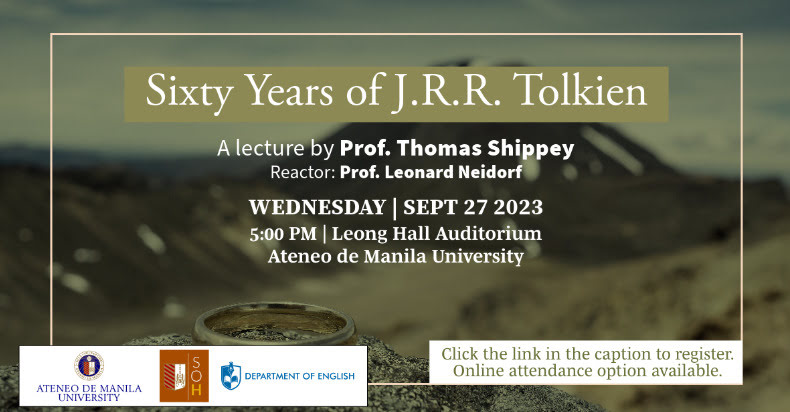
* Ateneo de Manila University’s Events at the School of Humanities this September Web page includes news of a free lecture by the venerable Tom Shippey, titled “Sixty Years of J.R.R. Tolkien”. Set for 27th September 2023. “Online attendance option available”, and booking now. At the Department of English, so I assume it will be given in English.

* There’s to be a major Tolkien exhibition at the Galleria Nazionale d’Arte Moderna e Contemporanea di Roma (GNAM), Italy’s national contemporary arts museum. This was announced verbally at a festival in early July 2023, by the GNAM director. Update: Thanks to Sebastiano Tassinari for getting the exhibition’s title, “J.R.R. Tolkien 1973-2023, Man – Professor – Author” and the dates. It will run from 14th November 2023 to January 2024. It will be a mid-sized show of 150 items.

* CCS Universe notes “Astronomer Keynotes at International Conference Celebrating Middle-earth”

“CCSU astronomer Dr. Kristine Larsen was one of two keynote speakers at the 50th Oxonmoot conference in Oxford last weekend […]. Her talk, focusing on letters Tolkien wrote to his children for over 20 years in the guise of Father Christmas, included references to eclipses, comets, constellations, and most especially auroras. In particular, she demonstrated how Tolkien’s artistic renditions of aurora in specific years echoed displays witnessed by astronomers in his native England.”

I didn’t see this on the official list of presentations, which I looked at in an earlier Tolkien Gleanings. Perhaps because it was a keynote talk, listed apart from the regular presentations?

* In Mexico, the event Tolkien: La fantasia del libro al mundo digital in September 2023.

* From Bangor University, via The Conversation, How J.R.R. Tolkien was inspired by medieval poems of northern bravery. A short article under Creative Commons Attribution.

“Fifty years on from Tokien’s death, that spirit of northern bravery endures as an alluring concept. What makes Tolkien’s fantastical world so appealing is the recurrent suggestion that the courage manifested to defeat the big monsters in The Hobbit and The Lord of the Rings is the very same courage that can be found in hopeless situations of a more ordinary sort.”

* Charles Williams expert Sorina Higgins this week reports several projects underway

  – An article on Tolkien’s only play, The Homecoming of Beorhtnoth Beorhthelm’s Son.
  – A book [on Williams], An Introduction to The Oddest Inkling.
  – My life’s work! The long-anticipated Annotated Arthuriad of Charles Williams.

* And finally, France.info visits the Lamb & Flag pub in Oxford, recently re-opened as a community-run venture and reportedly doing a roaring trade.

Seeing the oak for trees

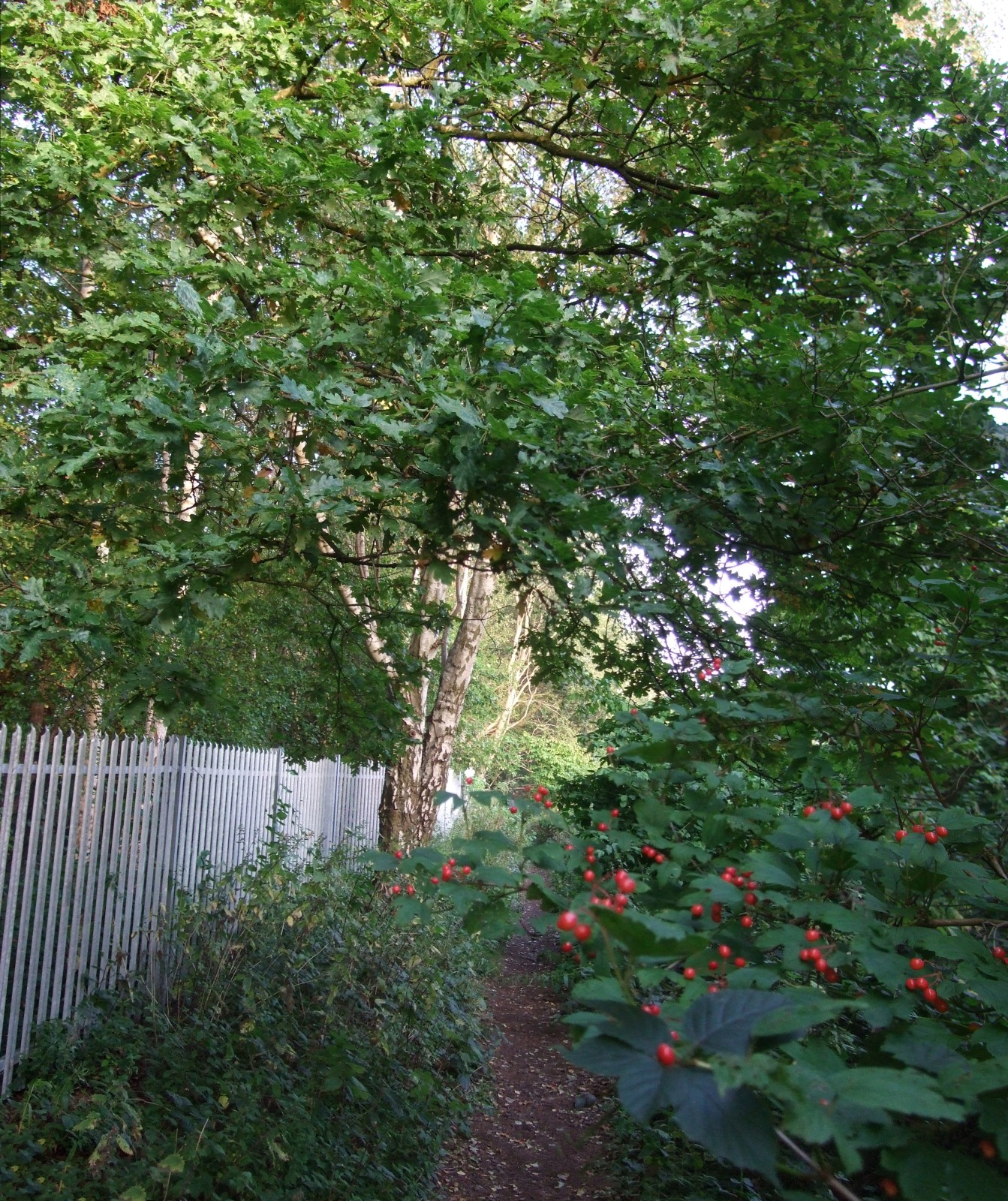
It sometimes pays to be looking downwards, which I do when litter-picking. On a walk to M&S, along the canal and via the new valley-spanning Wolstanton link-road, I spotted an oak sprig fallen on the path. “Now where’s that come from?” I wondered. There had once been a little oak sapling on the path, which circa 2005 I had occasionally protected. I had several times cut back the lesser shrubs that were attempting to swamp it, letting sunlight into its nook in the hedge. But in recent years I had been unable to re-discover it as I passed by. “Swamped and died”, I thought.

But there was an oak sprig, fallen on the path in front of me. I looked up. Spreading high above me was a fine healthy young oak tree. In the same place as before, but the shrubs had thickened and grown outward onto the path, while the oak had grown upward to the light. That was why I couldn’t find it again. I was looking for a struggling and scrawny sapling on the edge of the path, but it’s now a proper tree growing up from the centre of the hedge.

One also finds other things. The M&S walk was to get new ‘maximum’ Merino-wool thermals, before the cold damp weather arrives and they suddenly sell out. I had wanted Amazon’s Damart, but Amazon seemingly couldn’t deliver to any of the many Amazon lockers in Stoke (always “full”, which one can prove is a complete lie by ordering other items). Thus an early morning walk to M&S was called for instead. M&S’s Damart equivalent is HeatGen (£56 for a top and bottom combo). I’d also idly looked at the M&S sunglasses online, needing a new pair. But I couldn’t afford them at £20-£30. The HeatGen thermals are being paid for by a kind benefactor who doesn’t want me shivering again this winter, but sunglasses are not on offer.

So… what did I also find while litter-picking the route to M&S? You guessed it. A nice and perfectly good pair of men’s sunglasses. Free. And also the M&S brand. Strange, when that sort of thing happens. But it does, and surprisingly often. Not long ago I went to litter-pick and snip back the greening-up of an old disused railway-line path. With secateurs. On the way there I found a perfectly good pair of wooden-handled hedge shears, discarded with some other ‘builder and decorator’ fly-tipping and with a bit of dried paint on the handles… but un-rusted, still nice and sharp. What are the odds?

Tolkien Gleanings #119

Tolkien Gleanings #119.

* The Knowing and Understanding C.S. Lewis podcast interviews Holly Ordway on her new book Tolkien’s Faith. It’s a two-part interview, and only the first 25 minutes is currently available.

* A pleasing poster for the forthcoming German conference on visualising Tolkien’s work, to be held in Gottingen in Germany, 27th to 29th October 2023. No programme listing, as yet.

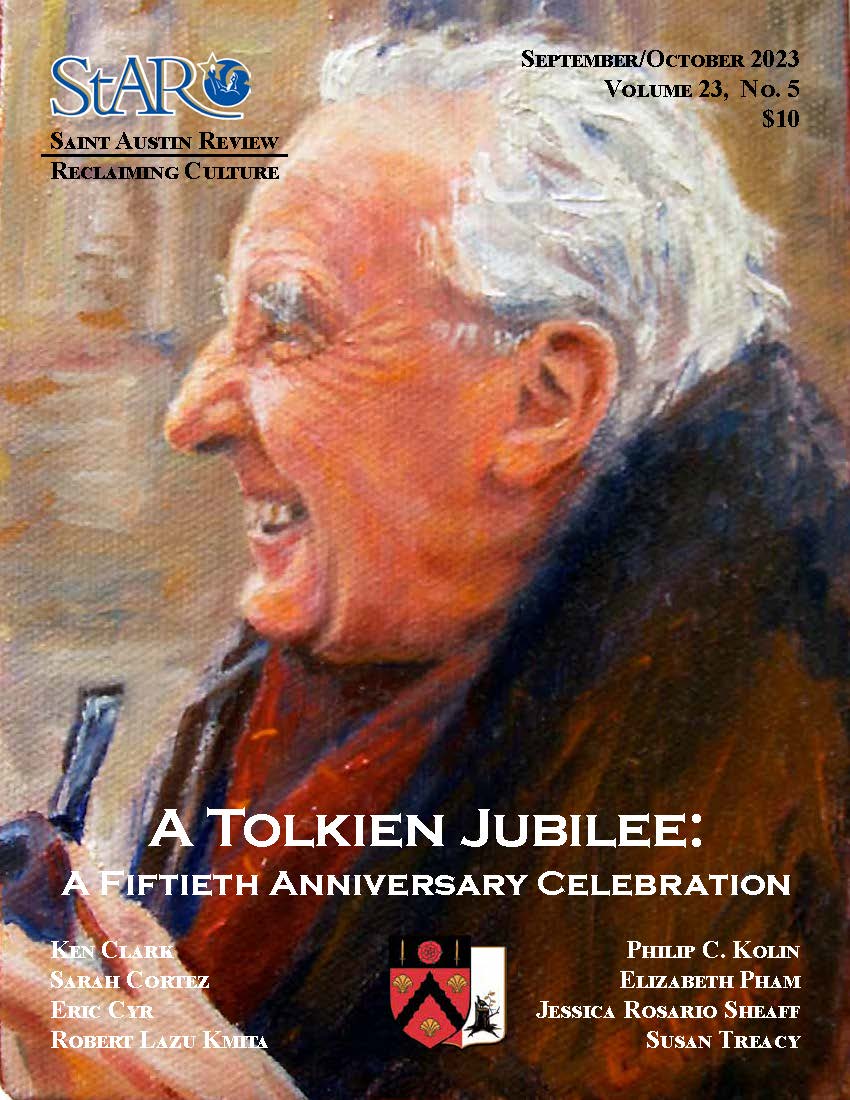
* A less pleasing cover for the September/October issue of the St. Austin Review, themed as ‘A Tolkien Jubilee’. Looks vaguely like an orange and elderly Ken Dodd, to me. It’s the teeth, I guess.

  – “On Fairy-Stories and Fantasy: 50 Years After the Father’s Farewell”.

  – “The Liturgy of the Mass Seen Through Tolkien’s Lens of Fairy-Story”.

  – “Good Love, Bad Love: From Tolkien to Denis de Rougemont and Back Again”.

  – A review of The Nature of Middle-Earth.

* Bitter Winter details a recently auctioned and (apparently) previously unknown 1969 letter from Tolkien.

* In The Critic this week, “Tolkien, 50 Years On: the true scale of his legacy is gradually becoming apparent”. One of the better and more thoughtful articles in the current wave of ‘Tolkien for the clueless’ articles appearing in newspapers and magazines.

* And finally, the long-running British Fairies blog this weekend surveys “Popular Views of Faeries in Victorian and Edwardian Times”, as seen on popular cards of the period. This post’s focus necessarily gives a one-sided view. But recall that a fairy-play, The Blue Bird, could win Maetlinck the 1911 Nobel Prize for Literature. And that Kipling, author of Puck of Pook’s Hill (1906), had won the Nobel Prize in 1907. Such was the context in which Tolkien began writing.

Amazon is full

Every single Amazon locker in central Stoke-on-Trent is full and accepting no new orders…

“This location is temporarily unavailable because it’s full.”

All of them. Even the big one at the main Post Office and the city’s main shopping centre. How can this be? It’s the same for a tiny cheap item or a larger expensive item, so size or price are not the problems. Nor can it be that it’s an item that’s somehow ‘hazardous’ or ‘fragile’.

All lockers have been full for about five days now. Did a chunk of the population just win the Lottery, or something? Or perhaps students are returning, flush with new loan cash?

How are Amazon going to cope at Christmas, if they can’t cope at the start of September?


Update: Still all “full”. Easier to go to M&S at Wolstanton, and cheaper too!

Get lost, Guardian…

The Guardian newspaper makes a flying visit to Stoke today…

Frontier towns are bypassed, forgotten, often forlorn, occasionally vicious in the old sense of the word: full of vice. Seediness inhabits their edges, and edges are what they mainly are.

Thanks. The visitor from the Guardian comes away dizzied by the place-names and the many-towns -ness of the place…

… to this madness of nomenclature [names] and borough fragmentation, we can add the fact that the five, or six, towns merge into Newcastle-under-Lyme to the west, making the latter’s contours and clamour indistinguishable from Stoke’s. No green belt has curbed this coalescence.

No… the writer has overlooked the steep valley ridge. From the woods behind The Villas, through the Richmond St. allotments and adjacent Park, along the ridge into the very long Hartshill Park above the school, then across the recreation ground and to the woods above PotClays, then into the start of the Bradwell Woods alongside the A500, and then along the woodland ridge toward the north and the cross-over tunnel to Bathpool and Kidsgrove. It’s not official Green Belt, and is occasionally nibbled at by the Council for new housing (e.g. the new fill-in-estate above the south end of Hartshill Park, on the old primary school site), but the valley ridge serves much the same purpose in providing a belt of greenery between Stoke and ‘Castle. All very narrow and fragile (e.g. Newcastle’s mad plan to build on the Bradwell Crematorium recreation grounds) admittedly, but it’s there.

The Guardian, presumably visiting from London, was confused not just by Stoke but the whole of the Midlands…

Arguably, the whole of the Midlands could be construed as a region intended to confuse and defy

Yes, it must be strange to visit a place that most southerners believe doesn’t really exist. For many who rarely venture north of the Watford Gap, England is just ‘the south’ and ‘the north’, with nothing possible in-between. Just the stalwart manufacturing powerhouse of the nation. ‘Nothing to see here, move along now.’

High on disorientation, I drove around like a J.G. Ballard cipher.

Ballard was a 1970s science-fiction writer known for his tales of isolation, disorientation and quiet despair in post-apocalyptic landscapes. Even the Guardian’s uber SatNav has problems…

I plugged Wedgwood into the satnav and was sent to purgatory – a weird semi-private estate

Oh, the horror… ‘unprepared Guardian journo accidentally finds somewhere quite nice in Stoke’. But isn’t it actually rather nice to live in a place which so delightfully bamboozles and confounds so many visitors? And yet which is all perfectly obvious to locals. Especially walkers and cyclists, who know a totally different and far greener city than the grotty ‘main roads city’ that the car-bound know, including all the semi-secret ‘little ways through’ like the old Market Drayton line.

Ye Olde Market Drayton railway line

Apparently we only have two key attractions for Guardian readers. The Potteries Museum, and…

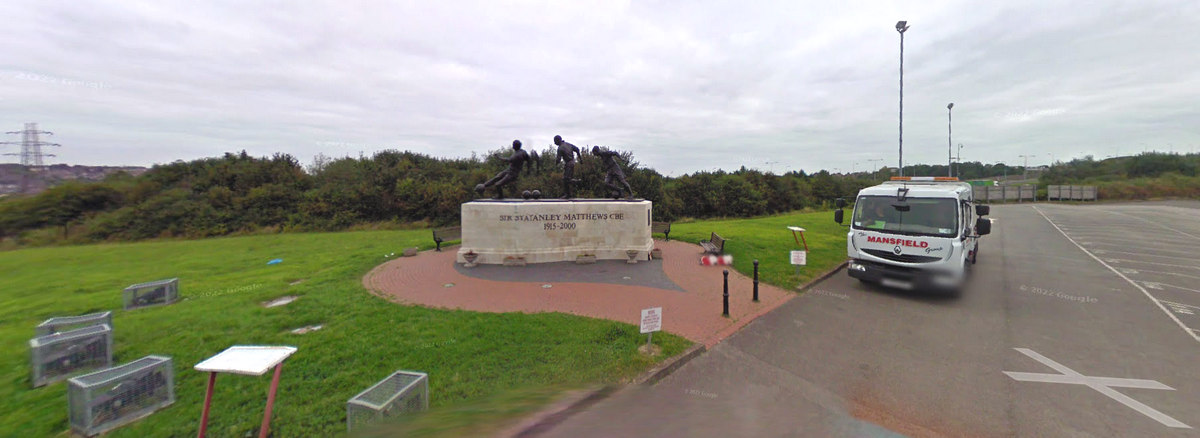
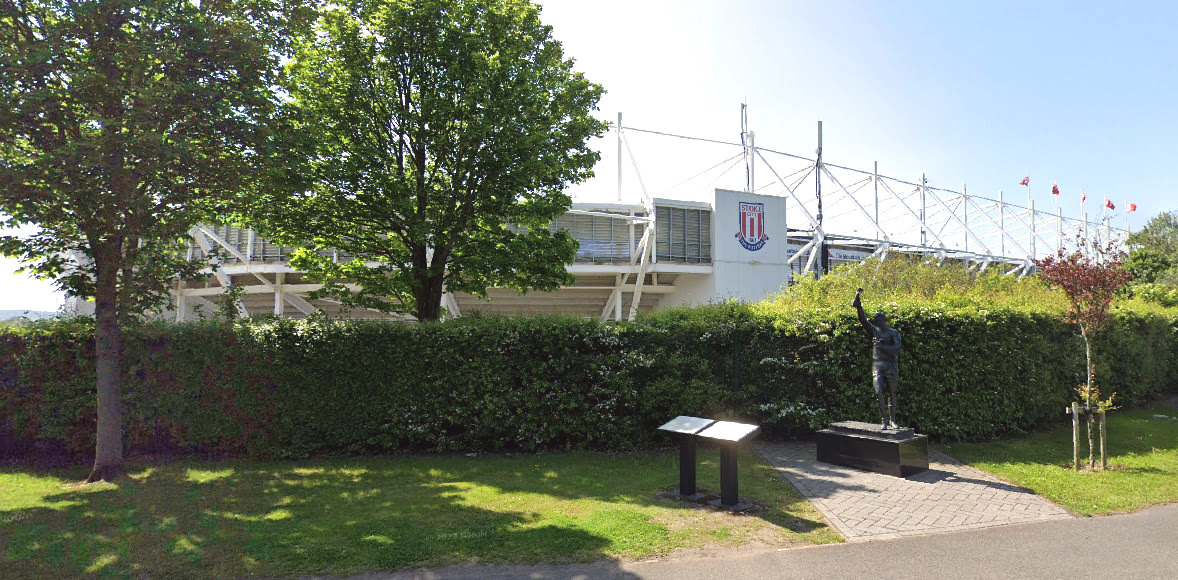
the Stanley Matthews statue at Stoke City stadium

Well, yes… I guess if you’re a football historian. Though it’s in the car-park at the back and then around to the north, which is not open to casual visitors or walk-throughs (the lower walk-up gates are often shut, unless there’s a match or Job Fair etc). Good luck getting permission to visit/photograph when it’s not a match day, and even then you might have trouble with the stewards. A first-time football historian visitor to the city might however want to visit the Stanley Matthews ‘ceramic shrine’, in the Minster churchyard, I’d suggest.

But if the newspaper’s readers do ever visit the Stadium, they should note there’s also a Gordon Banks statue out by the roadside and publicly accessible.

Tolkien Gleanings #118

Tolkien Gleanings #118.

* “A Tale of Two Essays: The Inklings on the Alliterative Meter” in Notes and Queries (August 2023). No download, but a useful long abstract…

“… why did Tolkien claim precedence [for the metrical appendix in ‘On Translating Beowulf’] despite knowing, strictly speaking, that such precedence was false? My solution to this minor mystery is that Tolkien simply got ‘scooped’ by his friend [C.S. Lewis]. That is, Lewis unintentionally pre-empted Tolkien’s essay, yet his own essay seems to have directly spurred Tolkien, a perennial procrastinator, into completing a metrical work fifteen years in the planning.

* A Spanish cultural journal has a new Tolkien special, complete with slightly scary cover-art. Seems to be a fairly standard mix, but the article on a “biographical link” may interest some…

a profile of the author; a discussion of LoTR; a look at “twelve clues that illuminate some enigmas” in his work; discussion of the film adaptations; and “Andreu Navarra explains his biographical link with Tolkien”.

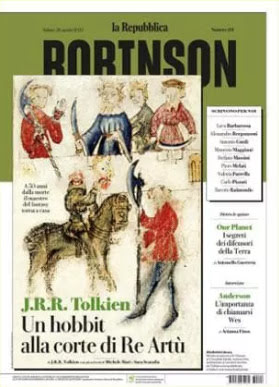
* In Italy, the La Repubblica newspaper’s cultural magazine also celebrates Tolkien. Specifically the new Italian Sir Gawain & The Green Knight

* Oxonmoot 2023 is now underway in Oxford. The final schedule includes, among others…

  – “A Tolkien Onomasticon: the need, and a possible approach”. [The need for a full and scholarly name-list]

  – “Making The Invisible Visible: presences of evil and disappearing characters in illustrations for J.R.R. Tolkien”. [How do we illustrate the “hidden things” in Tolkien or his descriptions such as “Not a nasty, dirty, wet hole”?]

  – “Dyeing in Middle-earth”. [“Explores the links between Tolkien’s use of distinctive colours to define the races of Middle-earth, and the flora he names” in LoTR].

  – “A Different Gaze: hidden features in Tolkien’s drawings” [We can now see “some minute features which might otherwise have remained unnoticed” [and the talk will itemise] “the hidden features in Tolkien’s drawings which have been identified so far.”]

  – “Reading Tolkien in the 1950s” [This was “a very different experience from the context of present-day publications and adaptations. It is worthwhile examining the development of our knowledge of the Legendarium in this light.”]

  – “Creative ‘Borrowings’: an overview of Heimskringla’s influence on J.R.R. Tolkien and C.S. Lewis” [On “the two authors’ different responses to the classic Norse text Heimskringla, written by the twelfth-century scholar Snorri Snurluson.”]

  – “Water-Lillies Bringing: a horrific monster hidden in plain sight” [Bombadil as a reflection of “a terrible monster posing as a kind and innocent figure”? Sounds like it’s about the real-world River-man folk-lore, and perhaps and/or inland pool nixies. Both of which I’ve detailed in my recent book.]

  – “The Animals That Are Not There (and the trees that are)” [Why “among all of Tolkien’s descriptions of nature, are there almost no descriptions of animals?”]

The latter talk also asks… “How come Bilbo doesn’t have a dog that goes on walks with him, and why aren’t there any cats in the Prancing Pony Inn”? Because dogs appear to be big nasty smelly hairy farmyard things with fangs, not the modern cute breeds. Having a dog would also likely alarm dwarves and elves, scare off all local birds and wildlife (as they do), and would further mean the ring could not be used — the presence of the dog would give Bilbo away. Also because he probably has nasty memories of the white wolves invading the Shire in the Fell Winter of 2911 (he was there, though a young hobbit at age 21). As for cats, with all the ruckus going on inside the Prancing Pony, the stables packed with smelly (and then escaped en masse) horses, and a Black Rider prowling about outside, any cats would have been sensibly keeping well away from the frontage and stables of the Prancing Pony while the hobbits were there. Perhaps the next morning they were all round the back, sniffing for the kitchen scraps? Actually, we know Bob and thus the Pony has at least one cat, since the text tells us so: “Bob ought to learn his cat the fiddle, and then we’d have a dance”.

* A new undergradate dissertation from Ohio, “Into the Mythopoeia of J.R.R. Tolkien and C.S. Lewis: Memories of War through Fantasy Literature” (2023). The author has done primary source work in the Bodleian. The download is embargoed, but the page has a long abstract.

* And finally, the Derbyshire well-dressing tradition has been extended to Tolkien. Holymoorside has three new well-dressing panels featuring Tolkien scenes, each made with around 40 varieties of flowers, plus leaves and seeds collected from the locality. Well-dressing is a folk custom practiced in the Derbyshire Peak district and parts of North Staffordshire, involving the painstaking creation of large decorated panel-pictures made with flower-petals and seeds, which are then placed around local springs and water-wells.