Tolkien Gleanings #118.
* “A Tale of Two Essays: The Inklings on the Alliterative Meter” in Notes and Queries (August 2023). No download, but a useful long abstract…
“… why did Tolkien claim precedence [for the metrical appendix in ‘On Translating Beowulf’] despite knowing, strictly speaking, that such precedence was false? My solution to this minor mystery is that Tolkien simply got ‘scooped’ by his friend [C.S. Lewis]. That is, Lewis unintentionally pre-empted Tolkien’s essay, yet his own essay seems to have directly spurred Tolkien, a perennial procrastinator, into completing a metrical work fifteen years in the planning.
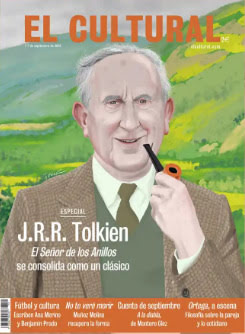
* A Spanish cultural journal has a new Tolkien special, complete with slightly scary cover-art. Seems to be a fairly standard mix, but the article on a “biographical link” may interest some…
a profile of the author; a discussion of LoTR; a look at “twelve clues that illuminate some enigmas” in his work; discussion of the film adaptations; and “Andreu Navarra explains his biographical link with Tolkien”.
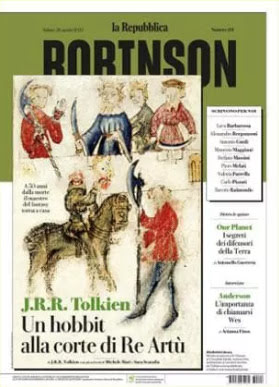
* In Italy, the La Repubblica newspaper’s cultural magazine also celebrates Tolkien. Specifically the new Italian Sir Gawain & The Green Knight…
* Oxonmoot 2023 is now underway in Oxford. The final schedule includes, among others…
– “A Tolkien Onomasticon: the need, and a possible approach”. [The need for a full and scholarly name-list]
– “Making The Invisible Visible: presences of evil and disappearing characters in illustrations for J.R.R. Tolkien”. [How do we illustrate the “hidden things” in Tolkien or his descriptions such as “Not a nasty, dirty, wet hole”?]
– “Dyeing in Middle-earth”. [“Explores the links between Tolkien’s use of distinctive colours to define the races of Middle-earth, and the flora he names” in LoTR].
– “A Different Gaze: hidden features in Tolkien’s drawings” [We can now see “some minute features which might otherwise have remained unnoticed” [and the talk will itemise] “the hidden features in Tolkien’s drawings which have been identified so far.”]
– “Reading Tolkien in the 1950s” [This was “a very different experience from the context of present-day publications and adaptations. It is worthwhile examining the development of our knowledge of the Legendarium in this light.”]
– “Creative ‘Borrowings’: an overview of Heimskringla’s influence on J.R.R. Tolkien and C.S. Lewis” [On “the two authors’ different responses to the classic Norse text Heimskringla, written by the twelfth-century scholar Snorri Snurluson.”]
– “Water-Lillies Bringing: a horrific monster hidden in plain sight” [Bombadil as a reflection of “a terrible monster posing as a kind and innocent figure”? Sounds like it’s about the real-world River-man folk-lore, and perhaps and/or inland pool nixies. Both of which I’ve detailed in my recent book.]
– “The Animals That Are Not There (and the trees that are)” [Why “among all of Tolkien’s descriptions of nature, are there almost no descriptions of animals?”]
The latter talk also asks… “How come Bilbo doesn’t have a dog that goes on walks with him, and why aren’t there any cats in the Prancing Pony Inn”? Because dogs appear to be big nasty smelly hairy farmyard things with fangs, not the modern cute breeds. Having a dog would also likely alarm dwarves and elves, scare off all local birds and wildlife (as they do), and would further mean the ring could not be used — the presence of the dog would give Bilbo away. Also because he probably has nasty memories of the white wolves invading the Shire in the Fell Winter of 2911 (he was there, though a young hobbit at age 21). As for cats, with all the ruckus going on inside the Prancing Pony, the stables packed with smelly (and then escaped en masse) horses, and a Black Rider prowling about outside, any cats would have been sensibly keeping well away from the frontage and stables of the Prancing Pony while the hobbits were there. Perhaps the next morning they were all round the back, sniffing for the kitchen scraps? Actually, we know Bob and thus the Pony has at least one cat, since the text tells us so: “Bob ought to learn his cat the fiddle, and then we’d have a dance”.
* A new undergradate dissertation from Ohio, “Into the Mythopoeia of J.R.R. Tolkien and C.S. Lewis: Memories of War through Fantasy Literature” (2023). The author has done primary source work in the Bodleian. The download is embargoed, but the page has a long abstract.
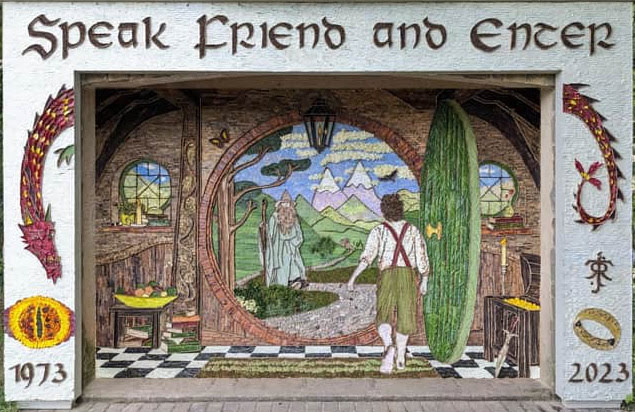
* And finally, the Derbyshire well-dressing tradition has been extended to Tolkien. Holymoorside has three new well-dressing panels featuring Tolkien scenes, each made with around 40 varieties of flowers, plus leaves and seeds collected from the locality. Well-dressing is a folk custom practiced in the Derbyshire Peak district and parts of North Staffordshire, involving the painstaking creation of large decorated panel-pictures made with flower-petals and seeds, which are then placed around local springs and water-wells.