“Gandalf had made a special study of bewitchments with fire and lights” — The Hobbit.
A new free audiobook on LibriVox, Pyrotechnics: The History and Art of Firework Making (1922). Includes “Military Pyrotechny in the Great War”, written only a few years after the war ended. The final third of this discusses signalling and illumination star-shells fired from Very ‘flare’ pistols, and larger rifle-fired star-shells.
The enemy capabilities were also noted by Cyril Fall (The First World War, 1960)…
“A German attack meeting stout resistance was often a remarkable cooperation between infantry and artillery by [signalling] fireworks far more detailed than the British or French could achieve. The sky was at times so full of yellow, red, and green rockets that the observer wondered how anyone could make head or tail of the signals. Yet time after time the artillery would lengthen or shorten its fire or carry out a re-bombardment of varying duration. This may be Greek [i.e. incomprehensible] to the infantryman of the Second World War because, having other means of communicating with the artillery, he finds it hard to realise how vital rocket signals might be.”.
As an experienced wartime signals officer, J.R.R. Tolkien would have had a basic familiarity with ground-candles, coloured smokes, aerial flares and the ubiquitous star-shells (the British used 10 million of these every month).
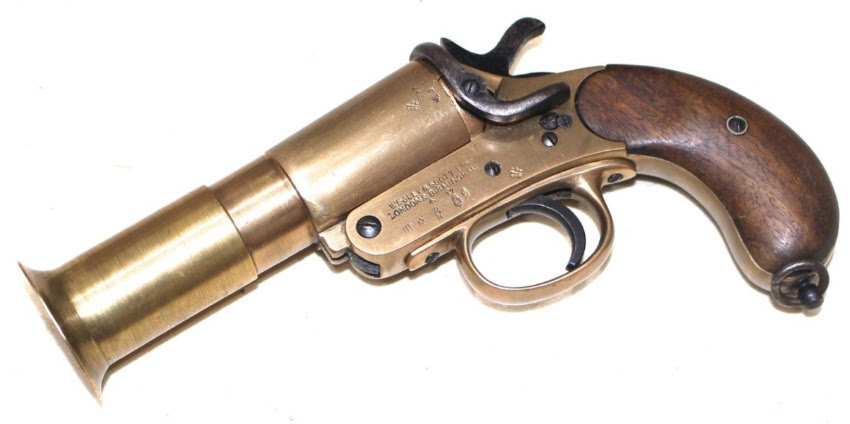
British star-shell pistol, 1917.
Presumably he also had some understanding of larger signalling fireworks, and possibly even experience of maroons. The latter being British firework rockets, usually used as maritime distress rockets at sea and designed to go off with a very loud ‘bang’ noise. These were in use in London and at least one industrial town, during the latter part of the First World War. They served as advance night-time air-raid warnings / calls for scattered fire-crews. The sound presumably being akin to the “deafening … signal for supper” dragon-rocket, encountered early in The Lord of the Rings. One imagines there would also be a dazzling flash if one happened to be looking at the night sky when one went off, akin to the flash that dazzles all the hobbits on the vanishing of Bilbo.
Which makes one wonder if Tolkien’s evident interest in fire and fireworks might have some origins among such experiences, although today we might tend to think of ‘signals’ in terms of wireless and codes. I’m however uncertain if maroons were also used for the frequent air-raids that crossed the east coast of England, where Tolkien was helping to counter airship raids later in the war. Possibly not on the sleepy coast, where a policeman or postmaster with a bicycle and a loud voice (then the more usual British method) would have sufficed for the few civilians. Perhaps further inland, in the industrial towns? But the only hard evidence I can find for the municipal civilian use of air-raid maroons outside London is from the textile town of Macclesfield in Cheshire (Reporting the Great War, p. 29).
The first use in London of maroons was not until a large airship bombing raid of July 1917, the authorities being previously worried that their abrupt use in a vast city would trigger panics and stampedes (especially dangerous at night in the blackout) for the bomb shelters. But the public fear had lessened by then, since new incendiary bullets and darts were destroying what had once seemed to be untouchable ‘monster’ airships. One is reminded here of the special bow of Lorien in The Lord of the Rings, which is used by Legolas to bring down the flying Nazgul on the Great River.
My searches suggest that the history of signalling fireworks and star-shells and maroons in the First World War remains to be written. But there is now at least a biography of the ‘wizard’ behind the many weird and yet very workable British military fireworks, Gunpowder and Glory: The Explosive Life of Frank Brock OBE (2020). It looks like this book would make an accessible starting point. I also encountered (but couldn’t get) a 1924 article of unknown title in the Journal of the Royal Engineers, and rocket-scientist Willy Ley’s book Shooters and Shooting (1942) which appears to have a section on star-shells.
[…] * My new blog post, musing on some possible influences from “Tolkien’s wartime fireworks”. […]