Tolkien Gleanings #41

Tolkien Gleanings #41

* A new and long YouTube video lecture in the Vermont Humanities Lecture Series, which surveys ideas about “Tolkien and Goddess Worship” in relation to the Virgin Mary, and with the final third becoming a rather unconvincing hunt for valkyries. The lecturer is a Tolkien scholar from the University of Vermont, and he’s also on the board of the journal Mythlore. Though I see that Vermont Humanities is wholly independent of his University, being funded by the U.S. National Endowment for the Humanities for public outreach. Sound quality is excellent for the main speaker, but the audience questions at the end can’t be heard and are not summarised by the speaker.

* Briefly appearing on the search engines in late February, a University of Oxford residential summer-school “The Making of Middle-earth: J.R.R. Tolkien and the First Age” (July 2023). The Merton College Web page for this vanished within a day or two. Despite the chunky four-figure ticket-price, I suspect all the tickets sold-out in ‘a bang and a flash’.

* Newly for sale by a rare book dealer, at a ridiculous price, 14 old Tolkien fanzines and three old journal issues.

The issues are: Entmoot #2 to #4 (now freely online); Niekas (an APA perzine, now freely online), #9 to #16, #19, #20; Palantir #4 (now freely online); and Tolkien Journal Vol. II, 3 & 4; Vol. III, No. 2 (1966, now freely online).

* A new academic book is being trailed by the International Balkans University, titled Reimagining the Works of J.R.R. Tolkien. Amazon and Google Books know nothing about it at present. The University page for it doesn’t offer a table-of-contents, and none can be found via search. Though the page does at least state… “seven critical essays and one personal account” plus a foreword by Thomas Honegger. The volume’s editor has an essay in the book and there’s a public abstract for this on ResearchGate, which reveals it to be Jungian in approach. I also found a note from the cover artist, which implies that the printed book is due soon. Honegger’s list of recent publications has it as “2022”, but it looks to me like the book has slipped to spring 2023.

* In German, a new open-access compilation of academic responses on the topic of the emerging paid profession of research into the fantastic. Sadly the licences are confused, which may inhibit translation or summary for publication in English. The front page has the permissive “Creative Commons Attribution”, but then the second page has the much more restrictive “Creative Commons Non-Commercial Share-Alike”.

* And finally, Tolkiety spots a curious syncronicity in Tolkien’s choice of his life-long wall-pictures.

New on the Internet Archive

Newly posted local books, free on Archive.org…


* New lifestyles in old age: health, identity and well-being in Berryhill Retirement Village (2004)

* Childhood’s Domain: play and place in child development (1986) (free-range kids, about a third of the book was researched via fieldwork in Stoke-on-Trent)


* Thanks For The Memory: great tales from North Staffordshire’s past (1999)


* AA 50 walks in Staffordshire (field-checked 2009) (offers plenty in North Staffordshire).

* Best Staffordshire Walks (1996)

* Cycling in the Peak District: off-road trails and quiet lanes (2007)


* Voice of the Universe: building the Jodrell Bank telescope (1987) (revised and updated)


* Wedgwood, of Etruria & Barlaston: an exhibition to celebrate the 250th anniversary of Josiah Wedgwood (1980, museum catalogue)

* Mason Porcelain and Ironstone 1796-1853: Miles Mason and the Mason manufactories (1977)

* Master Potters of the Industrial Revolution (1965)

* Keele Hall, a Victorian country house: the rebuilding of Keele Hall in the mid-19th century (1986)

* A History of the County of Stafford: Vol. 7 – Leek and the Moorlands (1996) (The Victoria County History)


* The River Trent (1955) (Has opening chapters on sources, the pottery towns, the upper Trent, the River Dove).

* Limestones and Caves of the Peak District (1977)

* Well-dressing in Derbyshire (2003)

* Man-land relations in Prehistoric Britain: the Dove-Derwent Interfluve, Derbyshire (1979)


* A Medieval Society: The West Midlands At The End Of The Thirteenth Century (1966)

* An Index of Names in Pearl, Purity, Patience, and Gawain (1981)

* Cheshire under the Norman Earls (1973)

At Swythamley

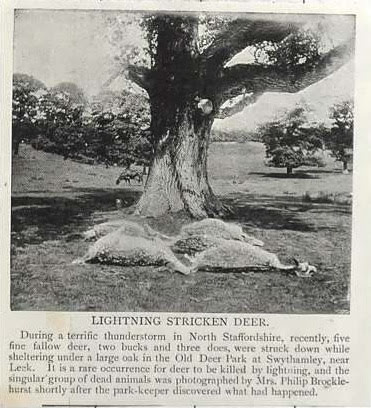
Currently on eBay in b&w (here colorised) and of possible interest to historians interested in Sir Gawain and the Green Knight, Swythamley Hall as it was at perhaps circa the early 1900s. The card being posted from the Wincle sub Post Office in 1905 and the deer being at the Hall since at least 1895…

And co-incidentally, some curious evidence from 1895 of the wild weather in the area together with a view across the parkland…

Tolkien Gleanings #40

Tolkien Gleanings #40

* “J.R.R. Tolkien and the Ethnography of the Elves”

A key publication that Tolkien would have had access to is Jon Arnason’s Islenzkar þjodsogur og aefintyri (Icelandic folklore and fairy-tales), printed in Leipzig in 1862. The book contains a large collection of elf stories collected in the 19th century (pages 5–130), but of no less interest is the introductory material which reviews Icelandic information on elves and their characteristics, using 18th and 17th century sources as well as contemporary tales.

* Mythmoot X from Signum University, on the theme of “Homeward Bound”. 22nd-25th June 2023 at the U.S. National Conference Center. The theme allows a variety of interpretations, and for The Lord of the Rings (my guesses) might encompass: the rarely discussed homeward journey from Gondor to Bree; Frodo’s changed sense of home after his quest; the dwarvish conception of Moria as ancient home; or Aragorn’s return home to Gondor and his long-anticipated kingship. Note online attendance at Mythmoot is possible… “our remote [access] team creates an excellent experience for our distance attenders with broadcasts”.

* A call for papers from Germany, for their Tolkien Seminar 2023 on the theme of “The Visualisation of Tolkien’s Work”. The organisers seem most interested in visual depictions of landscapes and places, rather than characters.

* The next Annual Tolkien Lecture will be at the University of Birmingham, with John Garth presenting. Although Tolkien never attended the university in his home city, a wartime military hospital had been set up there in the central Great Hall. This hospital was where Tolkien was first brought from France. 12th May 2023 is the date of the Garth lecture and (if last year was anything to go by) the YouTube release should then be January 2024.

* And finally, a review of The Fellowship of the Ring in Concert at Radio City Music Hall

Howard Shore’s exemplary [movie trilogy] score was performed by the Lviv National Philharmonic Orchestra of Ukraine, with choir vocals provided by MasterVoices and Brooklyn Youth Chorus, featuring soloist Kaitlyn Lusk and conducted by Ludwig Wicki.

Tolkien Gleanings #39

Tolkien Gleanings #39

* John Garth talks about working with original Tolkien source-materials, among other things, on the latest Prancing Pony Podcast (#278, 5th February 2023).

* I see the new book Thanks for Typing: Remembering Forgotten Women in History (2021) has a short ten-page section titled “Edith Tolkien in the eye of the beholder”. I then found there was a very brief review-note in a recent Mythlore on this, which called this section a “sound” survey of how Edith was understood in public forms such as a memoirs, biographies and (now) cinema. What little can be had of it via Google Books suggests it’s indeed a useful survey of her later stereotypical incarnations, as “Romantic Heroine”, “Unhappy Ever After”, “Proud and Opinionated Princess”, etc.

* A long sample of an ElevenLabs TTS Tolkien AI narrator voice. Not bad, a little ‘Indian English’ in places, but very listenable. It sounds almost as if they trained this AI voice on the official LoTR audiobook narrator and then trained that against readings by a similarly very refined high-caste Indian English-speaker. The disadvantage with these new AI TTS voices is that (so far) none can be produced offline and they require monthly paid subscriptions. For offline you’d still need to use the old-school TSS voices (the abandonware IVONA 2 Brian, British, is still the best such) and then in the Balabolka software you’d hand-craft various XML tags that control and shape how a TTS voice talks.

* Another demo, this time of AI-cloned Stephen Fry narrating The Hobbit. Impressive, and it’s from the Poland-based ElevenLabs again. A good demo, but if I plan to spend 8-12 hours or more with an audiobook I’ll still want it read by a human. Because I know that after ten minutes you get the aural equivalent of sea-sickness, even with these new AI TTS voices.

But that said, there are millions of good books which will never be an audiobook in any other way, and we’re only at the very beginning of the AI revolution. The results will get even better by 2024, 2025… and all the moaning and hand-wringing and EU ‘bans’ in the world won’t stop that from happening now. Of course, I do recall an account of Tolkien ‘casting the demons out’ of an early dict-a-phone machine (an early form of voice-recorder) before he would speak into it… so it’s highly unlikely he would have approved of such things. But they’re here to stay now.

* And finally, it appears that the rather pleasing 1975 Frank Frazetta Lord of the Rings Portfolio is back in print(?). Certainly $80 seems remarkably low, if what’s being offered is really one of the original 1975 run of the portfolio. So I’m assuming a reprint facsimile? Anyway the prints are b&w pen and ink drawings and are not too far from how I see the story, apart from his early-1970s ‘glam mag’ Eowyn.

Tolkien Gleanings #38

Tolkien Gleanings #38

* I’ve realised that 2024 will mark the 111th (“eleventy-first”) birthday of the birth of Tolkien’s legendarium, which sprang from his first encounter with the Old English word earendel.

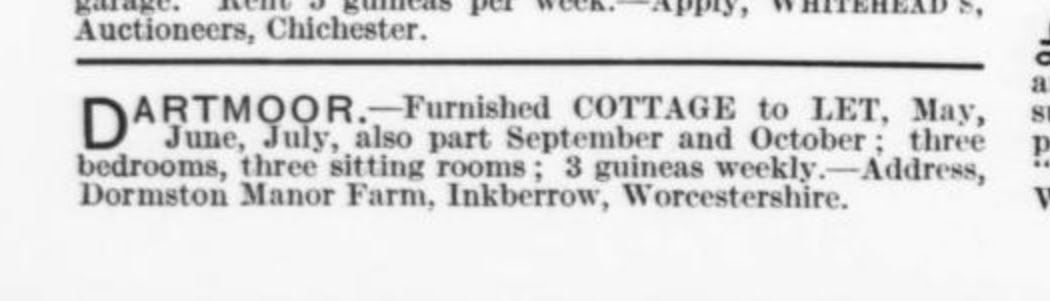
* Did Tolkien’s Aunt Jane own a cottage on Dartmoor, Devon, in the early 1923? An old ad I found in Country Life suggests she did…

From Country Life magazine, 21st April 1923, ads supplement page xlii. Tolkien’s Aunt Jane had moved to Dormston Manor farm in 1922 after “living briefly in Devon” (Reader’s Guide) and had re-named the farm ‘Bag End’ based on an old name for part of the immediate area. Tolkien came to visit the farm in 1923, seemingly in July, once she’d settled in and when he had fully recovered from severe pneumonia. Given the above advert I think it’s fairly safe to assume that this Dartmoor cottage was the same place in Devon she is known to have been “briefly” living in 1922. It was evidently on Dartmoor rather than on the coast, and she later she let it out for parts of the summer. It sounds quite sizeable and habitable, enough to let out as a 1920s holiday-let. 1923 was the time when the new-fangled ‘automobiles” and motorised charabancs took off, bringing remote places within reach, so she was prescient in anticipating this new business opportunity.

* Schreiner University presents the Margaret Syers Lecture for 2023, Dr. Martin Lockerd on “The Stolen Gift: Tolkien and the Problem of Suicide”. To be given on 28th April 2023 in Texas.

* My new post on “On Stocc and Stoke”, with reference to Tolkien and LoTR.

* And finally, “The Repair Shop applauded for ‘astonishing’ restoration” of letters from J.R.R. Tolkien. These being… “two notebooks with the letters, taken to bookbinder Chris Shaw who was able to work his own form of magic to revive the notes, which had fallen into disrepair after 55 years.”

On Stocc and Stoke

I found an interesting conjunction of Tolkien and the place-name of Stoke-upon-Trent. A review of Mark T. Hooker’s book A Tolkienian Mathomium: A Collection Of Articles On J.R.R. Tolkien And His Legendarium (2008) informed me that…

Hooker devotes an entire [ten page] chapter to the Shire place-name “Stock,” which he connects to English place-names, and eventually (via [the writer] Aelfric) to sacred trees (and St. Boniface and Owen Glendower), concluding that “Stocc would, therefore, appear to be the OE [Old English] name applied in pre-Christian times to a religious site”.

From Stocc comes Stoke. The reviewer demurs on the connection with a pre-Christian sacred grove, although obviously the original Stoke was sited at what is now the Minster where two large streams meet the Trent, and it’s well-attested that such ‘three watercourses meeting’ sites had symbolic meaning to pre-Christians — it would be a natural site to have once had a (sacred) grove serving Penkhull on the hill above. The reviewer adds that we cannot be sure that when Aelfric talked of “stock and stone” he meant ‘enclosed groves’ of trees and ancient standing-stones. The reviewer points to the 19th century uses of the phrase “over stock and stone” in Grimm’s tales [in English as German Popular Stories, 1823, in which the phrase is found translated], Asbjornsen and Moe’s Norwegian folktales [two possible books, 1847 or 1852?], and in later 19th century Swedish and Flemish [1873] poetry.

I find it in an 1837 edition of a Berlin bulletin on foreign literature (Literatur des Auslandes, No. 129), in an article on what appears to have been an English book on “Herne, the hunter”, which would be congruent with hunters who go ‘over stock and stone’ — meaning to traverse open country fast and directly, without reference to roads, tracks or local borders. The hobbits in LoTR do this, you’ll recall — resting in a sheltering wood, trespassing on a fearful farmer’s land, and later fatefully encountering a single standing-stone on the Barrow Downs.

The alliterative Gawain poet has it in Pearl (“We meten so selden by stok other ston”) and Tolkien echoes this in Treebeard’s parting lines “It is long, long since we met, by stock or by stone” (discussed by Shippey, Road to Middle-earth, page 181). Davenport (Art of the Gawain-poet) remarks that the poet evidently uses or alludes here to a “common idiom” of the time, but says nothing more about it. This would mean it was a “common idiom” in north and mid Staffordshire at that time (c. 1379 for Pearl, the phrase probably first encountered by the poet circa the early 1340s in the context of hunting). Here it would indicate liminal points in the open country, sheltered wooden enclosures for newborn white lambs, or high boundary-stones offering far and glittering views — both of these work as fitting allusions for a poem such as the Pearl.

The 1952 Brewer’s Dictionary of Phrase and Fable does not have it, and nor does the 1905 edition. In early examples I find it in a German collected edition of Goethe (1829), and an 1813 book-length account of the French retreat to the Niemen (title translated) has it, “…if at times there was an alarm at night, then it went [quickly] over stock and stone, and the [French, their torch-bearing scouts?] came close several times”. The first edition of Grimm’s Fairy-tales was 20th December 1812, so the text of this 1813 book could well have been written before encountering Grimm.

It can be found in a Faroes [Norse] ballad of battle between a boy Loki and a giant (Hammershaimb, Faeroiske Kvaeder, edited for the Nordiske Litteratur-Samfund, Copenhagen, 1851)…

[the boy Loki] struck off giant’s other shin.
He struck off the giant’s other shin [note: phrase is deliberately repeated].
And tossed in-between [i.e. between the lower legs] a stock and a stone [‘stokk og stein’]

But this would be presumably humorous, alluding to the vast size of the giant, so big that the distance of “a stock and a stone” could fit between his legs. A later superstitious folk-remedy for hand-pains in the Faroes does assume a small hand-sized stick and stone, true… but a puny stick and stone would not fit with giant’s size in the boy-Loki ballad.

The alternative un-poetic idea from the linguists is that stocc was simply a ‘wooden stick or post’ or perhaps even a mere ‘large log or stump’. Or simply just ‘a place’. Yet this is actually not incongruent with a known small enclosure, which would have been partly fenced and gated with wood and perhaps had a wooden stile. Especially if it was being used to enclose live-‘stock’ animals. In the context of the folk-tale idiom for rapid movement across open country, many such obstacles as fences and stiles would have been encountered and leaped ‘over’ (if on horseback, or if a large and nimble lad). Recall also the need, on moorland, to mark paths with wooden posts that would stand out above snow-drifts.

Anyway, those are my first thoughts. I can’t afford the £11 for Hooker’s book A Tolkienian Mathomium, but will provide an update on this if I can eventually get a copy.

The path alongside the River Trent at Stoke, at February 2023

Update, 23rd February 2023: The path is now open at the southern end.

Since spring is just about to start I wondered if the ‘new river’ path along the River Trent was now ready, down in Stoke town. You’ll recall that the whole of the Trent was re-routed at Boothen (site of the former Stoke F.C. ground) and a massive new river channel was constructed. So… I took a look.

The answer is: not quite yet, but it looks like it could be relatively soon (April??). Actually, you can walk along most of the new path. But you can’t then connect with the old river path at the end of the new path. That end is currently blocked, as I show below.

So at February 2023, here’s a step-by-step guide to how to access the Trent path as a pedestrian, when starting on the Trent & Mersey canal.

1. Come off the Trent and Mersey towpath at the low arched bridge at the Council House car-park at Stoke town (Stoke-upon-Trent). Go up these steps.
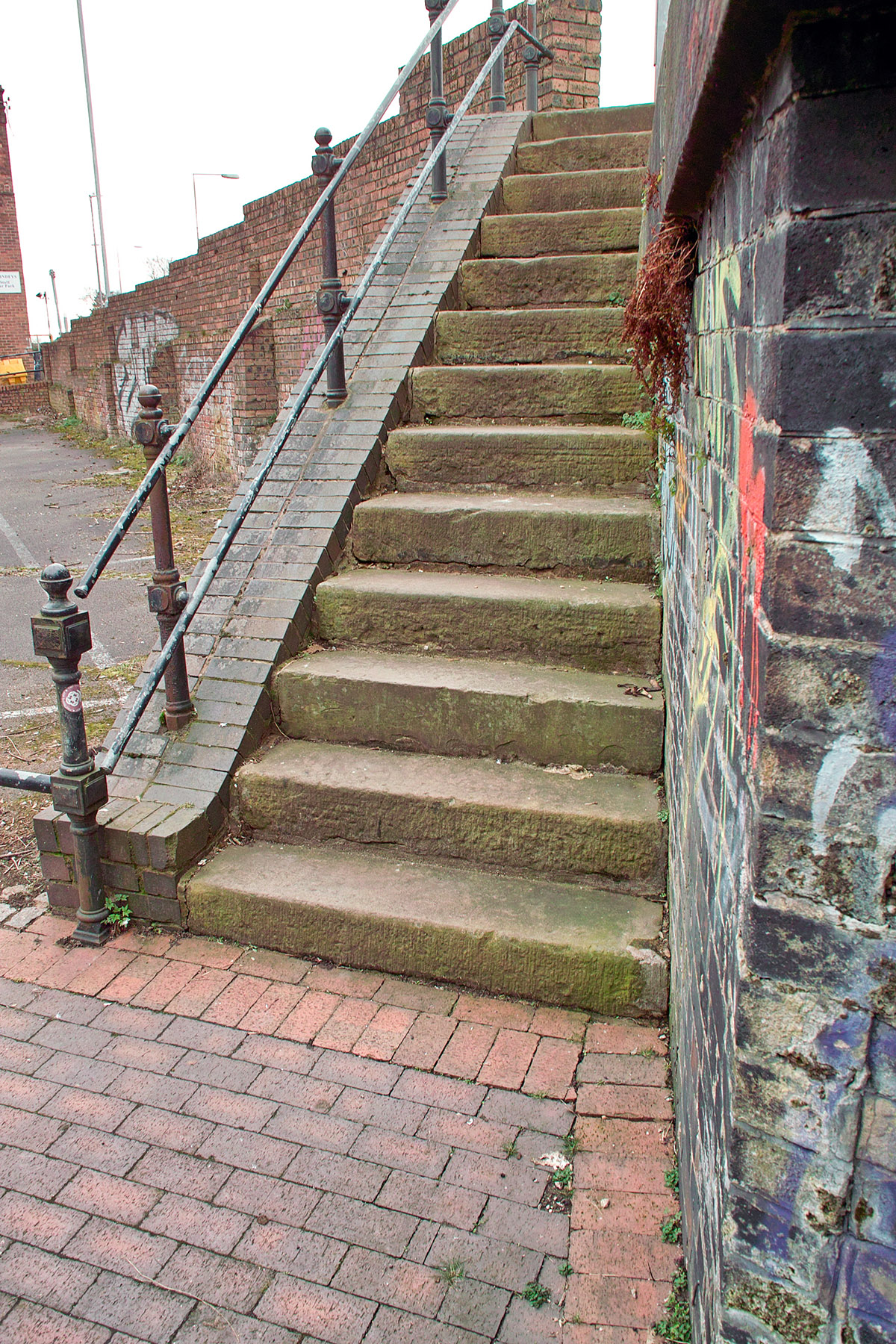
2. From the top of these steps you briefly cross the Council car-park entrance (“Wharf Place”, on maps) and go over the short but big bridge that crosses the A500 dual carriage-way road. This is too horrid to photograph but is very short, only 50 yards or so.

3. Once across the bridge, take the short curving pedestrian path down to the Minster (church).
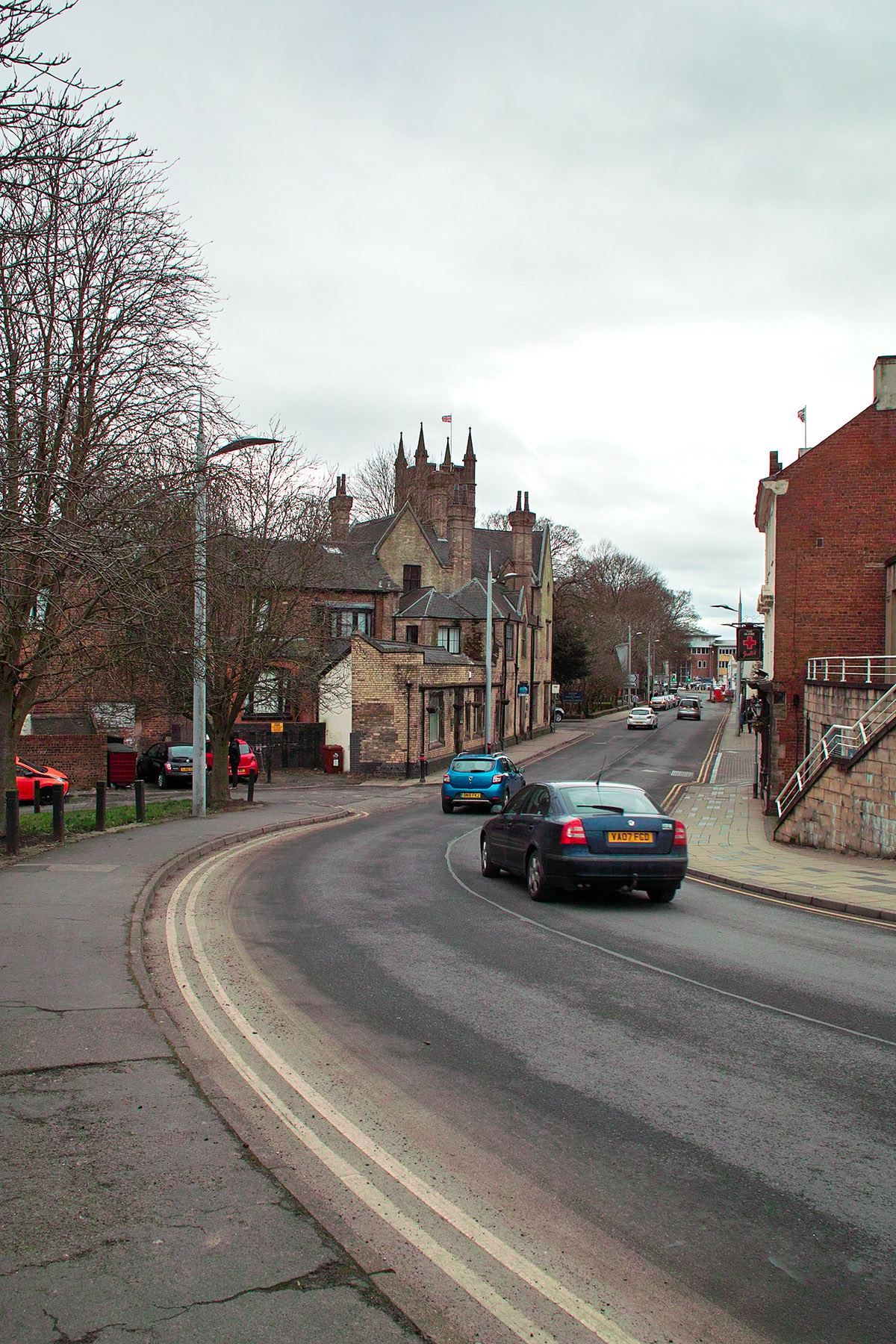
4. At the bottom of the curve, you will find yourself at the corner of the Minster churchyard at Brook Street. Enter the churchyard, and then go across it under the large mature trees.
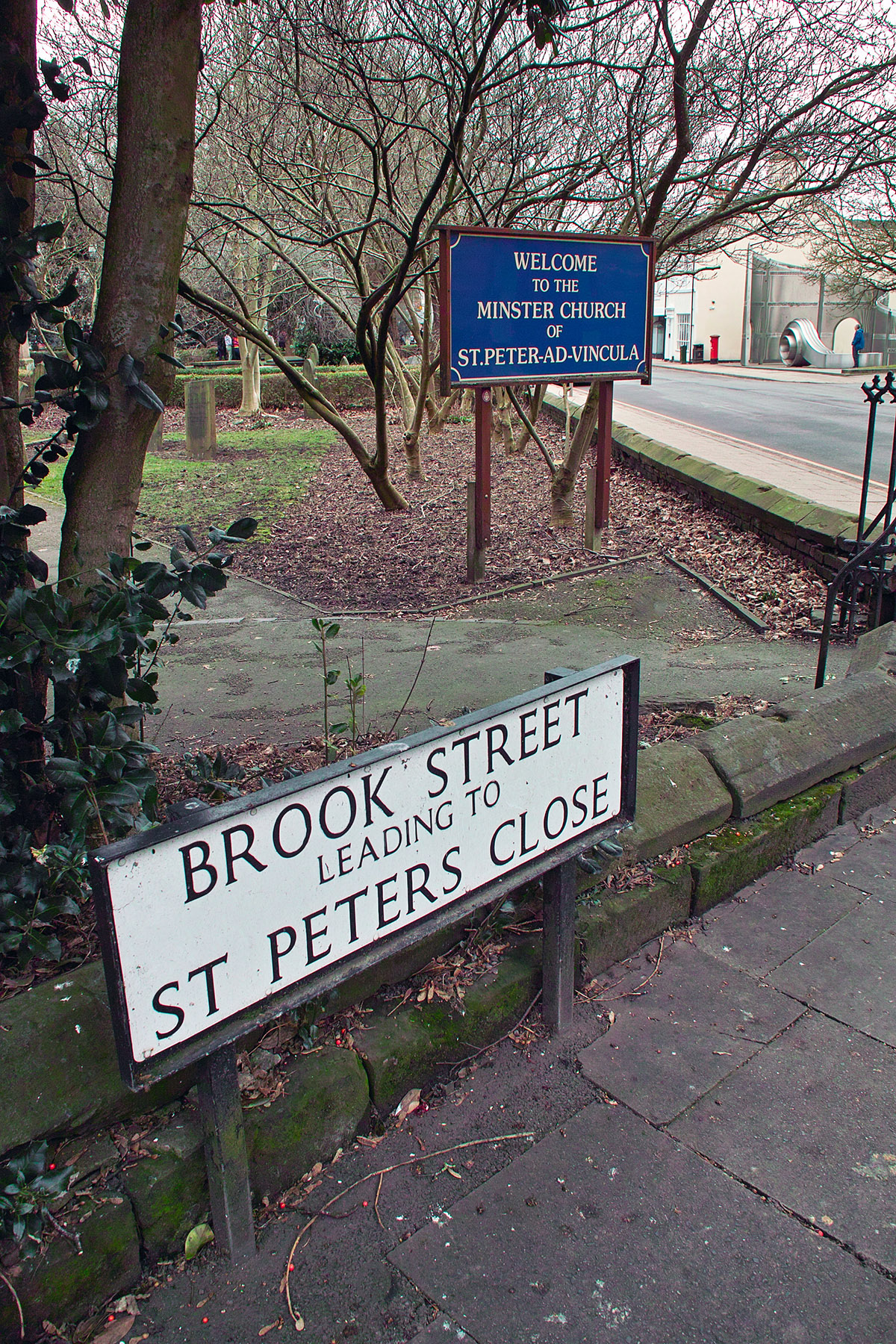
While at the church doors, peep through the trees on your right and across the road… to see Stoke’s new £10m townscape heritage fund at work. They’re renovating a row of shops that had been grotty eyesores for decades. There is also an ancient Anglo-Saxon cross and other Saxon stonework in churchyard, if you care to find it.

5. Take the path in the picture that curves away to the left. On exiting the churchyard, nip across the Church Lane bus-lane via its handy traffic islands. (Less nimble folk should instead use the right-hand path, and use the pedestrian crossing).
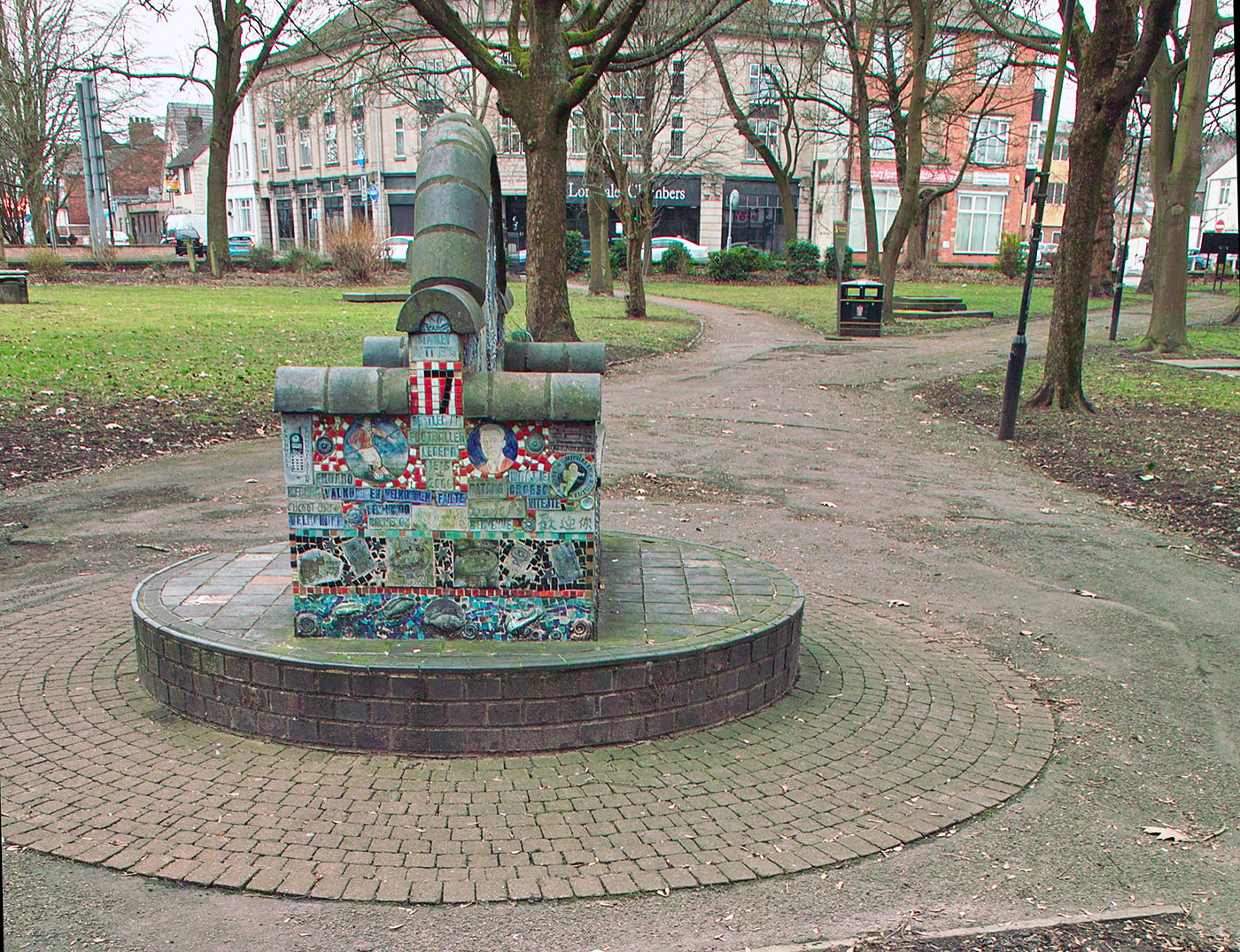
6. You will now be on the other side of the road and thus alongside the ‘other half’ of the churchyard. Go left along the side of this and toward the steps you can see in the distance. They’re about where the river-path starts, at its northern Stoke end.
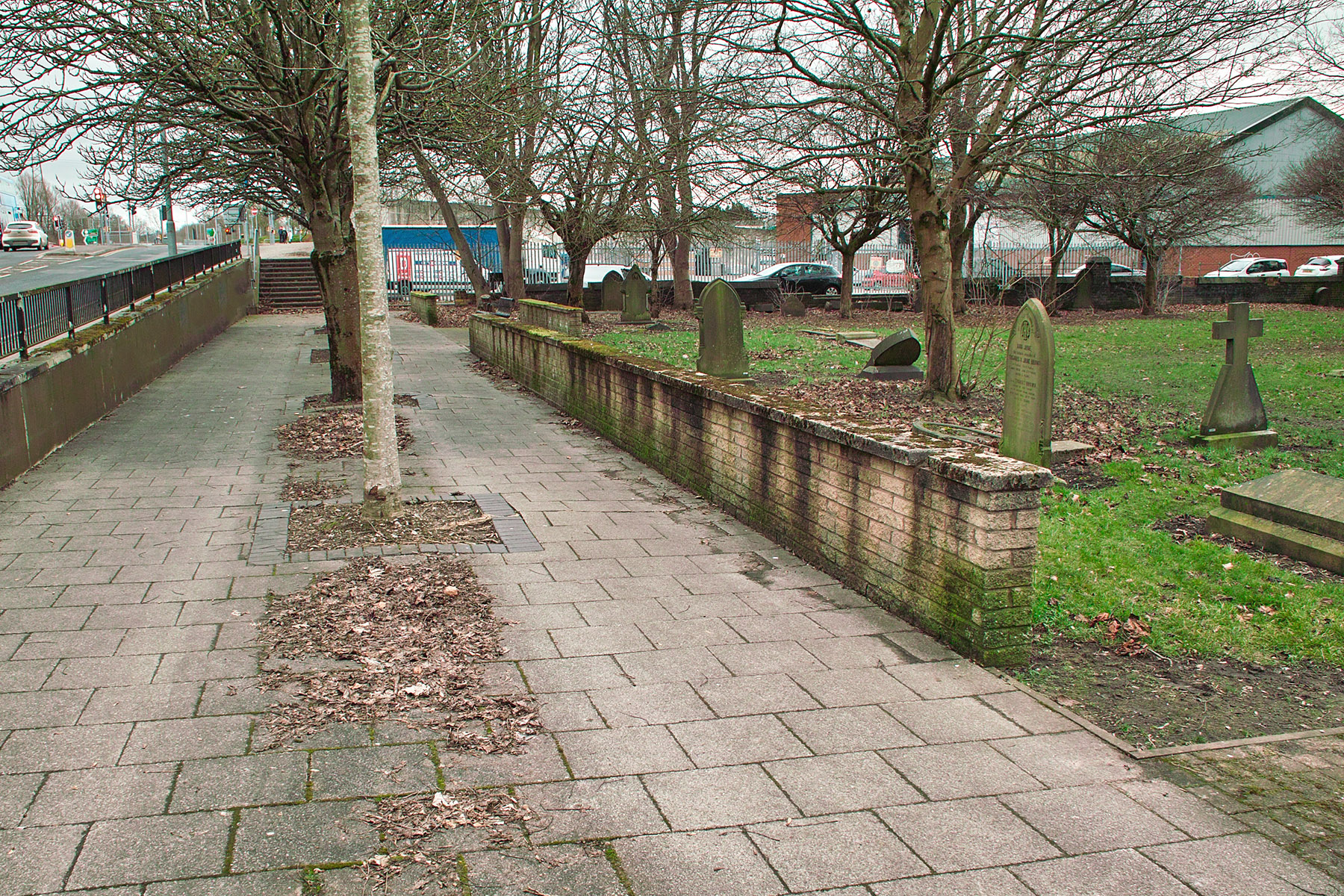
As an alternative, you might try the short and quiet Bowhead Street (side of the cemetery extension, where the parked cars are in the above picture), then turn left into the quiet Woodhouse Street. This option has the advantage of avoiding the steps and a close encounter with all the idling traffic fumes at the mega-junction.

7. Either way, you’ll find yourself on the start of the first (most northerly) section of the paved River Trent path at Stoke. It’s a bit grotty, especially at the “dossers’ bench”, but it does the job. Follow this paved path along for a few winds and turns, until it ends here in a rise…
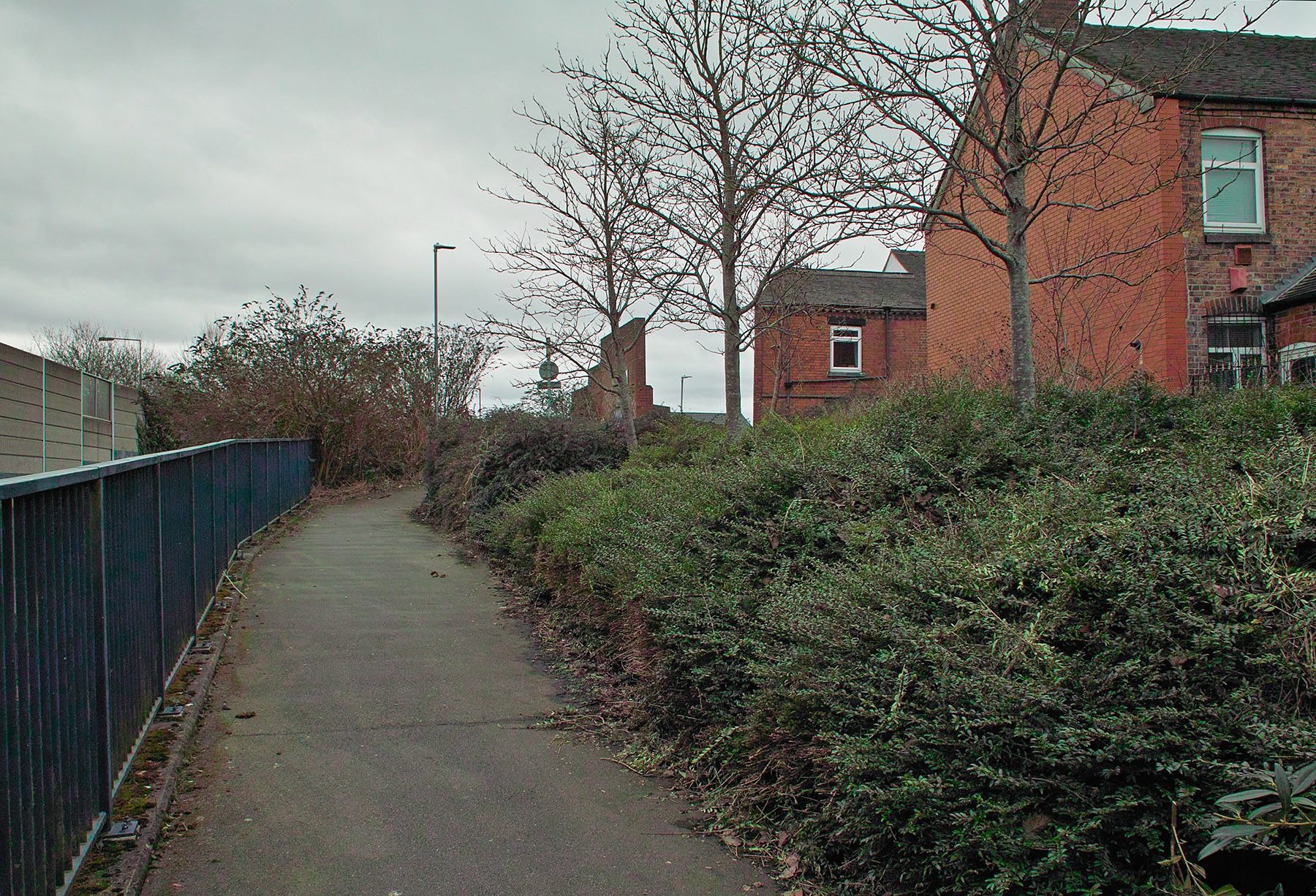
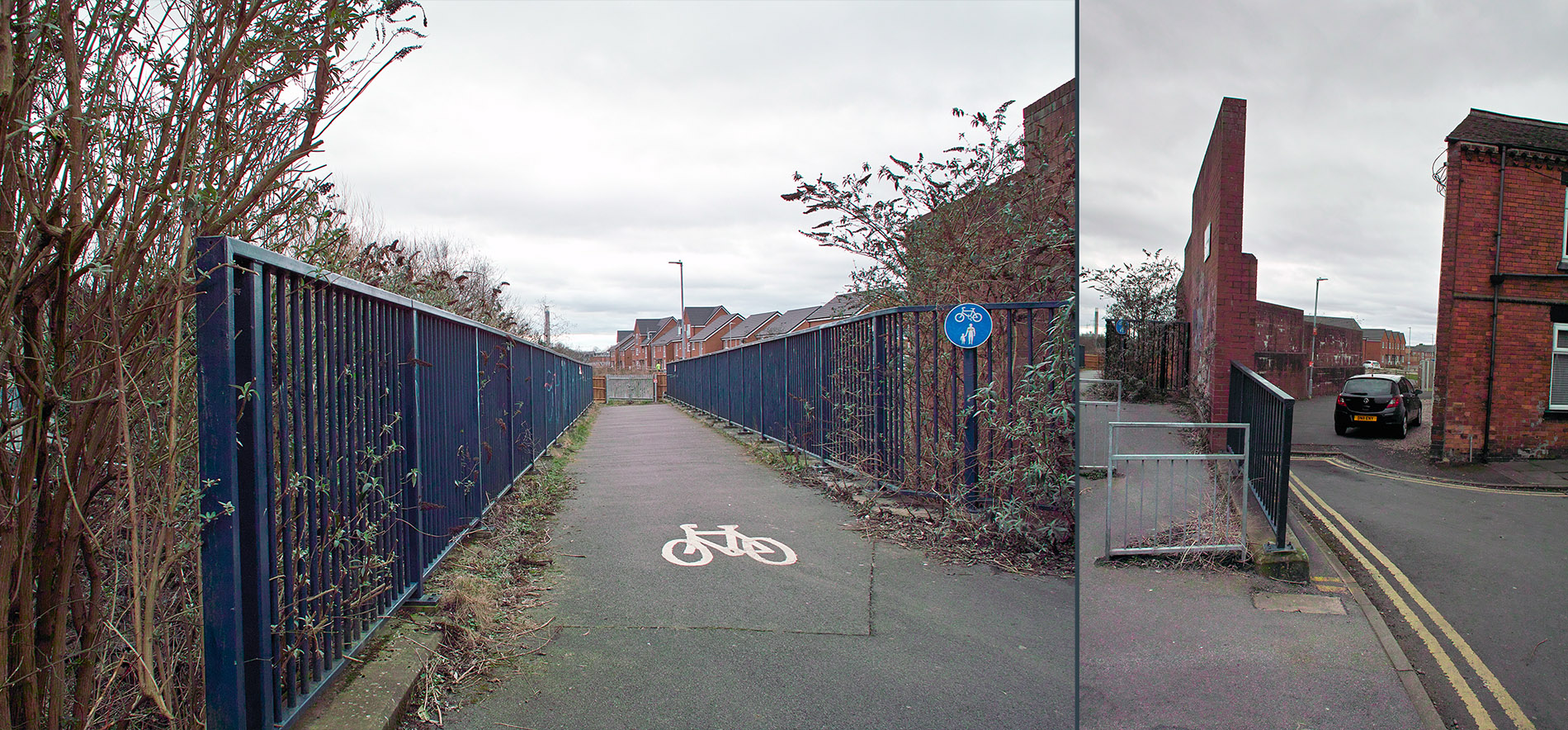
… and at the top of this rise you are then enticed to go across a pedestrian bridge by a cunning ‘cycles and pedestrians’ sign.

Once upon a time that worked to get you to the river, but no longer. Today it will only get you onto the Whieldon Road and on the way to Fenton, or over onto the canal with a bit of a wiggle.

So, instead, in 2023 you now go down the side of the bridge, as seen above in the picture on the right.

8. Yes, it looks like it might be someone’s parking-space. But go a few yards further on and you will have found the start of the new river-side path along the ‘new’ River Trent!
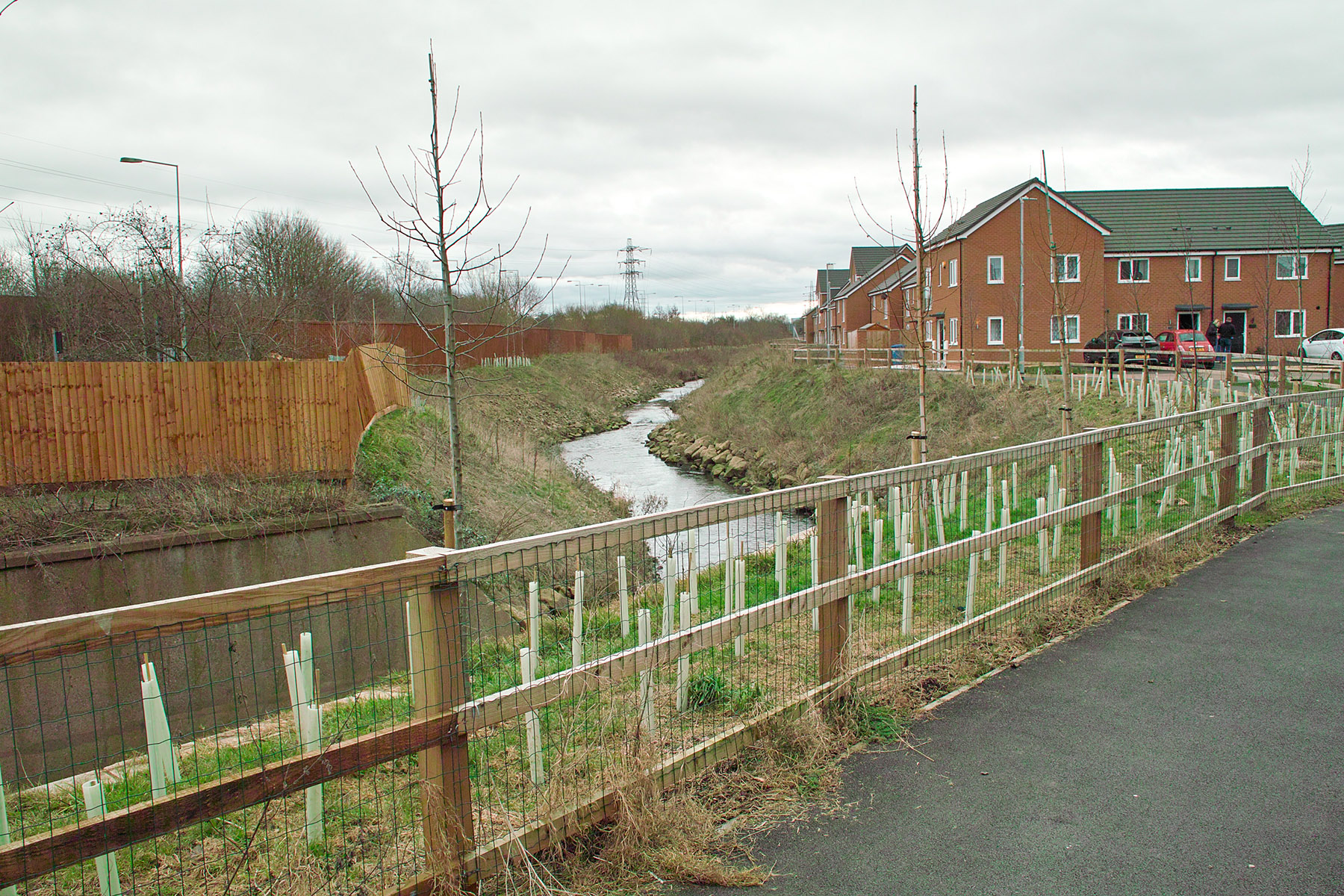
For now, before the trees grow and the vegetation takes over, you can look over the wooden fencing and admire the new nature-friendly banking and pebbling. So far, there’s not much rubbish being chucked over. But, as we all know, it only takes one feckless family and a few flytippers to ruin it for everyone else. Enjoy it while it’s rubbish-free.
9. Go all the way along this new footpath…
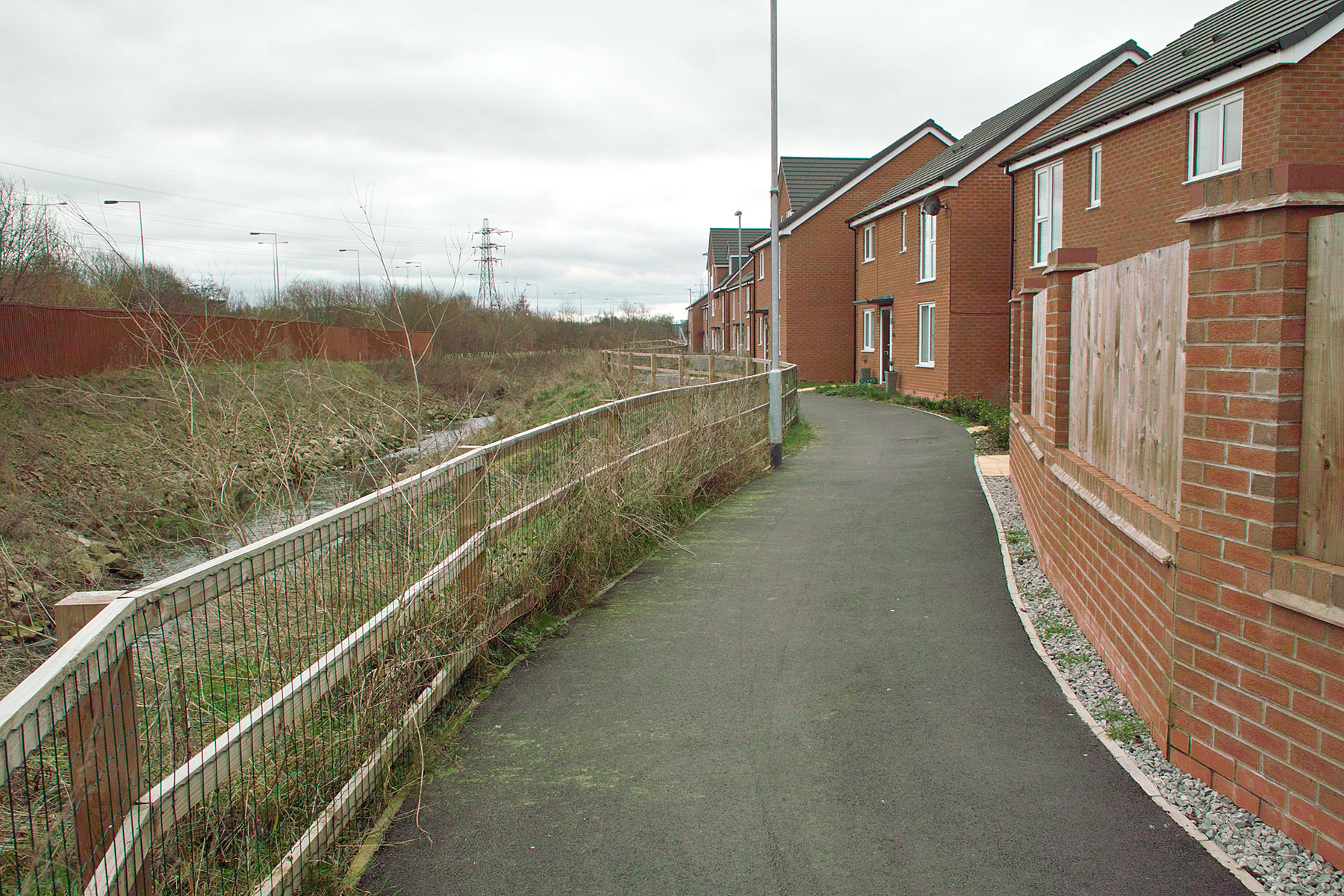
Now on a bike in summer, you’d have to be very careful. The houses are rammed against the path and they have tiny front gardens. With many young families and hundreds of blind corners for small kids and dogs to pop out of, there’s no way you’d be able to safely race along this path on a bike at 25 mph. Boy-racers beware.

Ok, so after a while you get near the end of the path… only to find it’s blocked and not finished yet (February 2023).
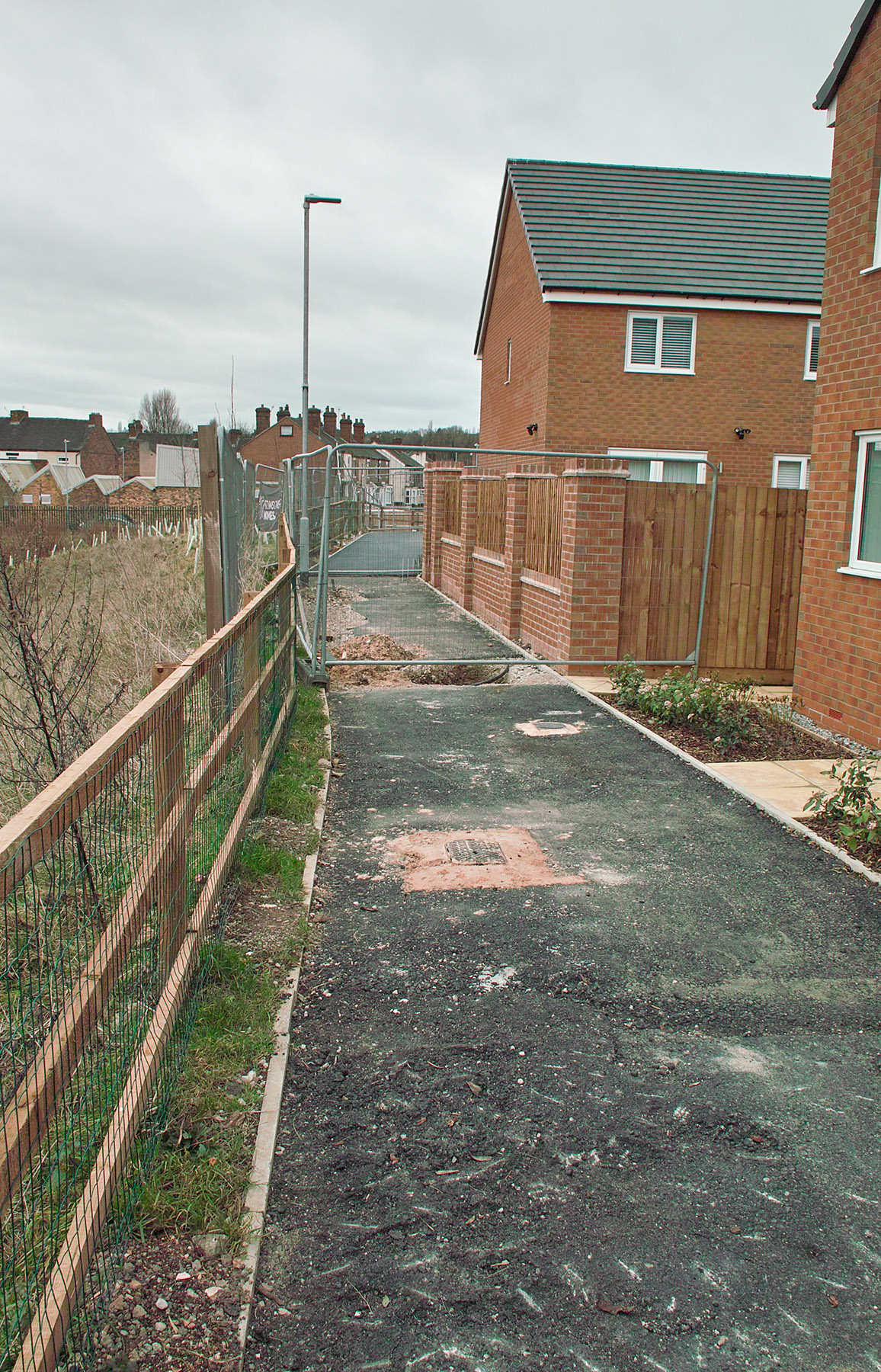
10. You might try to hook around through the estate, hoping for a bypass for this short blockage, and… still no access. The end point of the path is also not finished yet. Looks like it could be another six weeks work yet, especially if they first need to finish the “phase two” of the estate that’s currently going in alongside the path’s ending point.
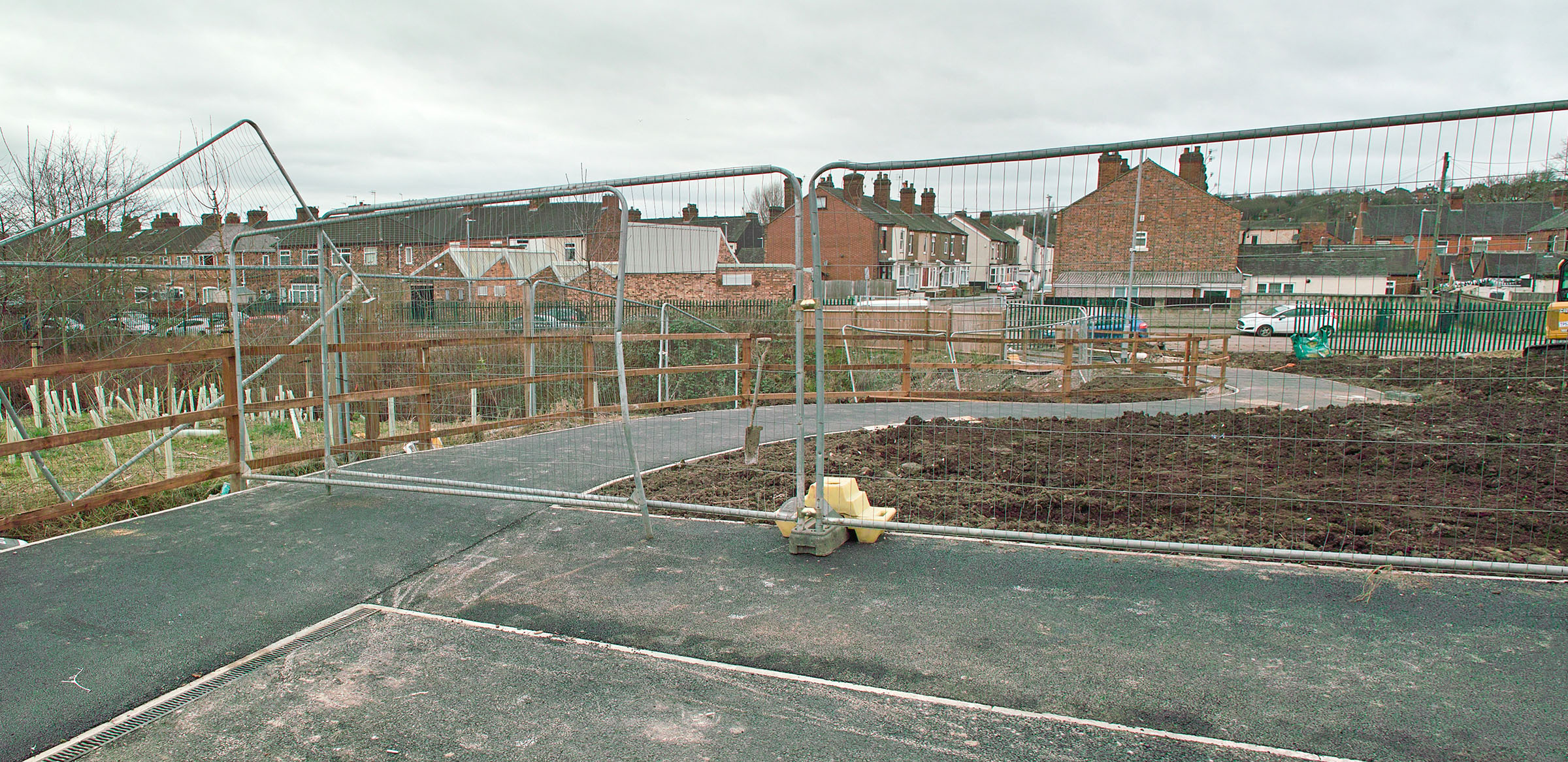
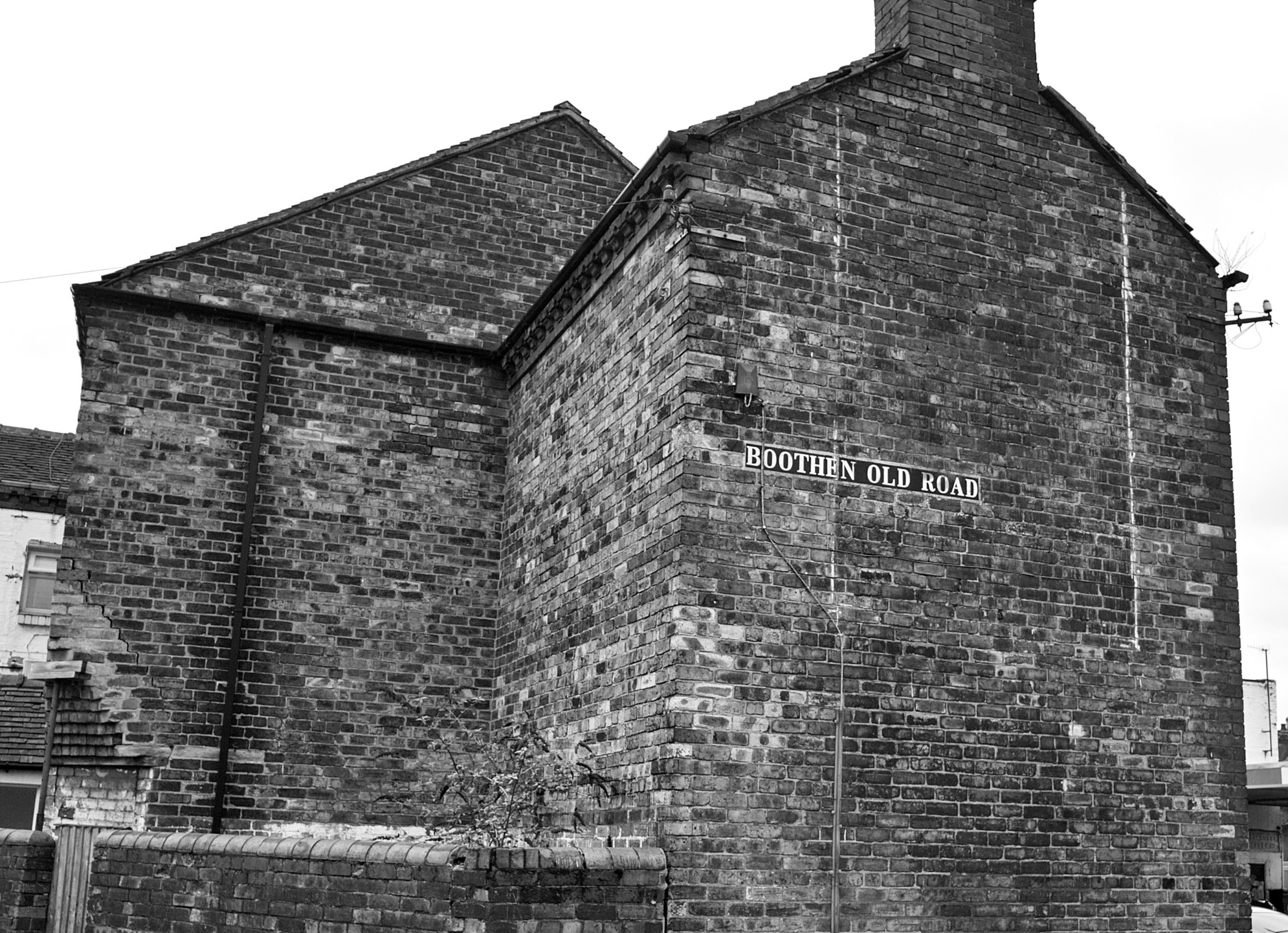
11. That’s Boothen Old Road you can see on the other side, a little south of the junior school. The entrance to the old established riverside path is a few yards further down on the left. Judging by the estate map seen below, it could well be a ‘nature bit’ at the southern end of the junior school’s new playing fields.

Here’s a half-built estate map showing how it should run. The path is in green.
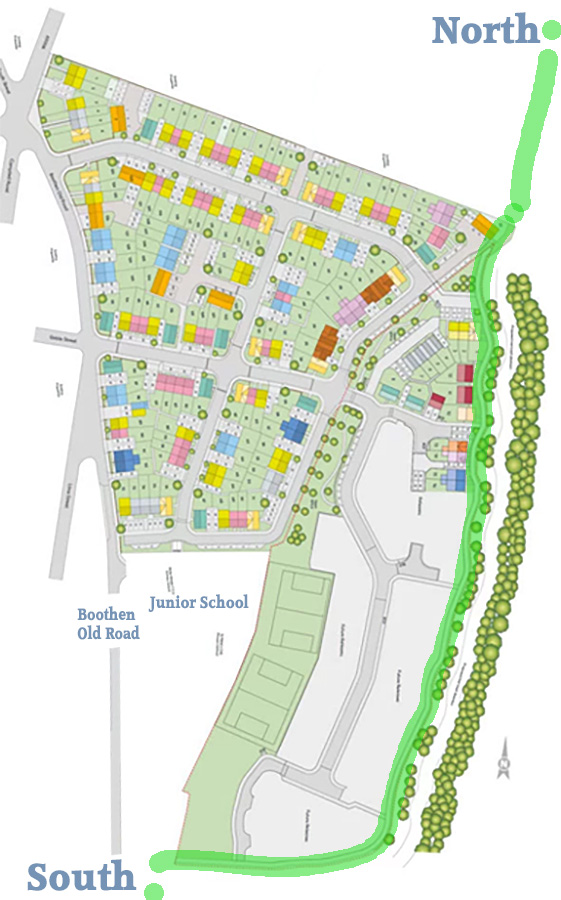


Good old Boothen Old Road, hurrah!

Due to the above blockage, for now you would instead need to go as far as Step 8 in the list above. But then you would:

9. Go a little way along the new riverside path, but then cut into the estate along Paul Ware Street, to reach the northern end of the Boothen Old Road.

(Bob McGrory Street may also be available through the estate, and a bit shorter. But possibly it would be easier to miss the turning of the path).

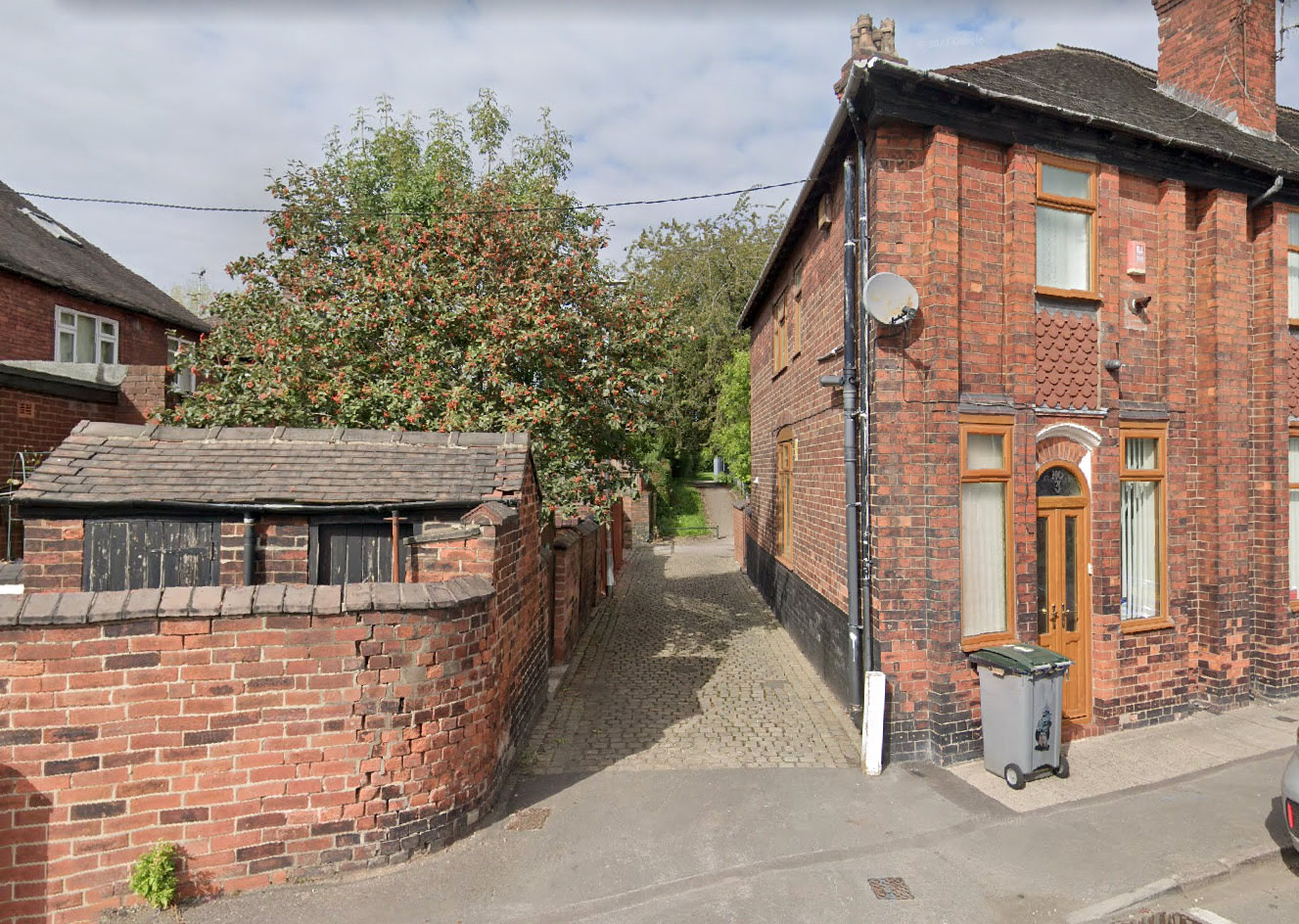
10. Now you’re on the start of the Boothen Old Road. You don’t want to go up that very tempting but very long cobbled alley on the right. Instead, keep on the gently curving road that goes down toward the junior school.
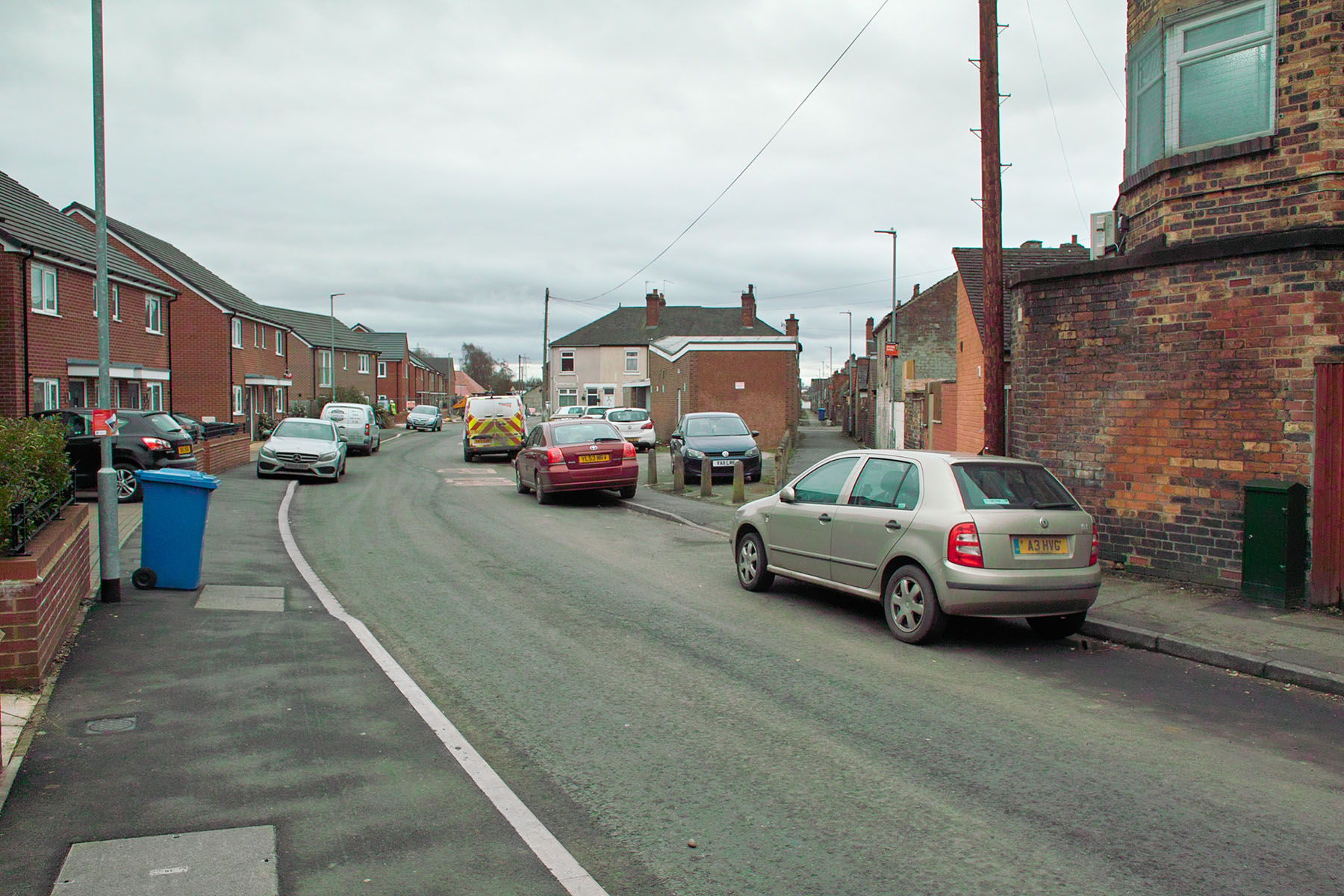
The obvious ‘bad parking and big bins’ problem means it can be a bit tricky to navigate the footpath down Boothen Old Road, but it’s not too bad.

11. Go a short distance past the School, and you will see the (currently) blocked-off end of the new path. That is where you would have come out, and will do once the new riverside path is open. As you can see from the picture below, you may now think you’re headed into some industrial estate cul-de-sac. But the entrance to the old river path is hidden from view on the left. My green arrow shows where it is.
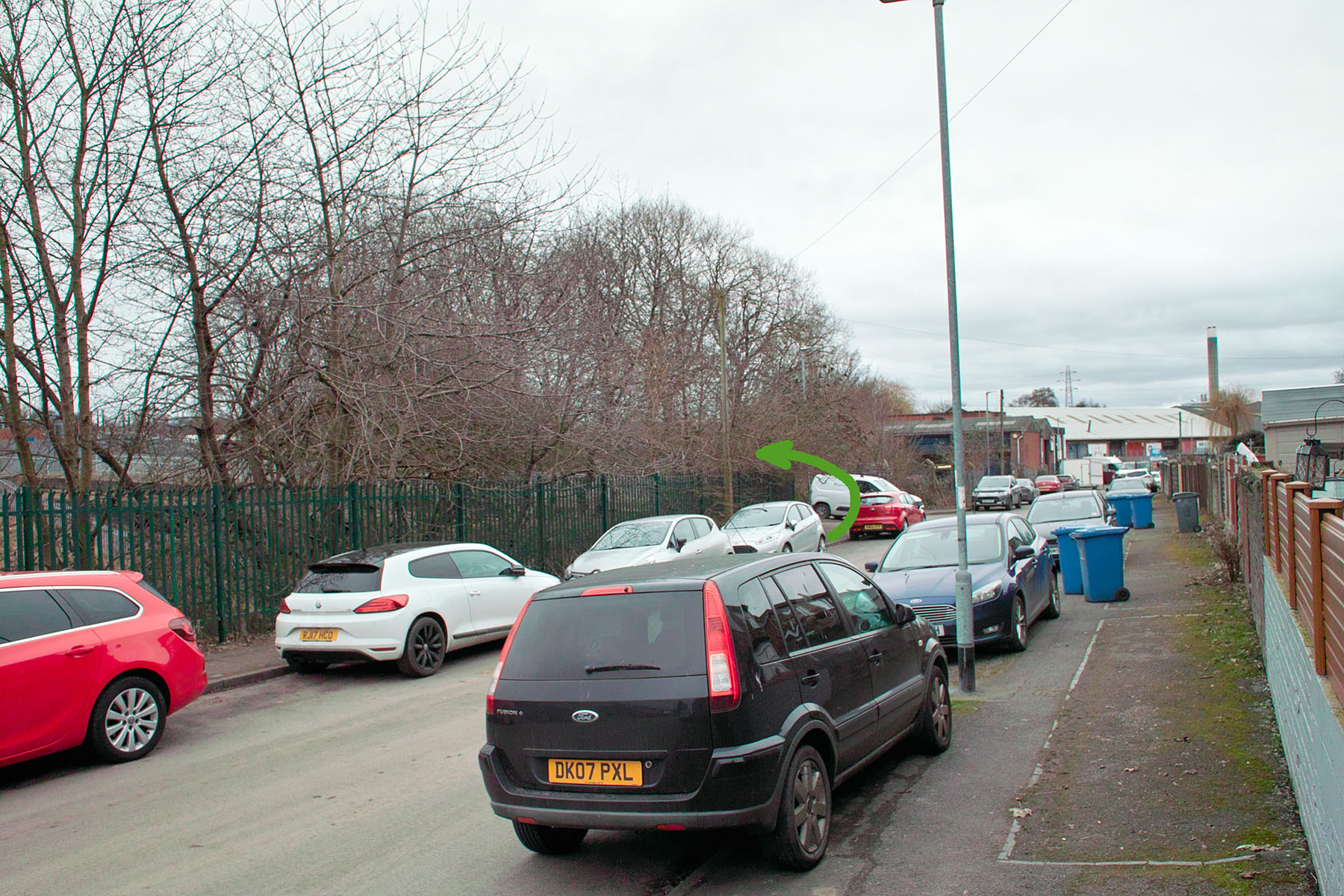


12. Ok, so by either route, you will now be standing at the entrance gate which will take you onto the longer-established river-path. You may still be unsure however, as it looks like you’re heading into a big dangerous electricity compound.
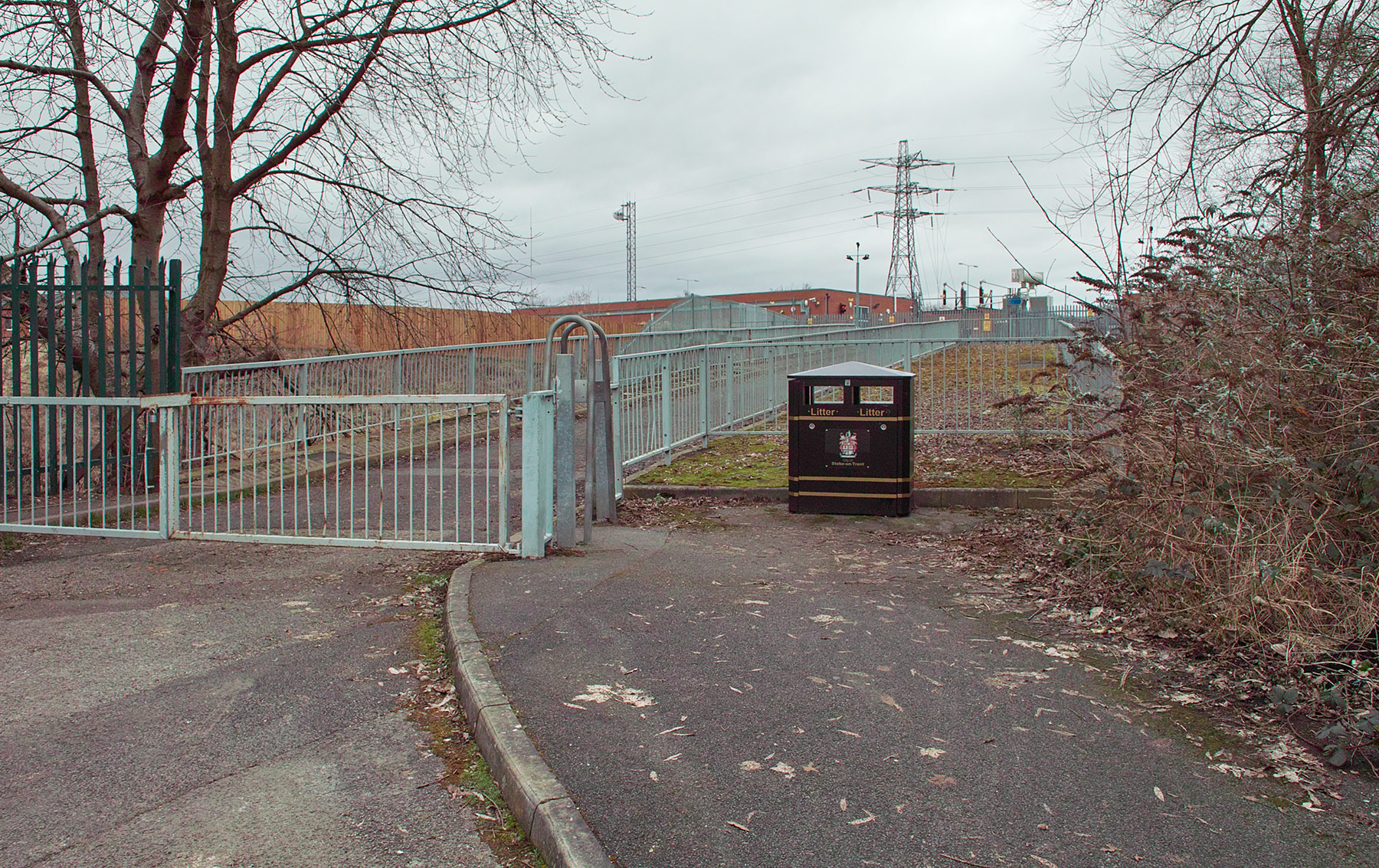
13. Have no fear though, no Thor-like electrical bolts will zap you if you step though. Go through the bike-gate and onto the bridge and you’ll see you’re on the right track. The river is below you.
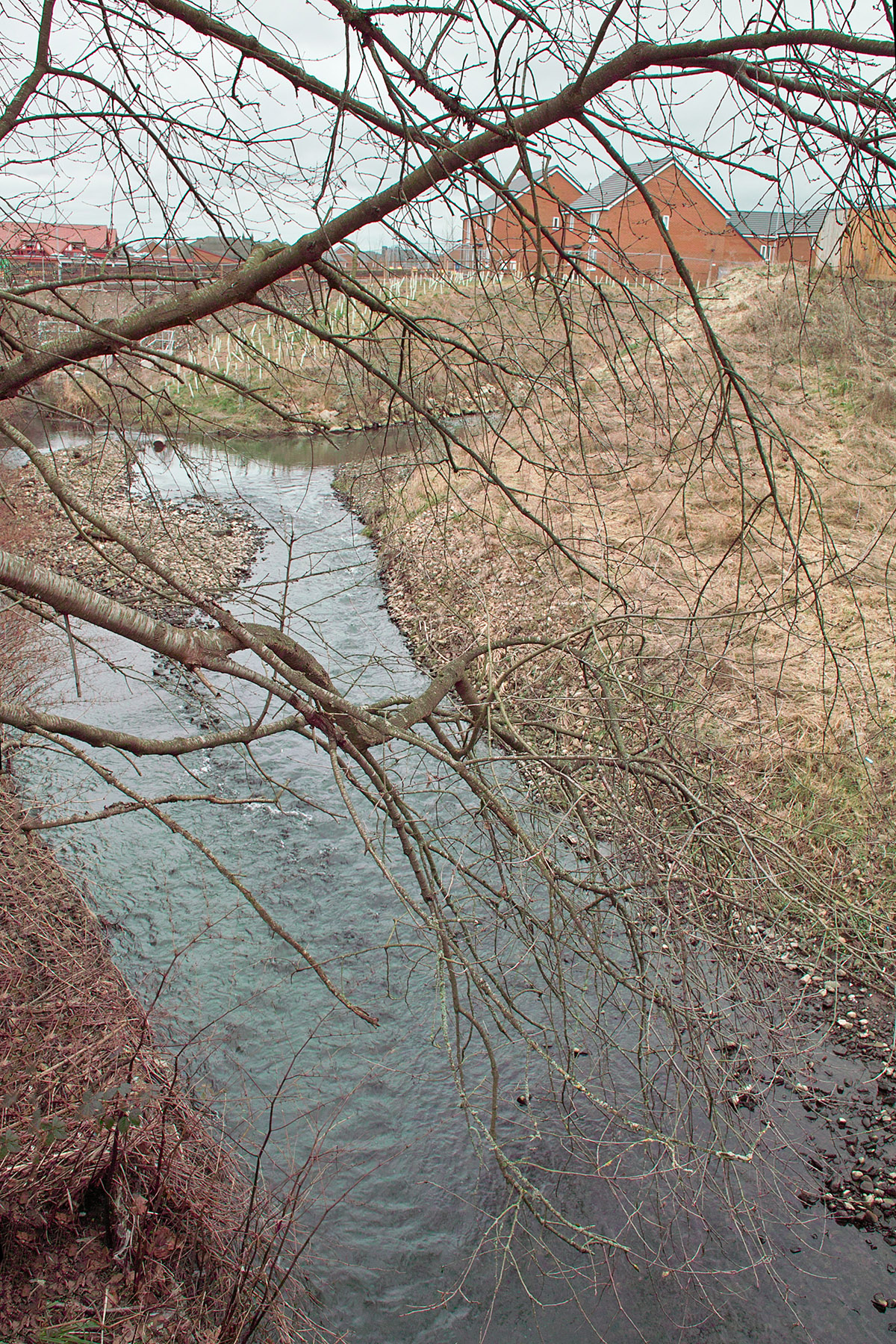
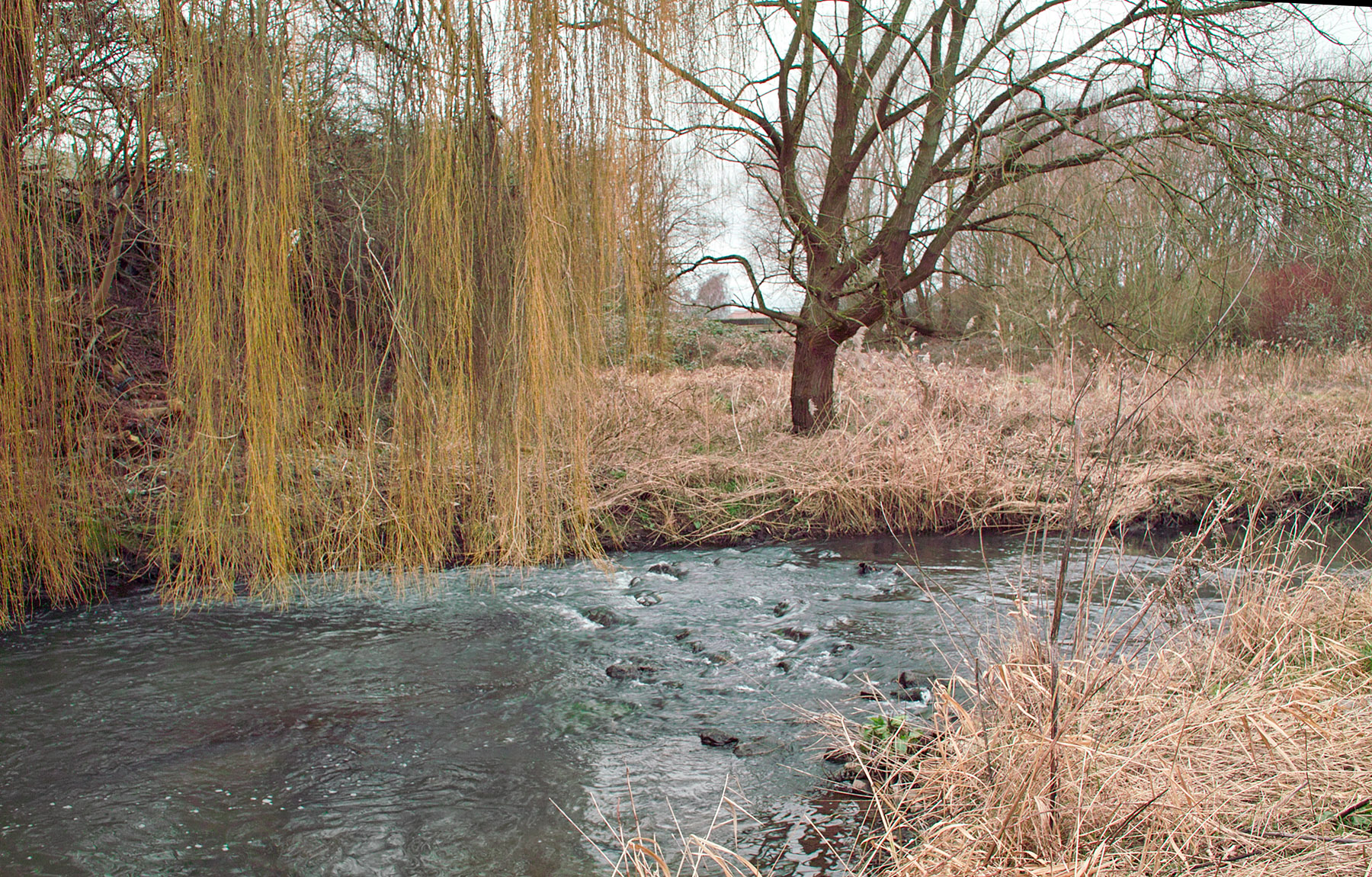
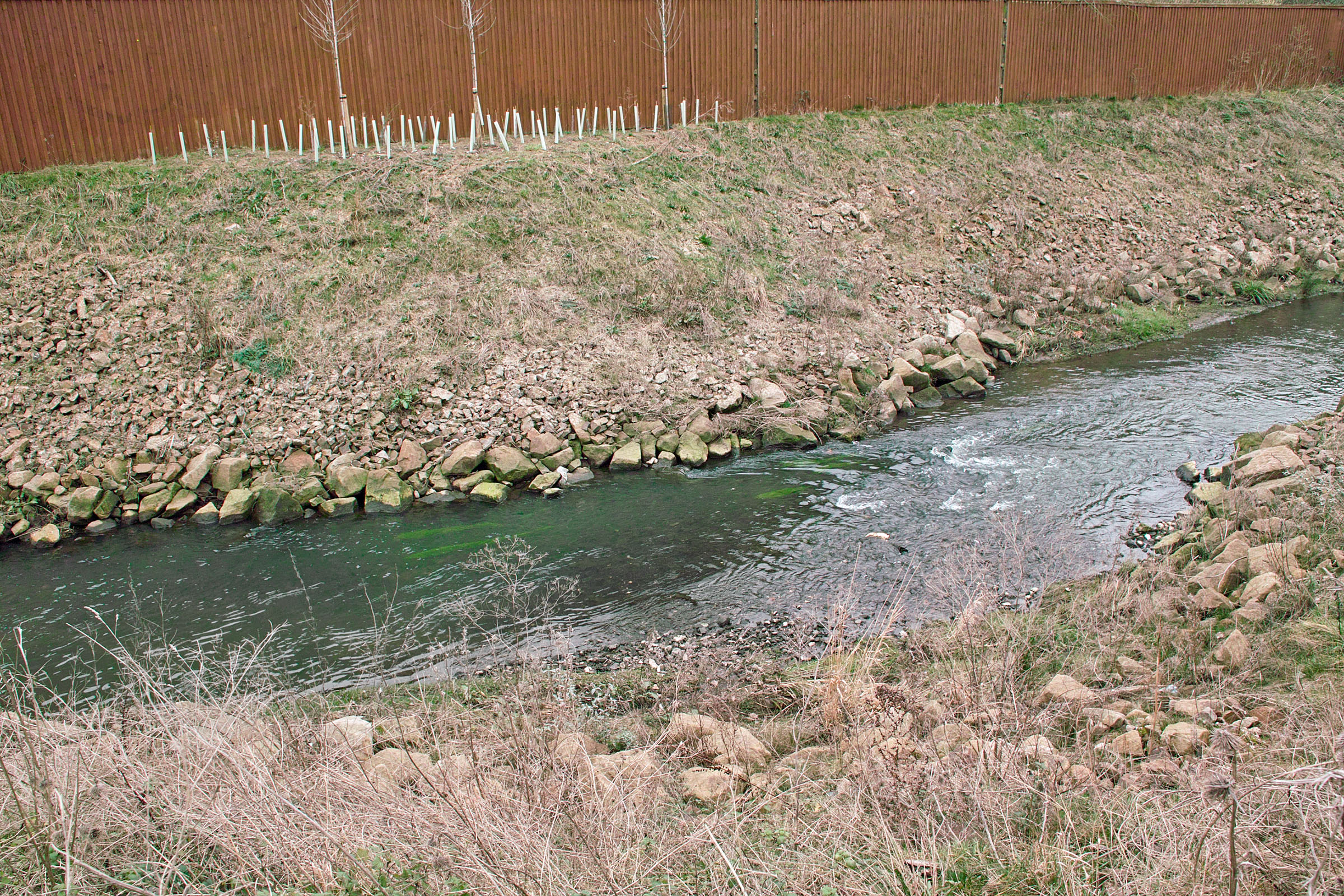
Again, you can see how the new river channel has been banked and shingled. Most of this view will soon be covered in leaves and greenery.

14. Finally follow the very grotty and litter strewn bit of the path, as it goes around the electricity compound. Druggies have obviously camped in the trees here. Hopefully the entire path from the Minster Churchyard to Hanford will get a very thorough litter-picking (and new signage) to celebrate the opening of the complete new path. But the path gets better after 50 yards, and eventually you see the paved path that runs down to rejoin the river. From here the nice and straightforward 1½ mile path will take you all the way to Hanford along the riverside (for an onward walk to Trentham Gardens and the Trentham Estate). The only problem you might have here is a bit of shallow flooding (only a few inches) of the path in the winter or early spring, after heavy rains. But that problem was caused by the river rising, and my guess is that the new upstream channelling and re-shaping will prevent this in future.
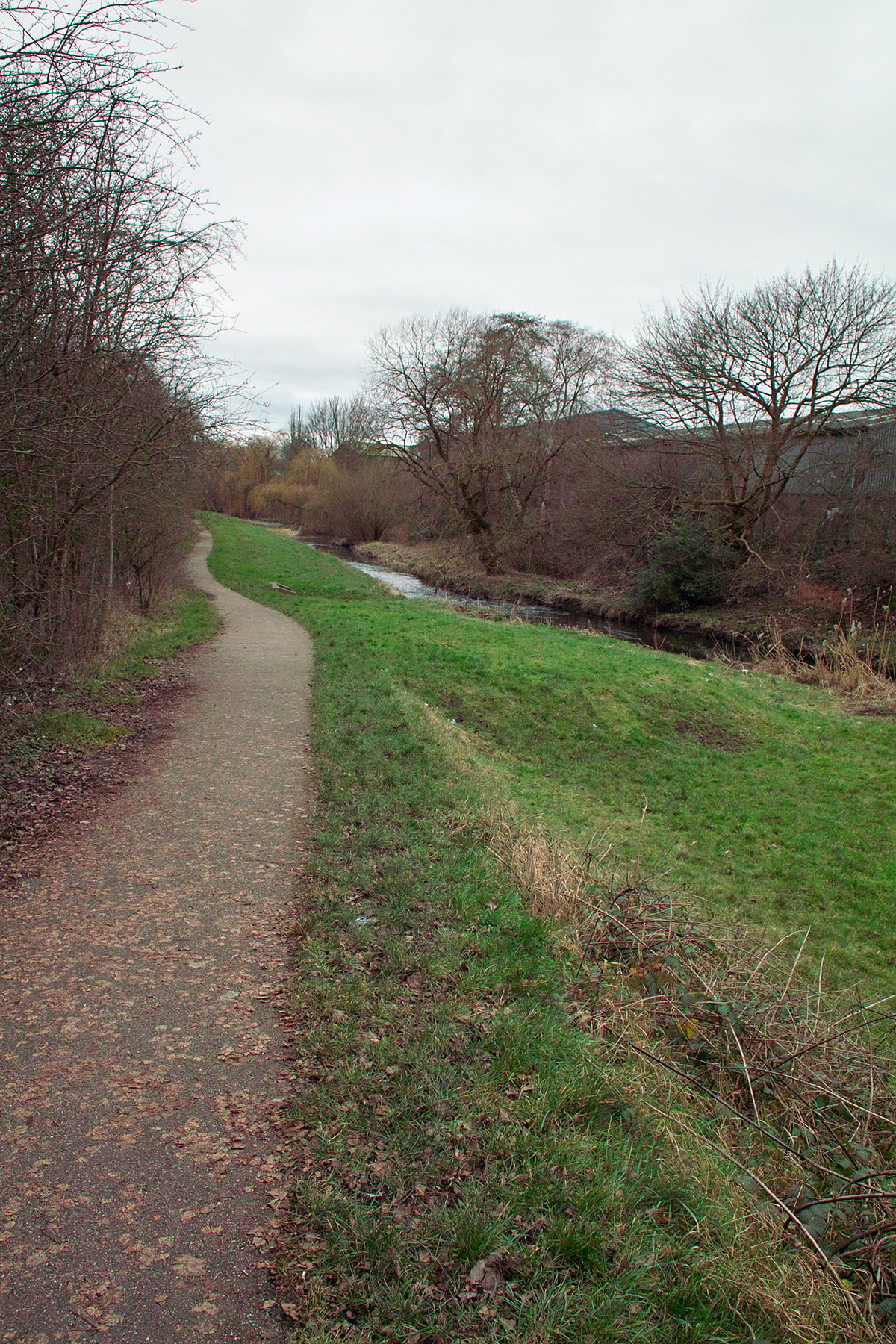
That’s it. Admire the many tree-ish views as you walk along the young River Trent!