Tolkien Gleanings #19

Tolkien Gleanings #19

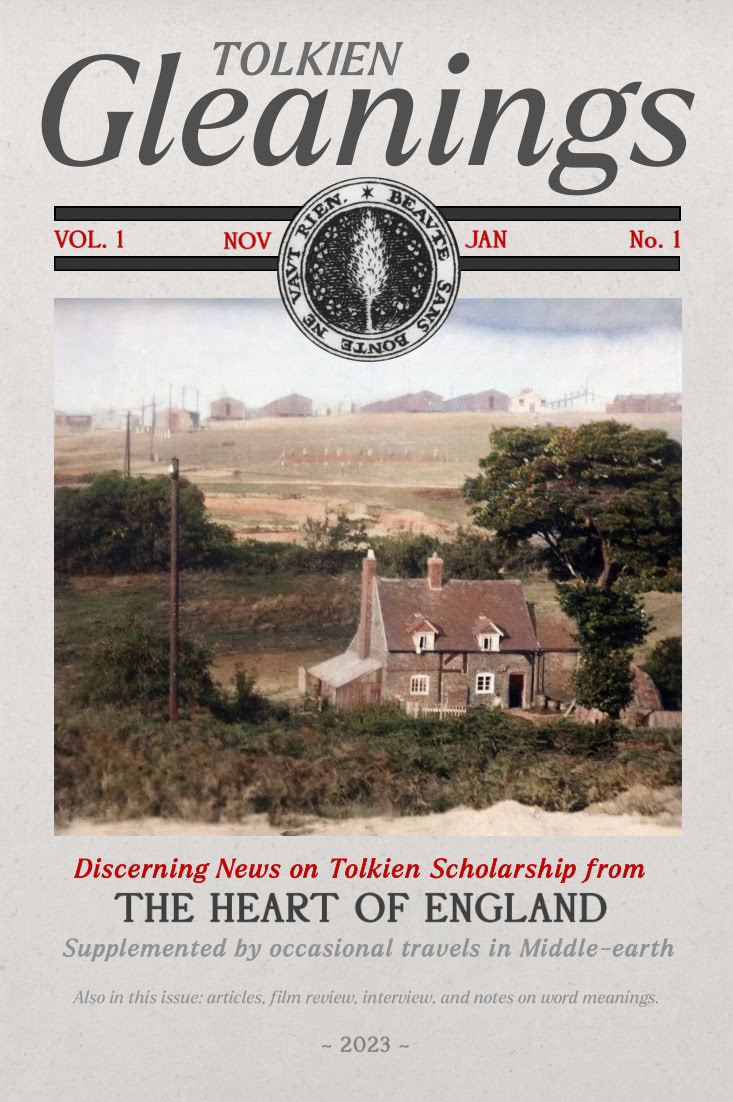
* The first issue of my Tolkien Gleanings PDF omnibus edition can now also be had as a download on Gumroad. A few silly typos have been corrected.

* “Tolkien’s Animals” will be the theme of a future special-issue of the Journal of Tolkien Research. There’s still time to send something in. The deadline is 23rd January 2023 via kris.swank@signumu.org — for draft papers on Tolkien and your choice of…

a wide range of animals, and not necessarily connected with medieval conceptions. PLEASE use “Tolkien’s Animals” as your email’s subject-line.

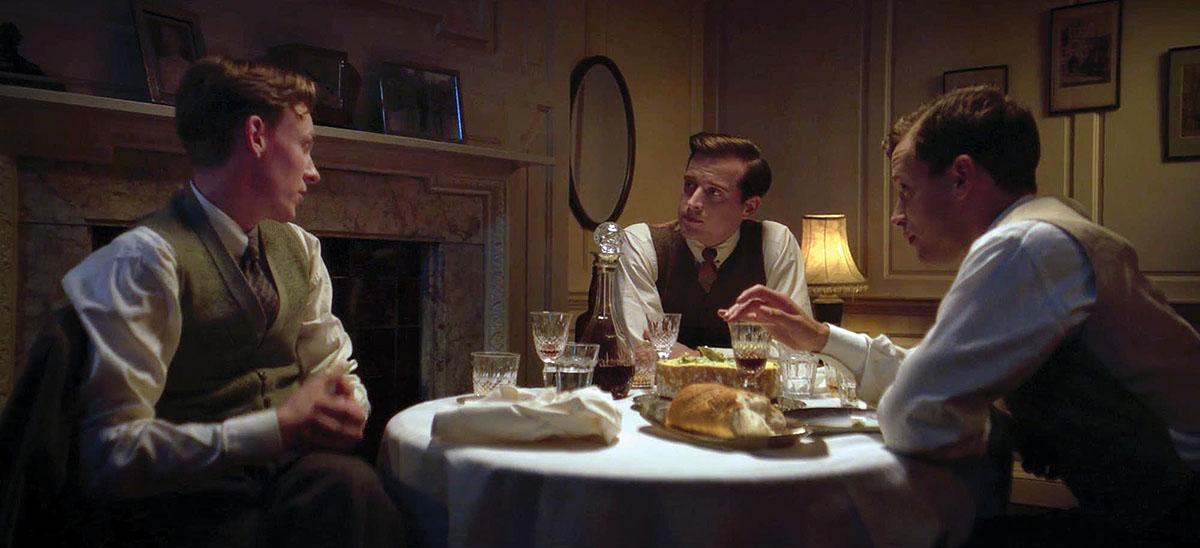
* New to me, a Norman Stone movie featuring a relatively brief portrayal of Tolkien. Who knew? The Most Reluctant Convert slipped out in November 2021 to a piffling box-office take, before landing on the main streaming services in June 2022. Though it is now hitting some “Best of 2022” lists, and also some of the Christian streaming services. It’s from the maker of the fine Shadowlands (1985) movie about C.S. Lewis. The new film portrays Lewis’s journey…

from vigorous debunker of Christianity to become, as he said, ‘the most reluctant convert in all England’.

I found it very well filmed and polished, but for a non-Christian Lewis might as well be speaking in Swahili for half the movie. This is the problem I’ve always had with Lewis, half the time I just can’t fathom what the heck he’s talking about or why he’s finding it all so important. For someone supposedly trained to think clearly, he has a most convoluted way of putting things. Still… for those who can instantly grasp each religious turmoil as he goes through it, and parse the specialist language and doubts that each turmoil seems to entail, I daresay Reluctant Convert will be found to be a fine and intelligent movie. Many Christian reviewers like it a lot. Non-Christians may come away feeling rather baffled.
* The French magazine Livr’ Arbitres has what might be a Tolkien special-issue(?) for December 2022.

* Also in France (Google Translate not permitted on the source Web link, ‘French only’), news of two 2023 exhibitions dedicated to Tolkien. One exhibition title translates as “In the Footsteps of Tolkien and the Medieval Imagination” and is described as “major”. While another will “focus on other modern or digital artistic evocations of Tolkien’s work. Like digital art, comics, animation, videogames.” Doubtless more will be heard about these in due course.
Tolkien Gleanings #18

Tolkien Gleanings #18

* New in the journal Critereon, “Genre in Translations of Sir Gawain and the Green Knight. Identifies differences between the Tolkien and Simon Armitage translations of Gawain.

* The second edition of the book Journey Back Again: Reasons to Revisit Middle-earth (2022). Each chapter explores a reason why people re-read The Lord of the Rings. According to the editor’s home-page the book was launched with an event in the late summer of 2022. This second edition (seemingly not expanded or revised) was announced for “November 2022”, and is now on Amazon UK as a £9 Kindle ebook. Which means Kindle owners can yet the first 10% free as a sample.

Judging by the one review, the book doesn’t appear to have a chapter on the pleasure of discovering small interconnections, un-noticed in many previous readings. For me the LoTR deepens like a coastal shelf, when partly read with an eye to such things. For instance in the Fellowship Aragorn left “the hill of Cerin Amroth and came there never again as living man.” Why the emphasis on “living”? Does this imply his body was later transferred to Lorien from Gondor, after death? No, it seems not. But in the Fourth Age his beloved Arwen was buried on Cerin Amroth. One can then glimpse a later tradition, between these small cracks in the text. A tradition among the increasingly “rustic” remnant of the elves who remained in Lorien, that Aragorn’s spirit was sometimes to be seen (or felt) at the grave of Arwen.

* A new essay at the online Catholic magazine Fellowship & Fairydust gives an overview of “Tolkien the Religious Man”. Appears to be a useful introduction on the topic, and probably helpful — along with other materials — for non-religious people seeking to correctly grasp the outlines of Tolkien’s belief. The author also introduces a few new possibilities for influence, including pre-1914 influence of Cardinal Newman’s lectures on “Tolkien’s opinion on the matter of pagans’ knowledge of God”.

There are a couple of question marks on the above essay. It’s stated “the Oratory priests were all learned men”, yet Father Francis was definitely not a learned intellectual nor remembered as such. “Educated” might have been the better choice of word here. In Birmingham Father Francis is said to have been “paying a portion of his tuition fees with his own money when he was under no obligation to do so”, but so far as I am aware a kind uncle was initially paying the full school fees. The reference given in the essay is to Letters — and is thus almost certainly to the letter stating “Fr. Francis obtained permission for me to retain my scholarship at K[ing] E[dward’s] S[chool] and continue there”, which is not the same thing as paying fees. This statement by Tolkien may refer to his winning a foundation scholarship in 1902 (during which year he briefly attended the nearby St. Philip’s School). His foundation scholarship meant that “no fees will have to be paid for his education” to continue at King Edward’s (Chronology). The alternative explanation would be that Tolkien was referring to an extension granted for the extra year he spent at King Edward’s, at the end of his time there, while was trying for a place at Oxford. The matter is important in relation to the pressure Father Francis could have placed on the young Tolkien not to see Edith. Obviously, if he was even partly paying the boy’s school fees, then his leverage would have been much greater than otherwise. But the date of the forbidding was in the late Autumn of 1909, so the fees would not have been a factor either way.

* A new Journal of Tolkien Research review of the new Tolkien fix-up book The Fall of Numenor (2022). As well as problems of narrative arrangement, apparently it lacks something in terms of the expected scholarly apparatus.

* And finally, a special website at blackberry.signumuniversity.org lists a wealth of Short Courses at Signum University for January and also February 2023. Eight hours each, complete them in a month. Several on Tolkien or thereabouts. Who knew?

Tolkien Gleanings #17

Tolkien Gleanings #17

* Tolkien Gleanings is now available as a handy 96-page PDF magazine, free on Archive.org and also on Gumroad. All my previous blog Gleanings and MegaTolks are here neatly collected and presented, back to 2019. Plus additional scholarly articles, a review and an interview. Easily searchable, and the Web links have also been checked for obvious breakage.

Drop me a comment on this blog, if you have something to contribute to the next PDF issue. Such as a scholarly review of a little-reviewed book. Unlike the academic journals, I’m not averse to reviews of self-published scholarly books. No poetry or fiction please, unless you’re Pauline Stainer or Alan Garner. Each issue will collect my Tolkien Gleanings blog posts into a bundle, and add some additional texts and pictures of interest. Expect perhaps two issues per year, produced when I feel the urge.

* ““The Ring in Your Voice Tells It”: Voice and the Essential Self in J.R.R. Tolkien’s Legendarium” (2021). A free preview of a Masters dissertation, though it has a lengthy abstract.

* “Theology and Fairy-Stories: A Theological Reading of Tolkien’s Shorter Works”, seemingly newly in open-access at a university repository. This was a chapter in the book Tolkien’s Shorter Works (2008). From the same author as the above, and again seemingly new in open-access, is his “Freedom and Providence as Anti-Modern Elements”. This examines… “the depiction of freedom and providence in Tolkien’s fictional works”.

* The Times newspaper ($ paywall) has a Priscilla Tolkien obituary.

* News of the forthcoming book The History of the Hobbit by John D. Rateliff. Being… “a re-issue of the revised 2011 edition”. Pre-ordering now and due to ship on 16th March 2023. The book… “presents the complete unpublished text of the original manuscript of J.R.R. Tolkien’s The Hobbit, accompanied by John Rateliff’s lively and informative account of how the book came to be written and published.” Also has the revised “rewrite” version of The Hobbit, supposed to make it more adult like The Lord of the Rings. Thankfully that was never finished. The 2023 book appears to only have a new cover, to make it uniform with other such volumes? Harper Collins also lists a “Deluxe edition” in slipcase, shipping on the same date.

* And finally, Shropshire Tourist Board on The Wrekin… “It has been suggested that it may have been the inspiration for J R R Tolkien’s Middle Earth in The Lord of the Rings”. What kind of tourist actually believes such airy marketing piffle? The ones who ‘spend big’ at the Gift Shoppe, I guess.

The wording is a verbatim filch from the Amberley book 50 Gems of Shropshire (2018), including the mangling of Middle-earth as “Middle Earth”. In this 2018 book the claim is given in passing and is un-referenced. The only likely source I can find, in print, is William Cash’s book Restoration Heart: A Memoir in which he recalls his “Uncle Jonathan” from his childhood, his Uncle being a local amateur archaeologist and hill-walker in the mid/late 1980s… “Jonathan explained that Tolkien used to walk up the Wrekin and used the famous defensive hill as a model for the shire in The Hobbit.” So it sounds like that claim could have seeded a small cloud of local oral confabulation.

Tolkien Gleanings #16

Tolkien Gleanings #16

* New on Archive.org to borrow, Roger C. Schlobin’s collection Phantasmagoria: Collected Essays on the Nature of Fantasy. This includes the essay “The Monsters are Talismans and Transgressions: Tolkien and Sir Gawain and the Green Knight”, which discusses how Tolkien might have subtly woven certain tones and shades from Gawain into The Lord of the Rings. Such as having a mostly “absentee villain”. The author briefly examines Boromir as a flawed character, but curiously overlooks Sir Gawain as the obvious template for Boromir’s lone and questing journey to find the mysterious Rivendell. Though I’ll admit that this quest is easy to overlook, deeply interwoven as it is across a dozen or more points in LoTR.

* Tea with Tolkien has a useful new Concise Outline of the Waldman Letter (Letter 131). This being a very long letter/pitch by Tolkien to an editor, written and sent in 1951. The Tolkien Gateway also has an existing summary online, but that is more verbose and slab-like.

* Douglas A. Anderson’s new scholarly Tom Shippey on Tolkien: A Checklist through 2022. Free as a .PDF file, though regrettably only for those with an Academia.edu account.

* New this week at The European Conservative, the article “When Middle Earth Came to Vienna”… “The renewed obsession with the minutiae of Tolkien’s work gives me an excuse to revisit […] the inspiration for Tolkien’s Battle of the Pelennor Fields.”

* A talk on “The Pagan Tolkien” is set for 16th February 2023, snow-gods permitting… “Professor Ronald Hutton shares insights on the pagan influences evident in the work of J.R.R. Tolkien”. A heavyweight speaker, though at a small Shire-like village-hall on the edge of Gloucester, England. Booking now.

Jael’s Nail (1950)

Currently on eBay, and possibly of interest to some locally. The magnetic tape soundtrack for a local comedy movie called “Jael’s Nail” (1950). Evidently it was a locally-made 16mm comedy of some quality…

The Daily Mail Challenge Trophy, for the most outstanding film entered, went to Jael’s Nail, a black and white comedy by the Stoke-on-Trent Amateur Cine Society.

It also won The Wallace Heaton Cup for Best Photography, 1950. Of unknown ‘local colour’ and length. I’m not sure if the visual part of the movie survives, and can’t immediately find details for it online.


Update: Movie Maker reel listing from 1977: “A comedy about a man who claims to have the original nail with which Jael killed Sisera as told in the Old Testament”. So possibly Biblical and not of much local Stoke interest, re: local scenes and settings. Although I guess it might just have a contemporary 1950 Stoke setting? I’m imagining a sort of strange Stokie hybrid of Railway Cuttings, East Cheam, and Waiting for Godot, with a dash of The Life of Brian.

Tolkien Gleanings #15

Tolkien Gleanings #15

* John Ahern has a short but stimulating new article musing on “The Forest and the Descendants of Saruman”

It is easy to sentimentalize Tolkien’s trees. […] But there is another side to the story. […] Saruman may use the forests of Fangorn to fuel his machines, but for much longer than that Sauron used Mirkwood to gather his strength. On the whole, there are four forests in The Lord of the Rings and only one is unambiguously good.

* News of a talk at the 2023 Oxford Literary Festival, “The Great Tales Never End: in Memory of Christopher Tolkien”

“The Bodleian’s Tolkien archivist Catherine McIlwaine, writer John Garth and academic Stuart Lee discuss the role of J.R.R. Tolkien’s son, Christopher, in promoting the works of his father and furthering understanding about them.”

* Worcester’s The Magic of Middle-earth exhibition closed in the late summer, but was then quietly trucked up to Lichfield in Staffordshire. Who knew? Not many, unless perhaps you were on Instagram or perusing the local newspaper. The Lichfield publicity seems to have not gone much further than that. I find the exhibition closed on 11th December 2022.

* A new interview, “For The Love of Tolkien and Lewis”. This has news of a forthcoming screen documentary…

“Joseph Loconte, PhD., is an author, Senior Fellow in Christianity and Culture at The King’s College, and the Director of the B. Kenneth Simon Center for American Studies at the Heritage Foundation. […] His most recent project is a documentary on Lewis and Tolkien, with an emphasis on the way that war shaped their friendship and writings. Tri-State Voice writer Blake Whitmer recently sat down to interview him about his work.”

* And finally, I see that in Spring 2022 Malvern claimed Tolkien with a rather poorly proof-read leaflet (e.g. “C.s lewis”) containing a mapped walking route along the top of the Malverns…

An article in Mallorn in 1998, “A Fiftieth Anniversary Walk (or There and Back Again, an academics day out)” discussed and re-traced the walk in question…

“the [walk in the] Malvern Hills in 1947 was the last they [Tolkien and Lewis] went on together.”

Garth (Tolkien’s Worlds) is less sure, and offers that it was “perhaps” their last walk together. But they were definitely there. The new leaflet also makes an un-referenced claim that the Malvern Hills inspired the…

“Ered Nimrais mountain range, known colloquially as the White Mountains” and that “In a rare admission, Tolkien acknowledged that these White Mountains were, indeed, based on The Malvern Hills.”

This seems unlikely, given the greatly differing elevation and reach. Again one consults Garth (Tolkien’s Worlds) to find that the source was a recollection of a verbal conversation. On this Garth suggests a mis-remembering… “perhaps based on a mis-hearing”. This seems quite likely to me. Tolkien spoke rapidly and also mumbled, and it was difficult to catch everything he said even if you were right next to him. But a mis-hearing of what? Well, The Weather Hills would be a far more apt comparison. That comparison has already been made in Mallorn in 1992 in the article “The Geology of the Northern Kingdom”. This also offers some clear geological parallels. Weathertop is at the southern end of the Weather Hills, and thus the Hereford Beacon and its hill-fort remains would have partly inspired Weathertop. Again, quite a plausible surmise. We also know that they could be seen from Tolkien’s brother’s farm in Evesham, across the (relatively flat) Worcestershire countryside.

Tolkien Gleanings #14

Tolkien Gleanings #14

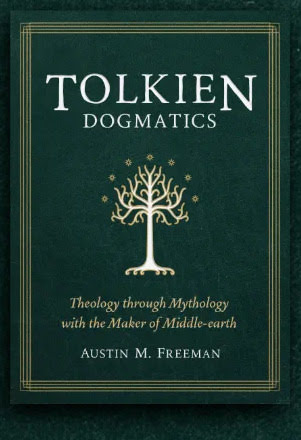
* Newly available via Amazon in dead-tree and e-book formats, the book Tolkien Dogmatics: Theology through Mythology with the Maker of Middle-earth (November 2022). Weighing in at 432 pages, it is billed as…

“a comprehensive manual of Tolkien’s theological thought. […] Austin M. Freeman [who teaches Apologetics at university level] inspects Tolkien’s entire corpus — The Hobbit, The Lord of the Rings and beyond — as a window into his theology”.

There’s no mention of use of the Letters here, which is slightly worrying. Though the book has an encouraging recommendation from Tolkien scholar Thomas Honegger…

Tolkien Dogmatics is likely to become a standard text for interested laypeople and literary critics as well as professional theologians when discussing the theology of the maker of Middle-earth.”

The book is a self-described “manual”. In that regard I noted a short buyer-review, stating that… “the theology is nicely organised”. Another source admired the wealth of footnotes. But it’s probably not the A-Z cross-referenced encyclopedia that a non-theologian Tolkien scholar might hope for. I see the author is also editor of the recent Theology and H.P. Lovecraft, in which he had a chapter comparing the world-building approaches of Lovecraft and Tolkien.

If you can’t afford Tolkien Dogmatics yet, apparently the publisher Lexham Press is sending out review copies. As yet, Google Books knows nothing about it while Amazon’s “Look Inside” only offers the front cover.

There’s a podcast interview with the author, scheduled for 21st December 2022.

* The next volume of the Journal of Tolkien Research is now underway, the first two items having been posted. One is an article which takes a rather over-complicated dive into “The Enigma of Goldberry”, the River-woman’s daughter who becomes the beloved of Tom Bombadil. The author usefully suggests that Bombadil’s reluctance to stray too far from Goldberry may be because he must be always on hand and attentive, to prevent her being drawn back to the river and to her former life as a nixie. The author also notes a connection of water-lilies with nix… (“[of] water-lilies both yellow and white, Grimm [1883] remarks that in modern German they are called ‘nixblumen‘ which translates as ‘nixie-flowers'”). This is not a late confabulation arising from 1870s scholarly interest in nix, as I can find the word in a 1740 German dictionary.

* The Journal of Tolkien Research also now has Kristine Larsen’s 2019 conference paper ““I am Primarily a Scientific Philologist”: J.R.R. Tolkien and the Science/Technology Divide”.

* A very long new article in First Things offers an in-depth review of the recent essay “A Prophecy of Evil: Tolkien, Lewis, and Technocratic Nihilism”. I had previously noticed the essay in question, but had backed off within microseconds — because the pictures were so cringingly naff and because it was evidently mostly about C.S. Lewis. But apparently it is worth a read.

* And finally, new to me is the stage play Lewis & Tolkien, of Wardrobes and Rings, which my searches suggest first appeared under spotlights circa 2018. The play is said to be a “mature and insightful” two-hander which portrays the close friendship of Tolkien and C.S. Lewis. It was brought to my attention by a listing for a March 2023 performance in America, and at a guess it may have further U.S. dates in 2023. The play…

“is set in Oxford’s Eagle and Child pub, where British authors C.S. Lewis and J.R.R. Tolkien meet for what turns out to be their final conversation.”

Potteries Post updates

A small update for my The Potteries Post. That’s it for 2022. I’ll be back with more local ‘news you can use’ in early 2023.

A sampling of recent posts at the Post, which has replaced my Facebook groups ‘Creative Stoke’ and ‘Wild Stoke’…

Opportunity: Staffs University has a day and evening Apprenticeship Fair on 4th Feb 2023.

Opportunity: Deutsche Bank Awards for Creative Entrepreneurs are now open for 2023.

Work: Staffs University (Stoke campus) requires a Senior Lecturer in Immersive Technology.

Good news: Staffs Wildlife Trust is taking on eleven open-space sites in the Moorlands.

Work: Newcastle-under-Lyme’s Appetite requires a part-time Community Co-ordinator.

Funding: Small businesses can bag £5,000 government vouchers for new software.

Work: The new ‘Great Northern Bog’ seeks part-time artists, £20-£25k commissions.

Good News: Peak District National Park bags £1 million for restoration of ‘bare peat’ bog areas.

New book: Staffs Uni Pro Vice-Chancellor co-authors an important new book on Visual Pollution.

Funding: Community Project Funding is now available from Music for All.

Opportunity: Connects Network event – hear from Alton’s Rural Brewing Co.

Opportunity / good news: Staffordshire will support new entrants into farming.

Opportunity: Could your business use a Keele graduate, to work on a digital project?

Training: Cheshire Wildlife Trust – Beaver Ecology and Reintroduction Training Day.

Work: The Forest of Mercia requires a Community Woodlands Officer.

Report: The UK Local Government Association’s new ‘Cornerstones of Culture’.

Work: Keele University requires a video producer, to boost student recruitment.

Work: Newcastle-under-Lyme’s CEDARS Short Stay School requires a Teacher of Art.

Good News: Newcastle-under-Lyme to plant a new “Lyme Forest” of 850 lime trees.

Work: Stoke Town High Street Heritage Action Zone seeks an artist – £8k commission.

Work: A full-time Art Teacher is required at Stoke’s Peak Education.

Work: Buxton Museum & Art Gallery seeks day-rate workshop artists for 2023.

Work: Stoke City Council is now advertising its new Tree Officer vacancy externally.

Report: Can a R&D tax policy help support the creative industries? Staffs Uni has the answers.

Work: The Buxton Opera House requires a full-time Head of Marketing & Comms.

Work: Artists invited to submit proposals for “What Does Staffordshire Mean to You?” workshops.

Work: A part-time arts Project Officer is required for ‘Outside’ in the Moorlands.

Work: Staffs Uni’s Media & Communications Hub requires a Technical Assistant.

Event: Stoke and North Staffordshire CEP Partnership Networking Meeting.

Opportunity: Staffs Uni has a Staffs Startup Community Launch evening event.

Opportunity: The Stoke Creates Exchange Forum has the December event date.

Work: Stoke’s 6th Form College needs a Teacher of Creative Arts – also has news of new T-level Ceramics.

Funding: Universal Music UK Sound Foundation grants, for teachers and instruments.

Talk: North Staffordshire RSPB, “in-depth talk” on Peak raptors in January 2023.

Good news: Stoke-on-Trent has a new Grade II Listed Building.

Work: Nottingham Uni has a paid PhD in Creative Arts Youth Work.

Work: Newcastle-under-Lyme’s Brampton requires a part-time Education Officer.

Opportunities: Dance with Frontline.

Work: Full-time Assistant Curator at World of Wedgwood in Barlaston.

Tolkien Gleanings #13

Tolkien Gleanings #13

* “Addenda: One Middle English Manuscript and Four Editions of Medieval Works Known to J.R.R. Tolkien and What They Reveal” (2021). This offers several new additions to the recent ‘Tolkien read this’ book Tolkien’s Library: An Annotated Checklist (which is to have a new edition on early 2023). The free PDF for the article can be had via searching Google Scholar for the title placed “in quote marks”. Last time I looked, academia.edu only allows public downloads in that way (for non-members).

* The author of The Annotated Hobbit has a new post on “The Hobyahs: A Reconsideration”. “Hobyahs” became known via printed books as a Scotch household bogey creature, akin to the common Midlands / Northern English ‘Hob’ and ‘Lob’ — but made rather more scary to children due to their vivid picture-book illustrations. As the article explains, Tolkien was interested in the word’s resemblance to his own word and he publically asked about its dissemination… although that interest came after The Hobbit.

* “Un souvenir brumeux de Dante dans The Lord of the Rings de Tolkien” (2021). In French with English abstract. Sees a possible influence of Dante’s Commedia on the Dead Marshes chapter in The Lord of the Rings

“Dante could have been a model for Tolkien. Despite the specificity of each text, the marsh appears as a space with a paradoxical nature, between life and death, between water, earth and fire. A space dominated by the indistinct and the deceptive, in which the presence of a guide is indispensable”.

Regrettably they appear to refuse and “404” all links, except to the home page or if found by internal search. You’ll have to search for “Tolkien”.

* The Imaginative Conservative has a new ‘short but informative’ post on “The Inklings and the Outbreak of World War II”. The Inklings…

“worried that England would be next on the invasion list, and they began to enumerate the innumerable times they had publicly condemned the Nazis.”

* “One Graph to Rule them All: Using NLP and Graph Neural Networks to analyse Tolkien’s Legendarium” is an open-access paper for a December 2022 conference. The researchers use new computational methods to… “study character networks extracted from a text corpus of J.R.R. Tolkien’s Legendarium.” An early version is available on Arxiv. Note that NLP = ‘Natural Language Processing’ computer-science, not the pseudoscience of ‘Neuro-linguistic Programming’.

* And finally, new to me is Introducing the Medieval Dragon (2020) by Tolkien scholar Thomas Honegger. A University of Wales book of 144 pages. The contents are…

   Preface.
   The Dragon and Medieval Religion.
   The Medieval Dragon and Folklore.
   The Dragon and Medieval Literature.
   Outlook and Conclusion.
   Endnotes.
   Further reading.