The Potteries Post updates with more local ‘news you can use’…

The Potteries Post updates with more local ‘news you can use’…
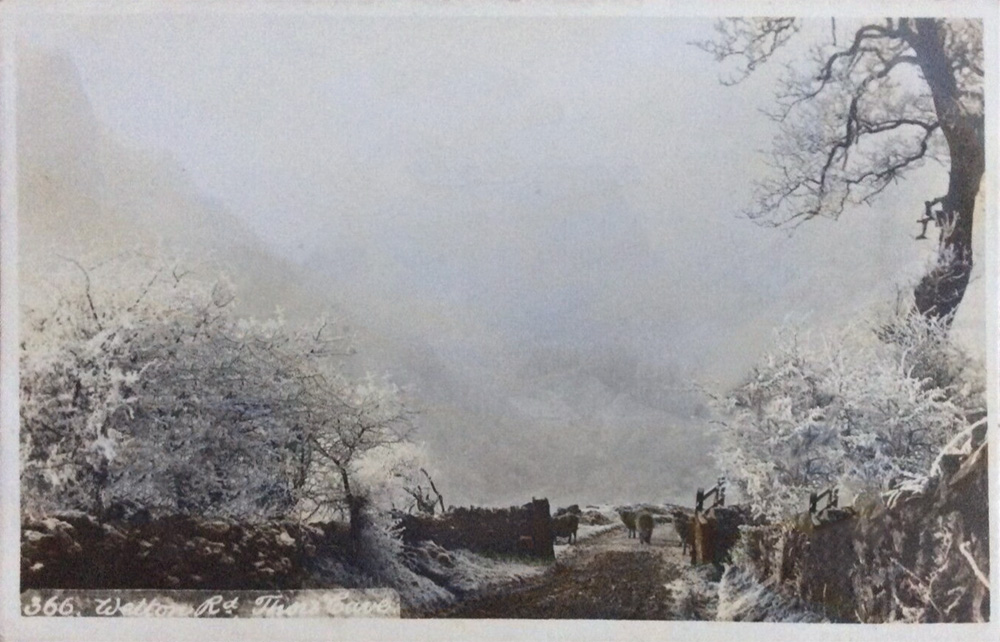
A rare if fuzzy picture of Wetton in winter, perhaps early 1900s since it was posted in 1909. Shows the unpaved track-like Wetton Road with the site of Thor’s Cave indicated in the mist above. Relevant to getting a feel for the setting and season encountered at the conclusion of the poem Sir Gawain and the Green Knight.
Pipe-smoking in Middle-earth is now in a third edition at $17 (September 2022).
Medievalism, the Lost Book, and Handicraft in The Lord of the Rings (the idea of the ‘lost book’)
“What’s in a Name?” Tolkien and St. Philip Neri…
“The Congregation of the [Birmingham] Oratory itself was established in the sixteenth century by St. Philip Neri, who, despite having very little name-recognition in the wider world, is a major figure in Church history”
Catholic Culture podcast interviews Carl Hostetter on the recent book The Nature of Middle-earth.
A new review of Tolkien’s Cosmology: Divine Being and Middle-earth (2020)
In French, Les Lettres du Pere Noel de J.R.R. Tolkien : les metamorphoses editoriales d’un corpus epistolaire fictionnel (J.R.R. Tolkien’s Letters from Father Christmas: the editorial metamorphoses of a fictional epistolary corpus) (HTML, so easily auto-translated).
A couple of local items were discovered while searching for new items for the new edition of my local Folklore bibliography…
1)
Mow Cop is in an unusual position. As evidenced by an interesting observation by D. Sylvester in the article “The hill villages of England and Wales”, The Geographical Journal, 1947…
“Mow Cop is probably unique as a hill village in that it lies across a fourfold boundary line dividing two parishes, two counties, two dioceses, and the two provinces of Canterbury and [missing word, probably “York”]”
Reminds me a bit of Tolkien’s Bree, also a liminal hill-place at the meeting of many ways. Apparently there’s now also a “Mow Cop relay” for the giant Jodrell Bank radio-telescope up there, which perhaps adds another and rather more cosmic “line”.
2)
Mid Staffordshire can claim the honour of saving the Venerable Bede for the nation. J. Baker, “Old English saete and the historical significance of ‘folk’ names”, Early Medieval Europe, 2017, has…
“The Old English Bede may well have been produced in the region around Staffordshire (T. Miller (trans.), The Old English Version of Bede’s Ecclesiastical History of the English People, 2 vols (London, 1890), I, pp. xiii–lix)”
Yes, ok… “Staffordshire”. It’s a big long place. Where exactly? Baker’s cited source (Miller) is on Archive.org and offers an exhaustive analysis of the dialect and words. He plumps with equal vagueness for “North Mercia” as the place that made the Old English Version of Bede, but usefully states that it must have been very near the area of the production of the Rushworth Gospels and the Vespasian Psalter. On the current thinking about the Gospels and Psalter that means somewhere around Lichfield. Which chimes with Miller who notes that… “Lichfield also early possessed a notable monastery”, and he further suggests Wenlock Abbey (15 miles SW of Stafford, over in Shropshire) as the site of the initial preservation of that copy of the Old English Bede. But where was the “notable monastery”? Probably very near Lichfield Cathedral, or else the monastery at Burton-upon-Trent (if that lines up with the dialect). But the precise answer will likely be found in the new scholarly book Lichfield and the Lands of St Chad (2020), which it’s said has done a huge amount of new work on this neglected topic in Mercian history.
Lichfield may also have had a role in preserving Beowulf, since the first known owner of the Beowulf original was the Bishop of Lichfield.
Slightly earlier than usual, though very suitably released on Bonfire Night, here’s the annual update of my The Folklore of North Staffordshire annotated bibliography.
Download: folklore_north_staffordshire_18_2023.pdf
This is now at version 1.8 (2023), as 14,000 words in 54 pages. It’s been subject to a big expansion (the last version was 40 pages), with numerous additions and some expansions of older entries. New additions are noted at the front, by name. It’s also had a lot of proof-reading for small typing and formatting errors.
Please update any local .PDF copies you may be keeping. There’s no print version, but it should be printable onto 14 sheets with booklet-making software. To then be folded and slipped between card covers.
Older versions of the .PDF have now been deleted from the blog.
I welcome descriptions of bibliography books that you may own or have access to, and which I have not yet been able to see.
Sad to hear that the the annual Stone Town Bonfire and Fireworks Display is unavailable, at least for the foreseeable future.
It seems the problem is simply space. The Town Council for the mid Staffordshire town is said to have somehow managed to redevelop the main Park in such a way that… “the area used for the bonfire will no longer be available”. Durh. It’s said that the town has no other suitable space for such a large and popular public event.
Although several options spring to mind, off the top of my head…
i) the Stone Common Plot would be an ideal site, though only for those walking the short distance from the town centre to it. There’s no car parking that I can recall, and a temporary wooden mini-bridge / ramp would have to be hoisted over the entrance stile. Still, a feature might be made of “leave your car at home” as part of the event. That might even attract some funds from a health charity, re: walking.
ii) rural places around about Stone may take up the slack. An opportunity for a nearby enterprising farmer with a big parking field, perhaps, in partnership with a trusted events company? What about Kibblestone Scout Camp, which is presumably able to cope with large roaring campfires at least — and perhaps something larger?
iii) there’s Wedgwood at nearby Barlaston, which I recall has both the parking and several big flat fields. And is used to handling public events. Trentham likewise, though that’s a bit further away and not really walk-able (Barlaston can be walked from Stone via the Common Plot and Downs Banks NT) and would likely be much more expensive and upmarket. What appears to be needed for Stone is something a bit more community-oriented.
iv) ideally there would be a giant flaming bonfire up on the ancient Bury Bank, as there probably once was, but that’s highly unlikely given the steep access problem and the huge amount of flammable bracken.
A note by fairy-tale scholar and authority Joseph Jacobs pointed me toward the Greek original, in Babrius, of the famous short fable “The Boy Who Cried Wolf”…
“Ultimately derived from Babrius: though only extant in the Greek prose Aesop. Gitlbauer has restored it [to the non-extant poetry] from the prose version”
… meaning the prose version as first found in the Collectio Augustana (dating perhaps from the 2nd century A.D., though said to be impossible to date).
I was interested and went in search of it. Archive.org has the Gitlbauer book of 1882. Jacobs erroneously pointed fellow scholars to Gitlbauer’s ‘restored’ Babrius 199 as the fable, but after some translation and searching I find it’s actually Babrius 161. Thus…
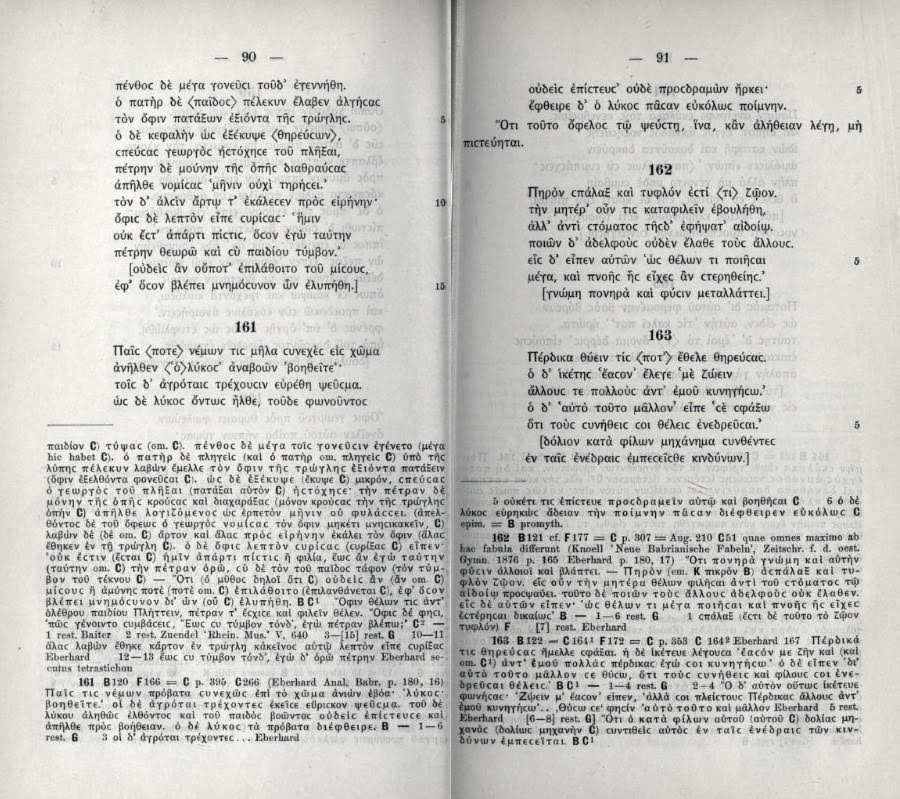
161 (literal auto-translation).
Παῖς νέμων τις μῆλα cυνεχὲς εἰς χῶμα
You play | when it rains | you put [throw?] the apples in [on?] the ground
ἀνῆλθεν δλύκος’ ἀναβοῶν ‘βοηθεῖτε’.
A rising [cry of] “wolf” | A loud noise of noises | Please “help me”!
τοῖς δ’ ἀγρόταις τρέχουειν εὑρέθη ψεῦεμα.
among the four farmers running, falsehood was found.
ὡς δὲ λύκος ὄντως ἦλθε, τοῦδε φωνοῦντος
But then the wolf did indeed come, they did not [heed the?] cry
οὐδεὶς ἐπίετευς’ οὐδὲ προςδραμὼν ἤρκει’
no aggressors, no countermeasures, it found
ἔφθειρε δ’ ὃ λύκος πᾶςαν εὐκόλως ποίμνην.
and he destroyed every wolf [sheep-dog?] who helped the shepherd.
[ Ὅτι τοῦτο ὄφελος τῷ ψεύςτῃ, ἵνα, κἂν ἀλήθειαν λέγῃ, μὴ πιςτεύηται. ]
[ That this is a benefit to the liar, so that, even if he tells the truth, he is not believed. ]
From which I take, for sense and story:
THE BOY WHO CRIED WOLF
A lone shepherd boy played a prank, because it rained and his apples were all eaten.
This laughing liar bobbed up on the valley ridge to cry “Wolf!”. Then loudly yelled “Help me!”.
Three times he played his prank. Farmers came running up, only to find a pack of lies.
Then one day the wolf did indeed come, but the sullen farmers came not.
Frantic cries went unheeded. The wolf found no men with long forks and sharp hooks,
And he destroyed every sheep-dog, the good friends who had helped the young shepherd.
[ This is how the liar is paid back for his lies. Even if he later tells the truth, he is not believed. ]
New and local on Archive.org…
* The Journals of Arnold Bennett (1954).
* Missuses and Mouldrunners: an oral history of women pottery-workers at work and at home.
* The Shorter connection (collection of the products of local potteries).
* Boote’s tiles: selections of the newest designs for tiling (Burslem tilery catalogue, 1906).
* A. N. Wilson’s acclaimed novel The Potter’s Hand.
* James Brindley and the early engineers.
* James Brindley: an illustrated life.
* Mysterious Cheshire. (An ‘earth mysteries’ booklet, 1980, with much to say about the Bridestones and Alderley Edge).
* Ancient Monuments: East Anglia and the Midlands (1955) (pictures of Arbour Low, Croxden and others).
* Recent Developments in the Archaeology of the Peak District (1991).
* Guide to the Cheshire Record Office (1991).
* The Place-names of Cheshire Vol I and Vol III (of five volumes).
* Old Midlands recipes. (Get yur sum “Tipton Eel Stew”. Yum, fresh from the canal! No mention of North Staffordshire Oatcakes).
* Midland Red North (post-war bus history).
* North Midlands trains in the thirties (pre-war railways).
* North Staffordshire Railway in LMS days: Vol. 2.
* The Peak District: the rivers’ way (Ilam to Edale, long-distance footpath guide, 1986)
* The Peak District: Regional Wildlife (1995)
* The Birds of Cheshire (1962)
* Flora of Derbyshire (1969)
* Caroline Hillier’s Paladin paperback A Journey to the Heart of England. Originally 1978, and here with a new foreword after a re-visit to the West Midlands ten years later. Encompasses the proper West Midlands including the counties.
New 1914 picture of the tented camp at Whittington, added to my Tolkien’s Staffordshire camps post.
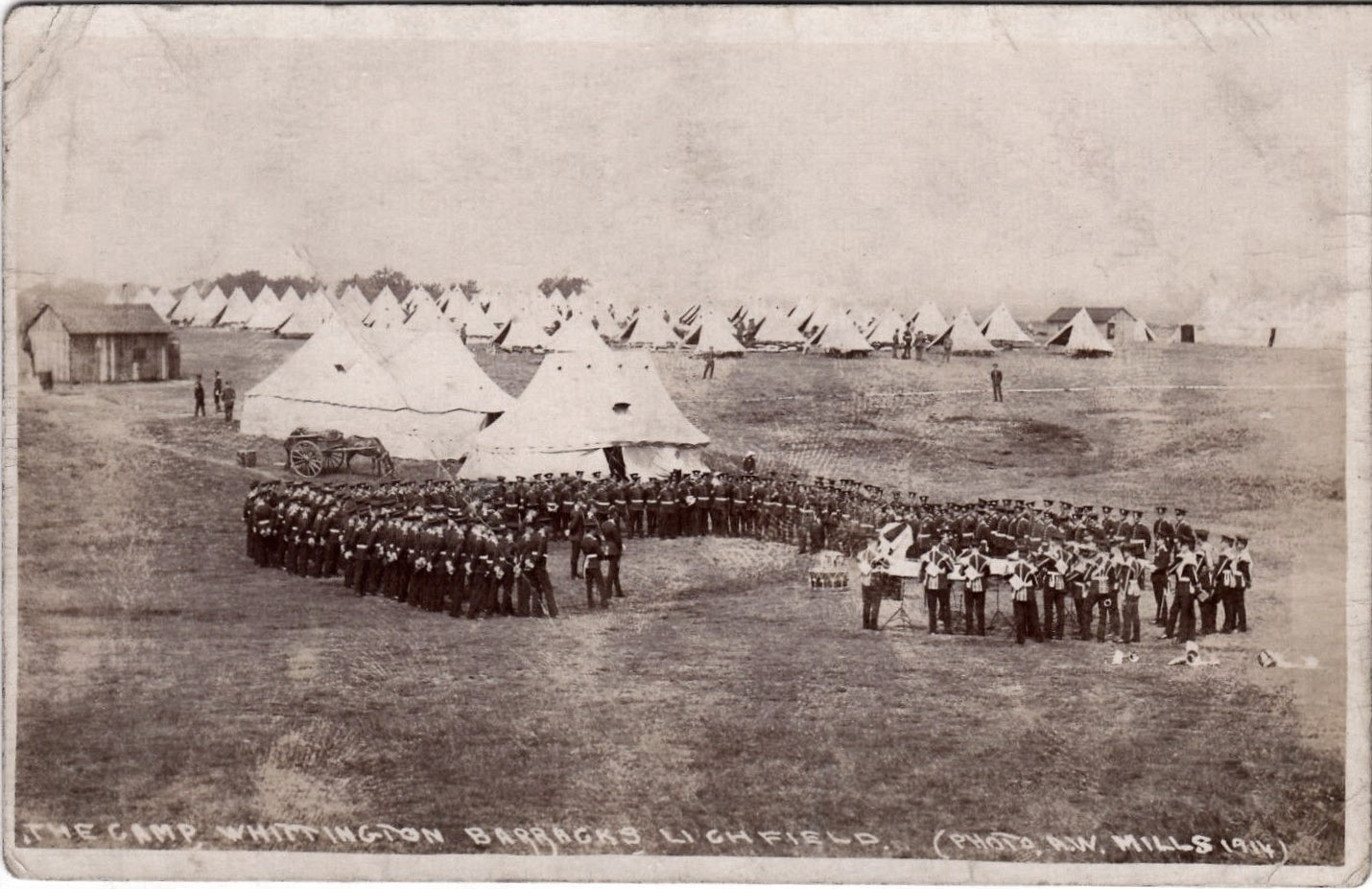
Appears to be the Church Service.
My The Potteries Post has had a small update with new items of ‘news you can use’.