A note by fairy-tale scholar and authority Joseph Jacobs pointed me toward the Greek original, in Babrius, of the famous short fable “The Boy Who Cried Wolf”…
“Ultimately derived from Babrius: though only extant in the Greek prose Aesop. Gitlbauer has restored it [to the non-extant poetry] from the prose version”
… meaning the prose version as first found in the Collectio Augustana (dating perhaps from the 2nd century A.D., though said to be impossible to date).
I was interested and went in search of it. Archive.org has the Gitlbauer book of 1882. Jacobs erroneously pointed fellow scholars to Gitlbauer’s ‘restored’ Babrius 199 as the fable, but after some translation and searching I find it’s actually Babrius 161. Thus…
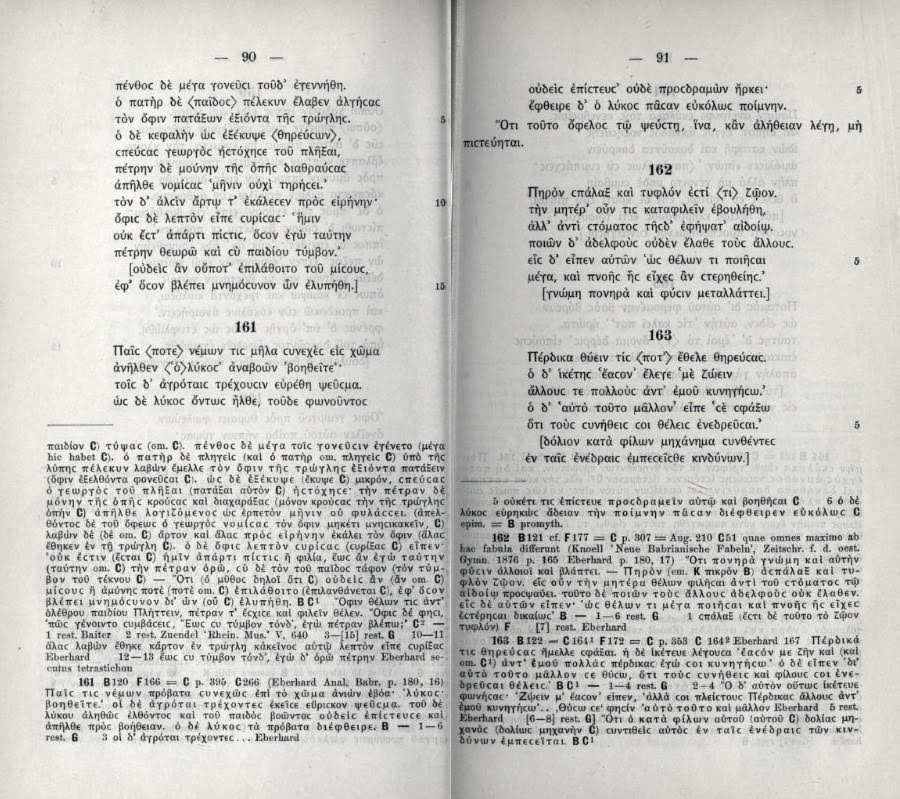
161 (literal auto-translation).
Παῖς νέμων τις μῆλα cυνεχὲς εἰς χῶμα
You play | when it rains | you put [throw?] the apples in [on?] the ground
ἀνῆλθεν δλύκος’ ἀναβοῶν ‘βοηθεῖτε’.
A rising [cry of] “wolf” | A loud noise of noises | Please “help me”!
τοῖς δ’ ἀγρόταις τρέχουειν εὑρέθη ψεῦεμα.
among the four farmers running, falsehood was found.
ὡς δὲ λύκος ὄντως ἦλθε, τοῦδε φωνοῦντος
But then the wolf did indeed come, they did not [heed the?] cry
οὐδεὶς ἐπίετευς’ οὐδὲ προςδραμὼν ἤρκει’
no aggressors, no countermeasures, it found
ἔφθειρε δ’ ὃ λύκος πᾶςαν εὐκόλως ποίμνην.
and he destroyed every wolf [sheep-dog?] who helped the shepherd.
[ Ὅτι τοῦτο ὄφελος τῷ ψεύςτῃ, ἵνα, κἂν ἀλήθειαν λέγῃ, μὴ πιςτεύηται. ]
[ That this is a benefit to the liar, so that, even if he tells the truth, he is not believed. ]
From which I take, for sense and story:
THE BOY WHO CRIED WOLF
A lone shepherd boy played a prank, because it rained and his apples were all eaten.
This laughing liar bobbed up on the valley ridge to cry “Wolf!”. Then loudly yelled “Help me!”.
Three times he played his prank. Farmers came running up, only to find a pack of lies.
Then one day the wolf did indeed come, but the sullen farmers came not.
Frantic cries went unheeded. The wolf found no men with long forks and sharp hooks,
And he destroyed every sheep-dog, the good friends who had helped the young shepherd.
[ This is how the liar is paid back for his lies. Even if he later tells the truth, he is not believed. ]
[…] (Regrettably “199” does not translate thus, and is ‘Fathers and Daughters’. Nor is Gitlbauer’s index any help re: wolf/wolves (λύκος/λύκοi) and his cross-referencing to a “Halmianam” edition, which means the earlier author Halm, is of no help either. Similar numbers to 199 were tried in Gitlbauer, assuming a slip of the pen by Jacobs, and I even tried some footnote text. Nor is there any other edition of Gitlbauer. I eventually translated the whole thing and found it’s 161 not 199. My translation.). […]