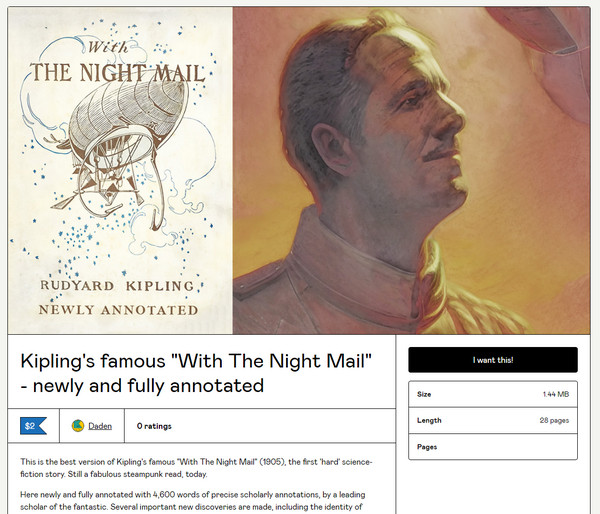
My labour-of-love “With the Night Mail”, annotated edition is available now as a .PDF file on the Gumroad service.
This is the best version of the famous “With The Night Mail” (1905), the first ‘hard’ science-fiction story. Still an absorbing and lively steampunk read, today.
Here newly and fully annotated with 4,600 words of precise scholarly annotations. Several important new discoveries are made, including the identity of “little Ada” — she was a real pilot! All four earliest versions have been checked and cross-referenced, and the modern corrupted text has been carefully cleaned. Differences between editions are noted in the footnotes.
There are 145 footnotes in total, explaining the technology, lingo, and places. One footnote even discovers a long ‘new’ section of dialogue about the risk of plague, unseen since the first publication — and never reprinted until now!
This .PDF is thus as close as we will get to a definitive version of the seminal story that launched the entire genre of hard science-fiction, and which had the honour of opening the highly influential Gollancz survey anthology One Hundred Years of Science Fiction (1969).
As a bonus, there are four new full-page colour illustrations including one of “George”. This labour-of-love e-book is 28 pages in total, delivered to you as a .PDF file. It may interest RPG gamers, as well as scholars and readers.
Many have agreed on Kipling as the first true SF writer in the modern sense:
Kipling was… “the first modern science fiction writer” — John W. Campbell, editor of the seminal Astounding magazine and pioneer of hard science-fiction.
What Kipling was doing in “With the Night Mail”… “had never been done before. There is no such subtlety in the contemporary proto-SF of H.G. Wells and Jules Verne. I think we may safely credit him with inventing the style of exposition that was to become modern SF’s most important device for managing and conveying information about imaginary futures”. — “Rudyard Kipling Invented SF!”, by Eric S. Raymond.
“With The Night Mail”… “anticipated the style and expository mechanics of Campbellian hard science fiction fourteen years before Hugo Gernsback’s invention of the ‘scientifiction’ genre and twenty-seven years before Heinlein’s first publication.” Eric S. Raymond, A Political History of SF (2000).
“With The Night Mail” is… “an amazing tour-de-force of inspired genius […] the sort of thing that Verne or Wells would never have dreamed of doing […] Kipling, in 1905, is doing things that science fiction as a genre wouldn’t achieve until Robert Heinlein arrived in the late 1940s.” — Bruce Sterling.
Kipling… “is for everyone who responds to vividness, word magic, sheer storytelling.” — Poul Anderson.
Kipling was… “a master of our art.” — Gordon R. Dickson.
“He was a superb and painstaking craftsman, the most completely well-equipped writer of short stories ever to tackle that form in the richest of languages.” … “”With the Night Mail” is an astounding vision … his influence on 20th century SF writers was probably greater than anyone else’s, except Wells … he was a master at making the fantastic seem credible”. — John Brunner.”
“When you read Kipling, you’re there, [he] builds a total sensory impression that surpasses the language” [which is partly why he will never be taught in schools] — C.J. Cherryh.
“what a good writer he was … the work is superb and he could make words sing. [On looking into the political claims that had dissuaded me from reading him,] I found that most of his supposed sins had been vastly overstated.” — George R.R. Martin.
At SF conventions… “I found that so many SF writers could see his sterling merit that I felt vindicated” [in my early love of Kipling, despite my mundane Eng. Lit. teachers who ignored him] — Anne McCaffrey.
There are two anthologies from science-fiction writers influenced by Kipling. Heads to the Storm: A Tribute to Rudyard Kipling, and A Separate Star: A Science Fiction Tribute to Rudyard Kipling. “Accompanied by introductions [to stories] in which the likes of Poul Anderson, L. Sprague de Camp, Joe Haldeman, and Gene Wolfe describe the impact that reading Kipling has had on their own writing.”
Also, in my new 2022 annotated text I could have mentioned some of the loose predecessors to “Night Mail”, but I didn’t want to speculate too much. I note these here…
1) Possibly Kipling had persevered with trying to fathom Edgar Allan Poe’s rambling “Mellonta Tauta”. A late political satire by Poe, now only comprehensible to those who know the tedious American politics of the period. Told as if letters from a slow balloon voyage around the earth, though there are encounters with faster luxury ‘liner’-like balloons…
“How very safe, commodious, manageable, and in every respect convenient are our modern balloons! Here is an immense one approaching us at the rate of at least a hundred and fifty miles an hour. It seems to be crowded with people – perhaps there are three or four hundred passengers — and yet it soars to an elevation of nearly a mile, looking down upon poor us with sovereign contempt.”
The tedious voyage leads to men struggling to amuse themselves by recalling “the old days” and how things were done then, and hence we get the tortured satire on Poe’s day. Possibly this was uproariously funny to Poe’s magazine readers, but it is almost un-readable now and certainly not the influential precursor to a whole field of later science-fiction.
2) I might also have mentioned H.G. Wells “The Land Ironclads” (1903) as having a slim claim to being the first ‘hard’ SF. But I think Arthur C. Clarke was right when he called it “an engineer’s story”, rather than imaginative futuristic SF. The new invention is deployed in the present-day (Wells’s setting is 1903’s cavalry, bicycle, trench and “Howitzer” artillery warfare of the Boer War) to make various political points. His armoured war-vehicles are 80-foot steam-powered metal tanks — and rather akin in shape to the various armoured land-craft that had, for a decade or more by then, been the staple of the American ‘boy inventor’ weekly story-magazines…
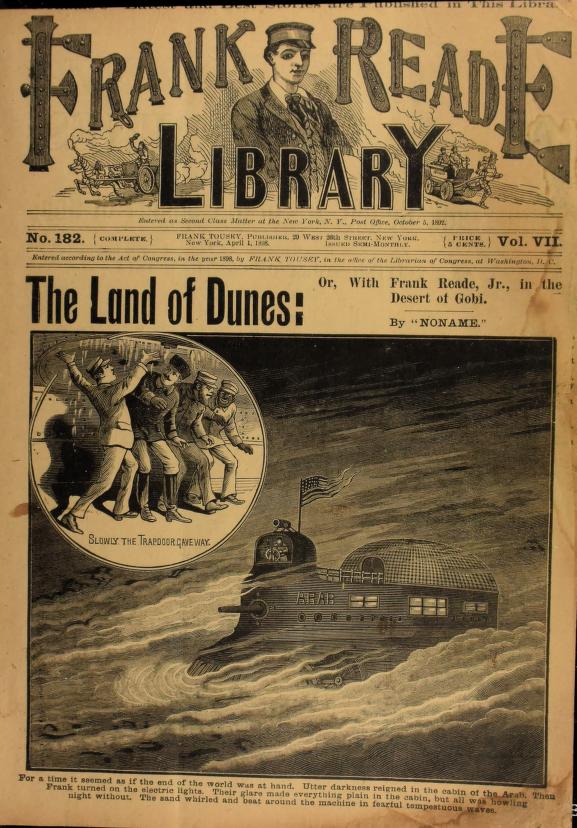
Example from 1898. This ‘land ironclad’ is similar in size and design to those of Wells.
Kipling instead imagines a complete distant-future world with multiple interlocking advanced technologies, attitudes, world-system and economies. And he makes it believable and human. He invents or anticipates numerous things that have since come to pass, and does so in a single tale.
3) There’s also a journalistic account that could have influenced Kipling’s “With the Night Mail” prior to 1905. This point has been suggested as such by the author of the free “Night Mail”-based RPG game Forgotten Futures. This short true-life article was Edward John Hart’s “With Her Majesty’s Mails to Ireland”, in The Strand Magazine in April 1895, being a brisk journalistic account of a mail packet journey across the Irish Sea from Holyhead in Wales to Kingstown. This article is now freely online at Archive.org. There is a similar encounter with a dingy tramp steamer, but Hart has him being avoided and gone in a few seconds. There is a similar recounting of shipping lights seen and passed, but such things are to be expected. The mail-ship ‘meets the dawn’ before her arrival. Those are the only similarities I can see. Possibly the general idea of such an account was all that taken by Kipling, if he had even noticed it.
[…] The world’s first ever ‘hard’ science-fiction story now has a new fully annotated edition for the first time, which also aligns the many textual differences from across its first four […]