More on Tolkien and Bingo

I’ve found a new and seemingly previously-unrecognised potential source for the name of “Bingo”, Tolkien’s original name-idea for Frodo in The Lord of the Rings. “Bingo Bolger-Baggins” was the initial name. The matter of this initial naming has puzzled many, despite it echoing “Bungo”, who was Bilbo’s father in The Hobbit. I’ve previously casually looked at the name in relation to the advent of the later modern commercial game of “Bingo” (seemingly in the 1950s as a replacement for “Lotto”). As part of another essay I also glanced at the idea that the common exclamation By Jingo! became in some trades the slang contraction of “Bingo!”.

Now a find of the popular book Merrie games in rhyme: from ye olden time (1886, London) reveals that “Bingo” was around in the culture of Tolkien’s childhood. This book of children’s games and songs was published six years before he was born. Its very first song-game is the “Bingo”…

The author the Hon. Emmeline Plunket is now better known among historians of astronomy for her scholarly Ancient Calendars and Constellations (1903, aka Calendars and Constellations of the Ancient World), and she thus appears to have been a scholar of Biblical and related astronomical systems — as well as a collector of the songs of her native land. She thus seems a reliable source, and the song is not a Victorian confabulation.

A publication review of Merrie games in the Saturday Review of Politics, Literature, Science and Art picks out four song-games headed by ‘Bingo’ — “There is ‘Bingo’ and the ‘Muffin Man'” — thus implying that the song-games were then common-knowledge even among parents and nannies and that their mention would ‘hook’ interested readers. Curiously the review disparages the artistic design — it was deemed not sumptuous and ornate enough for late-Victorian tastes! A short welcoming review of the book in The Antiquary also frowned on the ornate design, though for reasons left unstated.

What of scholarly attention in the modern period? Well, the book is cited, but not evaluated for authenticity, in the Opie’s The Singing Game and also in English County Songs: Words and Music. But otherwise it appears to have been totally ignored by later books.

Is there then any other good evidence for the existence of “Bingo” in English play-culture? Yes, two items can be easily found via search.

1) Tales of the Yorkshire Wolds (1894) cites… “the ancient song of ‘Bingo'” being played by the brass band at a churchyard gala at Cragside, while children nearby have gone on to play “a screaming game of kiss-in-the-ring” on the lawns.

2) Cornish Feasts and Folk-lore (1890) records… “Bobby Bingo, game of” as “very common” around Helston in Cornwall. Which links it with my recent book Tolkien & The Lizard: J.R.R. Tolkien in Cornwall, 1914 (2021). I there established that Tolkien’s companion on this seminal holiday was a musician and scholar of chant-song, and someone who had formerly been for many years the curate of Porthleven — which is the coastal port for the adjacent town of Helston and its outlying hamlets such as Godolphin.
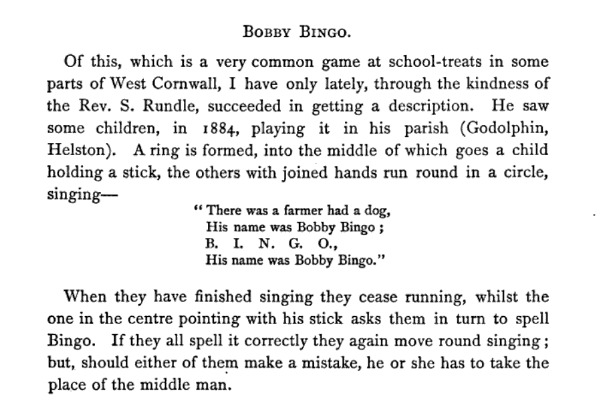
3) It was also noted at Stone in mid Staffordshire circa 1900, as a circle/dancing game (Trans. North Staffordshire Field Club, 1901).

Thus the game-song existed as far apart as Yorkshire and Cornwall, and in mid Staffordshire, albeit late in the Victorian period and after the publication of Plunket’s popular Merrie games.

I then searched for pre-1885 occurrences. This led me to Gomme’s A Dictionary of British Folklore (aka Folk-lore). The Dictionary was actually a series, and the book is thus un-findable under that title at places such as Hathi and Archive.org. It is actually to be found online under the title The Traditional Games of England, Scotland and Ireland : with tunes, singing rhymes and methods of playing (1898, 2 Vols. in the Dictionary of British Folklore series). From Vol. 1 tumbles a wealth of detailed lore on “Bingo”…

I’m pleased to find here another Potteries children’s song collected by Miss Keary. Fellow Tolkienians will also note the prominence of ‘Sting’ and a ‘Ring’ here, both items rather well-known to readers of The Lord of the Rings.

Regrettably Gomme omits all dates from correspondents and sources, so one can’t tell if some of these song-games pre-dated the popular publication of “Bingo” in a book aimed at children. However the final note in the article, usefully reprinted from Northamptonshire Notes and Queries, points out that “Byngo” was the name of the dog in the song “The Franklin’s Dogge” aka “Ye Franklin’s Dogge”. On tracking this down, it refers to a footnote in The Ingoldsby Legends as collected and published in the early Victorian period by the Rev. Richard H. Barham. His note gives a “primitive ballad” sung in spelling-out form (the same as the later children’s song-game). The song was had via a “Mr. Simpkinson from Bath” in Somerset and is as follows…

A franklyn’s dogge leped over a style,
And his name was littel Byngo!
B wyth a Y — Y wyth an N,
N wyth a G — G wyth an O–
They call’d him little Byngo!

This Franklyn, Syrs, he brewed goode ayle
And he called it Rare goode Styngo!
S, T, Y, N, G, O!
He called it Rare goode Styngo!

Nowe is not this a prettie song?
I think it is bye Jyngo!
J with a Y– N, G, O–!
I swear it is by Jyngo!

A “franklyn” was a medieval term for a freeman [farmer?] who owned land and property, but was neither a peasant serf nor a noble. My suspicion would be that the word is perhaps a small embellishment to give a more ye olde flavour to an original folk-source, since the phrase “old man” might fit there and sing better. But this text can be found given in The Ingoldsby Legends editions of 1866 and 1852, and thus it clearly pre-dates the later child-song collectors of the 1880s and 90s. In its B-I-N-G-O spelling form it correlates well with the later children’s forms.

Searches suggest that the children’s song-game of “Bingo” appears to have been forgotten by the early 1930s, and earlier meanings would have been swept away by the advent of the bingo gaming halls of the 1950s and 60s. Though interestingly the ‘piecing out’ element could be seen as being kept, but transferred from alphabet letters to what had previously been called “Lotto” numbers. Note also that the mid 20th century bingo-hall balls ‘leap’ in the air like little dogs (numbered ping-pong balls in compressed-air ‘blower’ cages were used to pick random numbers, before the advent of digital methods).

Yet in Tolkien’s early childhood the song-game “Bingo” was evidently a well-known part of children’s play culture in England, especially so circa perhaps from 1880-1905. It was also widespread, being found as far apart as Yorkshire down to the tip of Cornwall, and from Lincolnshire across to Shropshire. There is one early example that appears to be a tavern ale-song from circa the 1840s in Somerset. If the publication of this song is the origin of a game-song’s later spread, or was simply an early random survival of something already widespread in the 1840s, must now remain forever unknown.

As for Tolkien, “Bingo” could well have formed: i) part of Tolkien’s own games in young and middle childhood; ii) been encountered still alive in Porthleven and around Helston in Cornwall in the summer of 1914, or in mid Staffordshire when he was there; iii) and/or been a focus of interest via a 1920s encounter with the publications of the English song and folk-lore collectors of the 1880s and 90s, especially in pursuit of “the little dog leaped…” relic fragments from “Hey Diddle Diddle” — a nursery song we know Tolkien was very interested in and which he incorporated into The Lord of the Rings in the form of Frodo’s tavern-song at Bree.

Of course, I should say that it’s also well known that his young children had toy Australian koala-bears named the Bingos. There was a ‘Bingo Koala’ brand of stuffed toy bear sold circa 1928-30, and which looked much like normal teddy-bears but were grey-white.
Dame Edna in Birmingham

Barry Humphries (Dame Edna) in the latest edition of The Oldie

“The character of the collection [at the Russell-Coates in Bournemouth] has not been vitiated by the modish philistinism to be found in other museums across the country. Birmingham’s famous collection of Pre-Raphaelite masters is ‘temporarily not on show’ — which was probably what visitors to German museums in the thirties were told when they couldn’t find Chagall, Munch, Kokoschka or their friends on the gallery walls. A frightened-looking attendant told me a couple of Pre-Raphaelites might reappear during their forthcoming ‘Colonialism’ blockbuster.” [Likely linked with ‘Race, Empire and the Pre-Raphaelites’, a big Arts Council project ending in 2023].

Just as well I’ve seen it several times. Looks like I won’t see the same collection ever again now, as originals, judging by the other things I read about the leftist demolition job being done on this once-great museum. I suspect that many will now think twice before leaving things such as legacies or collections of paintings in their care.

Also a short book review in the same issue brings news of a new Arnold Bennett biography. The reviewer makes the usual mistake of thinking of The Potteries as “northern” rather than Midlands. But it points out that Bennett’s immense wealth (all earned from honest commercial writing and book sales) was one of the key reasons that he was so disparaged by other writers of the time.

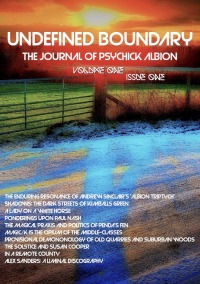
Undefined Boundary #1 (2022)

A new non-fiction journal, Undefined Boundary: The Journal of Psychick Albion. Interested in various British seers who walked on paths forgotten and thereby took inspiration for new creative workings, visionings and suchlike. And who probably also munched on a few curious mushrooms along the way.

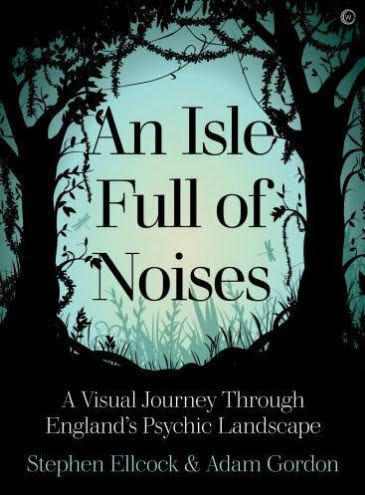
Also of interest: a new ‘historical survey’ artbook with the sub-title A Visual Journey Through Albion’s Psychic Landscape. Originally to be called An Isle Full of Noises, but now given the more politically-correct title of England on Fire complete with punky ‘scrawl’ typography.

Dinah Mulock’s ‘Olive’ and the Potteries

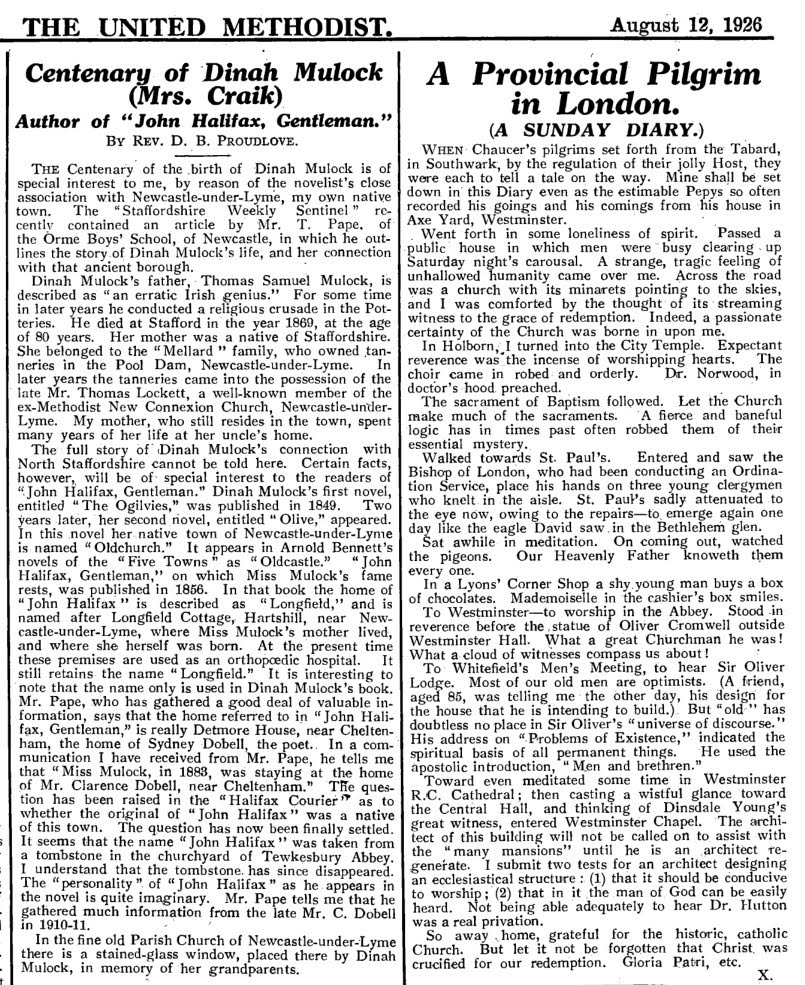
The United Methodist, 12th August 1929 had a summary of a paper by local historian Thomas Pape, of a paper on local Potteries novelist Dinah Mulock (daughter of Bryon’s notorious ‘Muley Moloch’)…

This reveals another Potteries novel new to me. Her second novel, Olive (1850) was one of those sweeping sentimental mid-Victorian three-volume melodramas that in this case, as the article alerts, depicted Newcastle-under-Lyme as ‘Oldchurch’. It has a baby girl born in a gloomy Scotland with a “shoulder deformity” and “curvature of the spine”, “not pretty” and she is rather hidden-away as “a pale, deformed child”. But her father dies and as a young child she moves to England and to the brighter ‘Oldchurch’, where she gradually becomes aware that she is unlike other girls…

[Her new home in the Potteries is] The old hall, seated on a rising ground, and commanding views which were really beautiful in their way, considering that Merivale [Hall, Oldchurch] was on the verge of a manufacturing district, bounded by pastoral and moorland country. Those strange furnace-fires, which rose up at dusk from the earth, and gleamed all around the horizon, like red fiery eyes open all night long, how mysteriously did they haunt the imaginative child! Then the town, Oldchurch, how in her after-life it grew distinct from all other towns, like a place seen in a dream, so real and yet so unreal! There was its castle-hill, a little island within a large pool, which had once been a real fortress and moat. […] there was a curious fascination about Oldchurch. In the cloudy memories of her childhood it rose up, as she used to go there with Elspie [her nurse], at far distant intervals. The two great wide streets, High-street and Broad-street, intersecting one another in the form of a cross: the two churches — the Old Church, gloomy, and Norman, with its ghostly graveyard; and the New Church, shining white amidst a pleasant garden-cemetery, beneath one of whose flower-beds her baby-brother lay. The two shops, the only ones she ever visited, the confectioner’s, where she stood to watch the yearly fair, and the bookseller’s, whither she dragged her nurse on any excuse, that she might pore over its incalculable treasures. [She dwelt there for] “those seven years of childhood, in a little Eden of her own.

Later she is old enough to attend a town ball, and this event starts to reveal her future situation if she were to stay in “prying, gossiping Oldchurch”…

Olive had never in her life before been at an orthodox ‘private ball’, with chalked floors, rout seats, and a regular band. She was quite dazzled by the transformation thus effected in the Derwents’ large, rarely-used dining-room, where [as a child] she had had many a merry game with little Eobert and Lyle. It was perfect fairy-land. The young damsels of Oldchurch — haughty boarding-school belles — whom she had always rather feared, when [her friend] Sara’s hospitality brought her in contact with them — were now grown into perfect court beauties. She was quite alarmed by their dignity, and they scarce noticed poor little Olive at all.

But she strives to overcome her disability and becomes an artist, moving to London.

I also discover that Dinah Mulock had four early fantasy tales for young children, “Little Lizzie and the Fairies”; “Sunny Hair’s Dream”; “The Young Ship-Carver”; “Arndt’s Night Underground”. All placed and published just after she had herself moved from the Potteries to London. Her “Arndt’s Night Underground” can be found in good form in Tales of wonder; a fourth fairy book (1909). It seems unlikely that they have any dashes of Potteries background, judging by the generic setting of “Arndt’s Night Underground”. Still, they’re in the public domain and they might be written or re-told so as to include local colour and placenames.

‘Sunny days are here again…’

Fascinating. After about 1972 the cumulative effects of the UK’s Clean Air Acts and central-heating installations probably had a nice side-effect… they gave the Midlands significantly more sunlight in winter and on sunny autumn days. The sun became able to cut through what had before been man-made fug and smoke and haze…

Since 1929… “significant changes [in total sunlight hours] occurred in the winter season, when there has been an increase in sunshine of about 20% for central and northern England. Sunshine has also increased in these areas by about 10% in autumn.”

“These increases could be a result of the Clean Air Acts of 1956 onwards, which has led to a decrease in air pollution.”

The effect was especially marked after about 1970. So… 20% more sunlight reaching the ground in winter by 2004, largely because the winter coal-fires were no longer burning in millions of homes. And it may well have ticked up by a further 5% in 2005-2020, though that’s my guess rather than the Met Office’s figures.

The upward inflection point in sunniness starts around 1972 for the Midlands, according to an accompanying graph. That’s about right, 1970-72 being the point when many middle-class people had central-heating installed and turned the old coal-shed into an outside loo for the garden. The trend would have been amplified by the Oil Crisis which affected industry and began in 1974, alongside wave after wave of nationwide industrial strikes from 1974-79 (factories standing idle etc). Then there was another burst of central-heating installation when Mrs Thatcher gave people the right-to-buy their rented homes in the mid 1980s. The Thatcher revolution of the 1980s also meant that many of the inefficient old ‘smoke stack’ industries were swept away by circa 1986.

Average surface temperatures also then nudged up slightly, in tandem with the increased sunlight. It got a bit warmer because smog, mist and haze was artificially cooling the land, by blocking warming sunlight. I imagine that the effects were especially pronounced in somewhere like Stoke-on-Trent. The city being said to have been smoky, especially at times when the pot-banks were firing their wares. It might then be an interesting historical exercise to see if the change can be tracked on the ground, in the data at the city-region level in the Potteries, and if the sunniness effect was actually greater in Stoke-on-Trent. That assumes, however, that the data still exists somewhere in its original un-tampered state. There will also be natural variation to accommodate, for instance the city’s 1986 Garden Festival had a terrible summer of near constant rain, wind and cloud. Not much sun was seen during that entire spring/summer, by all accounts.

Source: National Climate Information Centre Climate Memorandum No. 21, 2006, UK Met Office. Using a data-set that ran to 2004.