Wild Yorkshire today muses on Totties. In Anglo-Saxon, Wild Yorkshire notes…
‘tōta’ was a lookout post
Interesting. Bosworth-Toller has it only as the root tot, ‘a projection’. A quick look at other sources does suggest ‘lookout (post)’. The implication is that the post’s watchers look about or ‘project’ their gaze about ‘here and there’, turning their heads in a way that is uncertain to the distant viewer. An old dictionary suggests a root in Old Norse totter (still understood, as in ‘she tottered about here and there’) and there was also apparently a similar ancient Belgian word with similar meaning. ‘Tootling about’ then appears to be the more modern car-inflected form. One could today talk about a tall old person ‘tottering about’ the town on legs, but the same person would ‘tootle about’ in a small car — with the ‘toot’ part of the word implying also a certain giddiness of driving that means the horn has to be tooted more often than not. Which might cause heads to turn.
‘Unsteady, dizzy, tottering about giddily’ seems to be the broad older meaning. The 1913 Webster’s had…
Totty (?), a. [Old English toti. Cf. Totter.] Unsteady; dizzy; tottery. [Obsolete or Provincial Engish], [used by] Sir W. Scott.
“For yet his noule [head] was totty of the must”. Spenser.
In the full text of the quote we can see this relates to wine…
Then came October full of merry glee:
For, yet his noule [head] was totty [dizzy] of the must [fresh fuming juice from the wine],
which he was treading in the wine-vats see,
And of the joyous oyle [oil], whose gentle gust
Made him so frollick and so full of lust.— Edmund Spenser, The Faerie Queene, Book VII (1605), Canto VII, Stanza 39.
Consider also the use of “tot” for drinking, as in the famous British naval “tot of rum”. One is giving the seaman not only the gulp of hard liquor (the ‘tot’), but also the ‘tottering’ effect it will have on the head and gait.
Yet the word is not just relevant to dizziness caused by wine or rum or (in a few Middle-English military examples) a sharp blow to the head. “Giddy, hare-brained” is a definition from the Universal Etymological English Dictionary (1720s/30s) and shows it can imply a general colt-ish giddiness of manner.
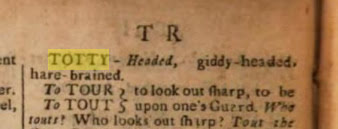
Which brings me to the modern meaning of totty (as ‘attractive nicely-dressed girls, tall and frisky and a bit giddy’). This meaning is not understood by all, curiously. A colleague was once showing a workman round a 16-18 college, and he later reported in the staff room that he had been utterly baffled by the man’s frank man-to-man exclamations about the vast amount of ‘totty’ to be seen in the place. He assumed the workman was referring to some kind of builder’s putty that had been used on the building’s fabric. Only later was the poor fellow told the meaning which every working-man in the Black Country knew. It is a class-based word.
One can see how this meaning might broadly relate to the Old English which Wild Yorkshire and dictionaries mention. Both a tower and a ‘frisky female’ totty being, by implication, ‘tall’ and also something to which one’s eye is immediately ‘drawn to’. They are head-turners, in other words. Consider also that a tall thin watch-tower is also something which one might ascend in a dizzying spiral manner, and at the top of which one might have a dizzying head-turning view.
All of which is perhaps interesting re: Tolkien, when you consider both the old disused watch-towers at the edge of the Shire and that in The Lord of the Rings Aragorn was originally to have been Trotter. Having wooden prosthetic feet, his name might initially seem to some to have implied ‘unsteady’, ‘tottering about’. And yet Trotter implies both a pig’s trotters and a horse’s trot, which are both very firm and steady things, quite the opposite of tottering. Tot- (giddy movement, elevated, head) and trot (sure steady movement, grounded, foot) look to me like similarly-named opposites.