From “The Potteries in the year of the Great Exhibition”, issued as a 28 page booklet by the Festival Committee of the Council of the City of Stoke-on-Trent, to mark the Festival of Britain in 1952.
The paragraph below was part of a short extract published at the back of the Festival brochure. Here edited for clarity, sense and errors.
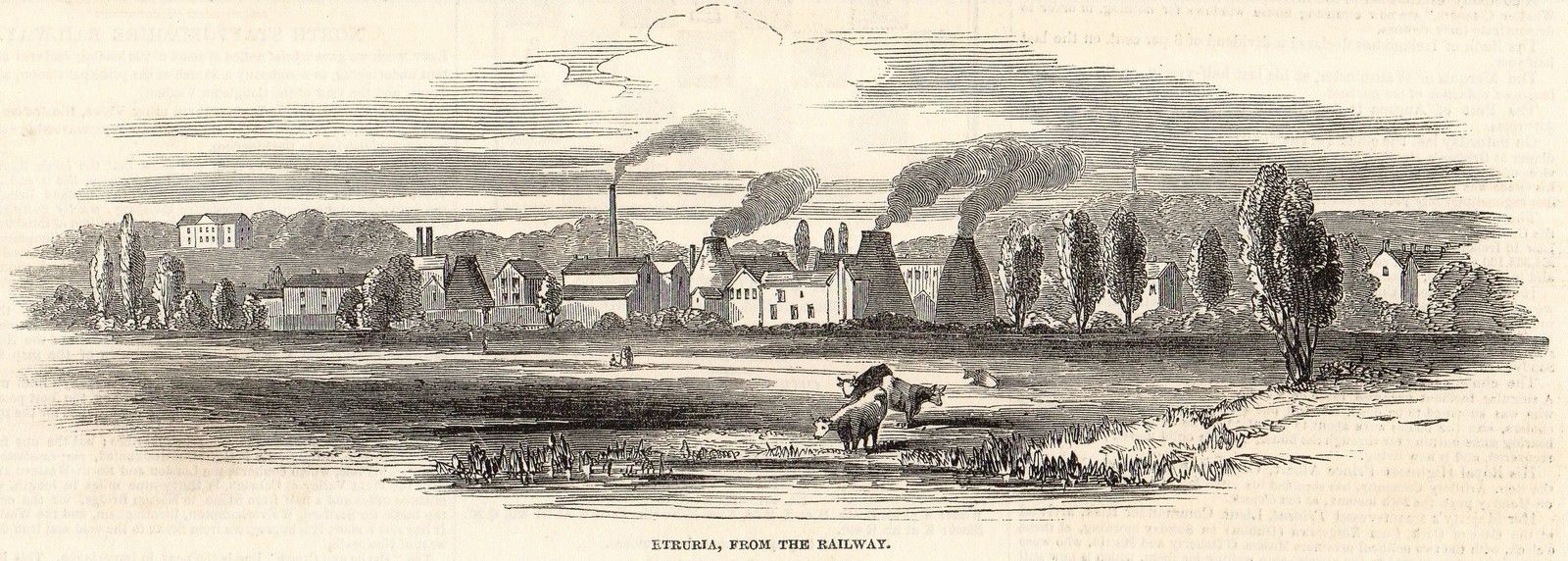
“The traveller [when walking from Stoke to Hanley in the year 1851], once off the main thoroughfare [in Stoke town], was almost immediately in open country. After passing the railway bridge [at the top of] Liverpool Road, Stoke, he would walk towards Hanley along a main road with green fields on either side, flanked by trees and hedgerows with cattle and sheep grazing right [down the hill] to the point where the Station Road ‘bus stop stands now. Directly opposite stood the isolated house known as Winton Villa (still visible from the railway bridge [to those travelling on a train, but] now built around by N.C.B. [National Coal Board] offices). [This Villa was] then the abode of Robert Garner1 one of the early surgeons attached to what is now the Royal Infirmary (but which was then situated [nearby] in Etruria Vale). The fields later consecrated as the [Hanley] Cemetery rose above the hollow lane which became Stoke Road. Blackberry bushes grew at its side. The [road to Hanley rose to cross the line of the Cauldon canal (1779) which] flowed by tall trees in which magpies nested (which gave the name to [nearby] Pynest Street). [As the traveller crested the final rise into Hanley he looked back west and saw] The valley [spread out below. This was] watered by the Fowlea [Brook] and was very pretty — the waters clear, sweet and full of fish. In the meadows along its banks, even beside the new railway, the shepherd still guarded his flocks.”
1. As well as a leading local medical man, Robert Garner was one of the founders of what became the North Staffordshire Field Club. In old age he became ‘The Father of the Club’.