“‘Your tongue is strangely changed, but the name sounds not unfitting so.”

I’m not sure if this has been suggested before, but I can find no trace of the suggestion. Here is yet another possible solution to the genesis of Tolkien’s word “hobbit”. That it came from his mind musing on, while marking exam-papers, the name of “Coalbiters”.

This being what would become the pet name for a group of his literary fellows some years later, the name arising from the Icelandic Kolbitar which was a euphemism for dull lads who laze by the hearth-fire when there is work to be done…

“youths who were indolent and dull and who lay in the ashes by the fire during the day, the so-called coal-biters.” (Grundriss der Germanischen Philologie).

The name being doubly fitting for Oxford professors because, as masters, they presumably had hands stained with black ink from their daily labours and were also liable to carry smudges of chalk (as if they had been lazing in fire-ashes) gained by labouring at good old-fashioned blackboards. But also fitting for musing on lazy lads who do not trouble to complete their exam-papers.

Anyway, the famous word “hobbit” was jotted down at the end of a long stint of marking school exam-papers, possibly as early as 1926 but likely some years later. Tolkien encountered a blank sheet from the final paper. On this he spontaneously wrote…

“In a hole in the ground there lived a hobbit”.

… and thus began The Hobbit. My suggestion is that line could have arisen, either prior and unbidden in his mind or in a mere moment’s consideration, from musing on coalbiters

“In a hole in the ground there lived a coalbiter … hole-biter … ho..bit … hob-bit.”

Tolkien being presumably aware that hob was also a word from the fireside hearth (see below) and thus connected at least in circumstance with Kolbitar. He would also have known of ‘Lob Lie-By-The-Fire’ from northern England, and the modern German ‘Kobold’ as a common name for a ‘house spirit’.


Even more speculatively, the “hole” might even be inferred if he had then recalled how the word “hob” was used in Cheshire. From a key topography of Sir Gawain and the Green Knight, on which Tolkien was by then the contemporary expert…

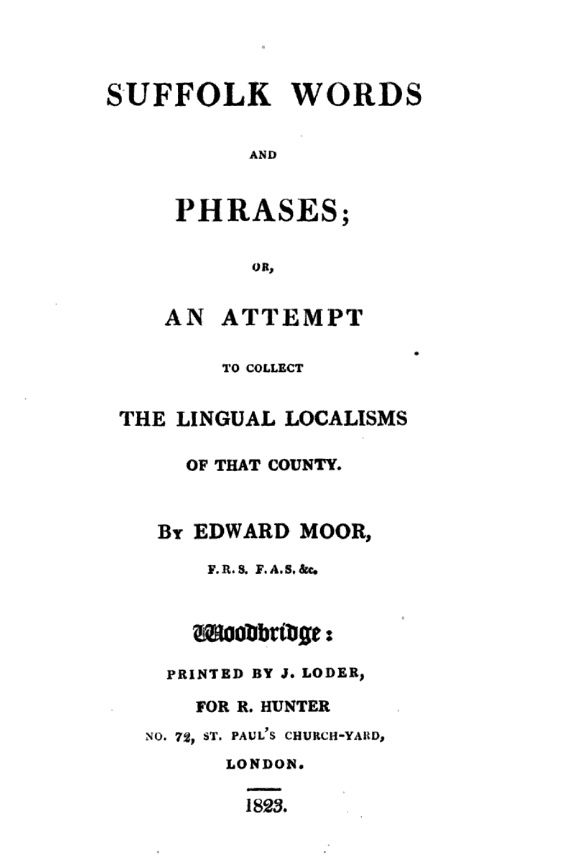
“In Cheshire, Hobbity-hoy is an awkward stripling between man and boy” (1823)
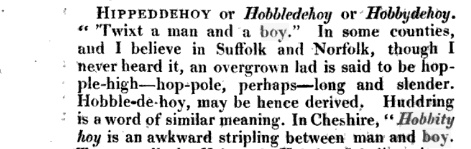
This link with a hole could be inferred from “Hobbity-hoy” since it likely derived in Cheshire from the likeness of the lithe and nervously energetic boy to a male ferret, which the Cheshire Glossary has it was called a “hob” in Cheshire and elsewhere.

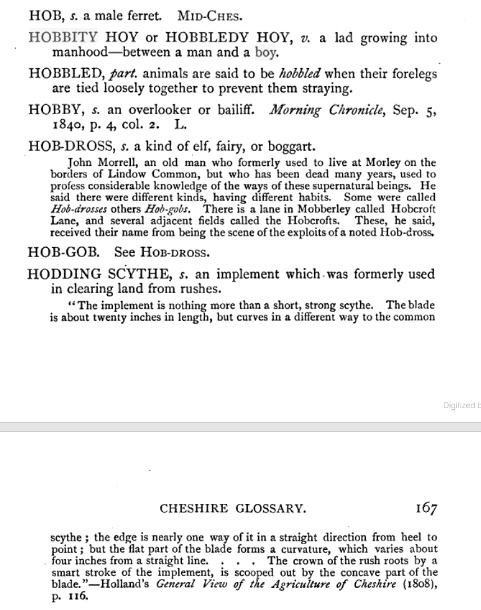
Ferrets having of course long been used for rabbit hunting in holes, and having an ashy-looking underside of fur. After hunting in a sandy burrow, this pale underside would likely look even more as if the creature had been “lying in the ashes of a fire” — similar to how the coalbiters boys were imagined.
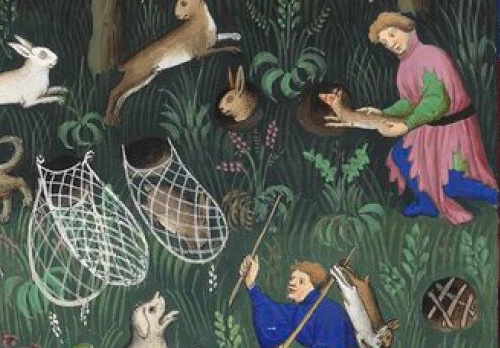
This word is also not incompatible with “hob” used in the olde-time fireside sense. In the era of big broad medieval fireplaces, a “hob” indicated the small shelves set in the corners of the hearth, above hot grates, on which tankards of cider and ale were kept hot. One can then imagine that the lid of a loose-lidded tankard would thus start to “pop” up and down when it became too hot and air needed to escape and the tiny vent-hole was insufficient, much like the action of a weasel or ferret popping his head out of a rabbit-hole and with the same flash of white chest-fur and shining eyes as some bubbling foam spilled up and out. One here also recalls the real tradition of lacing good cider with a dead rodent to help start the yeasting process. Could this be the origin of the phrase “pop goes the weasel”, when it was laughingly observed by the hobbity-hoy boys at the winter fireside that the dead weasel or ferret consigned to the brew on the hob “has cum’ alive again” and “iz tryin’ to pop out”?
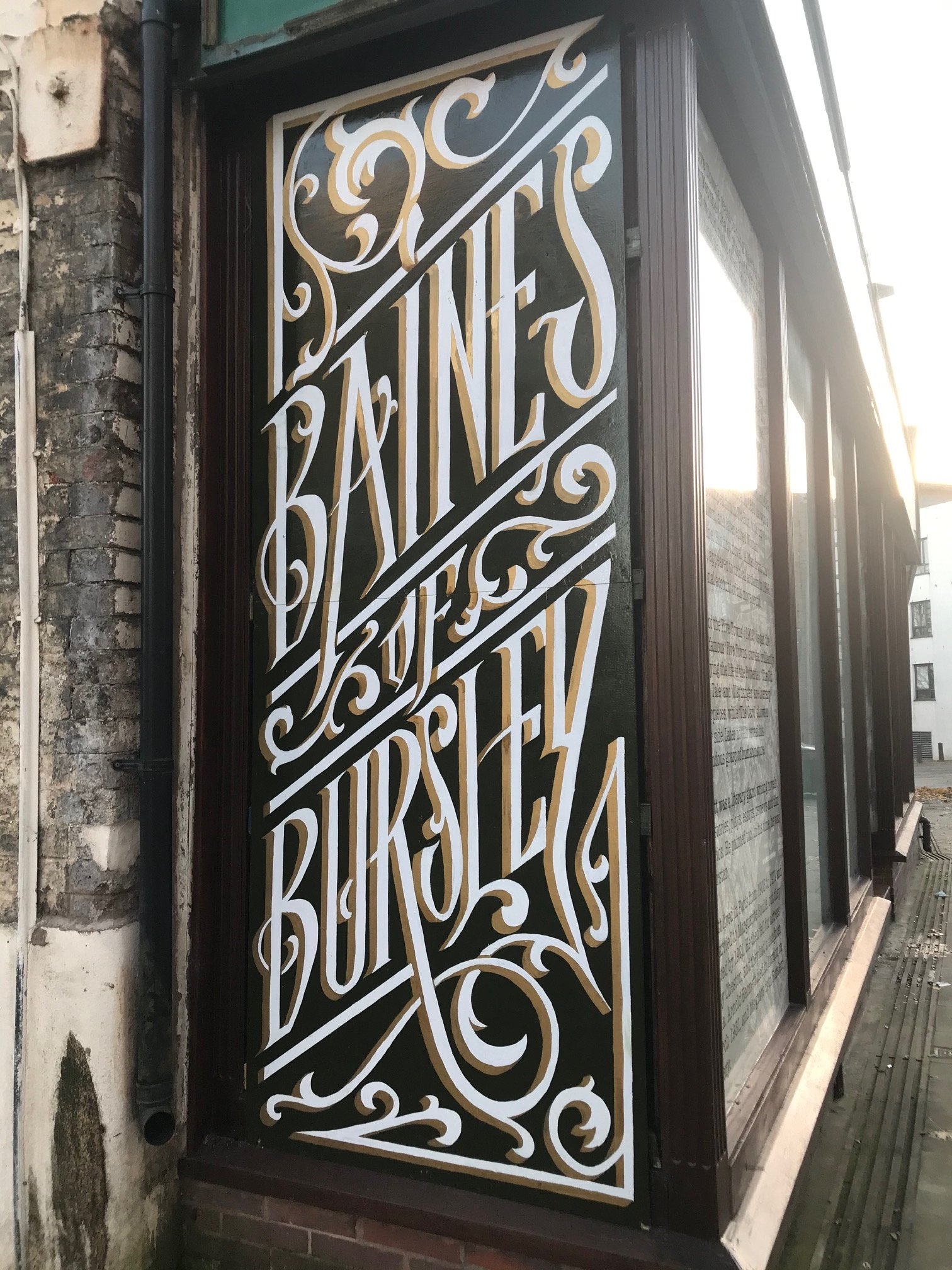
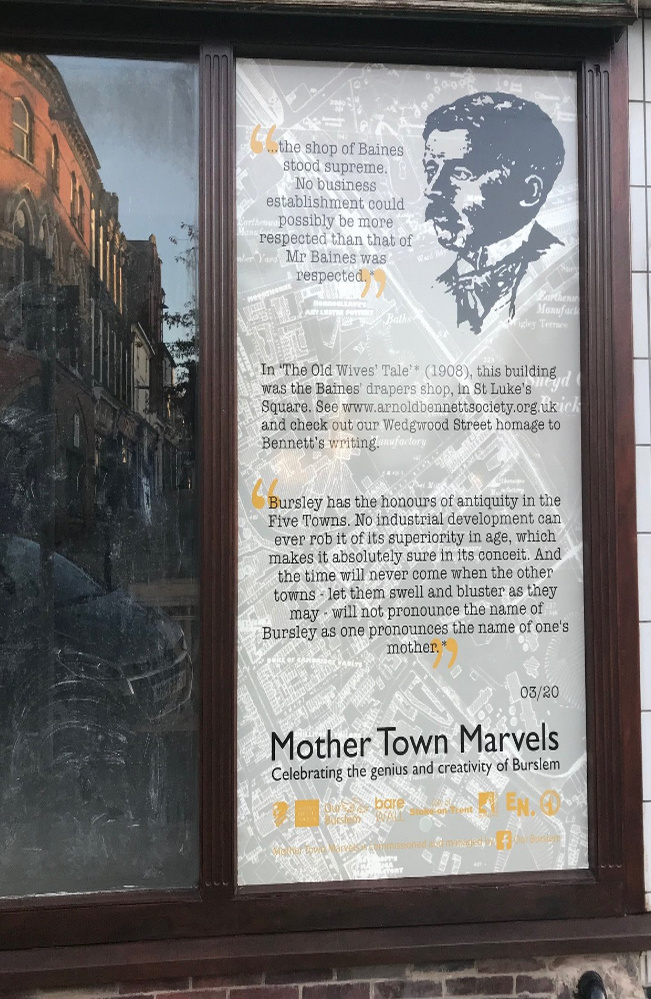
Tom Edwards in Burslem

A super bit of signwriting for a disused shop in Burslem, from Tom Edwards.

I’m not sure where you might find “Mother Town Marvels” online. Google appears to know almost nothing about them, and the Facebook “Our Burslem” group (seen noted in the corner of the window) is a general one.

Unleash the mega-Tolk!

It’s that time of year again. Recent Tolkien scholarship of interest, noted and downloaded for my reading as a 400-page combined “mega-tolk.pdf”. All free and public unless noted.


Tolkien’s wartime and immediate post-war experience:

* “Tolkien and the Zeppelins”… “his posting to Holderness, in April 1917, placed him in the alarms and excursions of another front line.”

* “Tolkien’s Work on the Oxford English Dictionary”. New evidence… “suggests that Tolkien was carrying out work for the OED earlier than previously believed.” By Christmas 1918.

Lord of the Rings:

* “Tolkien’s Tom Bombadil: An Enigma “(Intentionally)””.

* “Tolkien’s Lost Knights”. (On how Tolkien side-stepped the worn-out ‘fantasy knights’ genre and offered more appealing heroes).

* “Tolkien’s Thalassocracy and Ancient Greek Seafaring People: Minoans, Phaeacians, Atlantans, and Númenóreans”. (Tolkien Studies, not free)

Poetry and artistry:

* “”Doworst” by J.R.R. Tolkien: A Disappeared Poem”. (Early 1930s).

* “The Living Tradition of Medieval Scripts in J.R.R. Tolkien’s Calligraphy”. (On scribal hands that may have inspired his own style).

Book reviews:

* Garth’s “The Worlds of J.R.R. Tolkien: The Places That Inspired Middle-earth”.

* “A Wilderness of Dragons: Essays in Honor of Verlyn Flieger” (Journal of Tolkien Research).

* “A Wilderness of Dragons: Essays in Honor of Verlyn Flieger”. (Tolkien Studies, not free)

* “Music in Tolkien’s Work and Beyond”. (Mythlore)

* “Music in Tolkien’s Work and Beyond”. (Journal of Inklings Studies)

* “Tolkien and the Classics”.

* “Pagan Saints in Middle-earth”.

* “Hobbit Virtues: Rediscovering Virtue Ethics through J.R.R. Tolkien”.

* “Something Has Gone Crack”: New Perspectives on J.R.R. Tolkien in the Great War”. (Journal of Inklings Studies).

* “Tolkien’s Cosmology: Divine Beings and Middle-earth”.

* “Creation and Beauty in Tolkien’s Catholic Vision: A Study in the Influence of Neoplatonism”.

Surveys and bibliographies:

* “The Year’s Work in Tolkien Studies 2017”. (Tolkien Studies 2020, not free)

* Tolkien Bibliography (in English) for 2018. (Tolkien Studies 2020, not free)

Two local history books

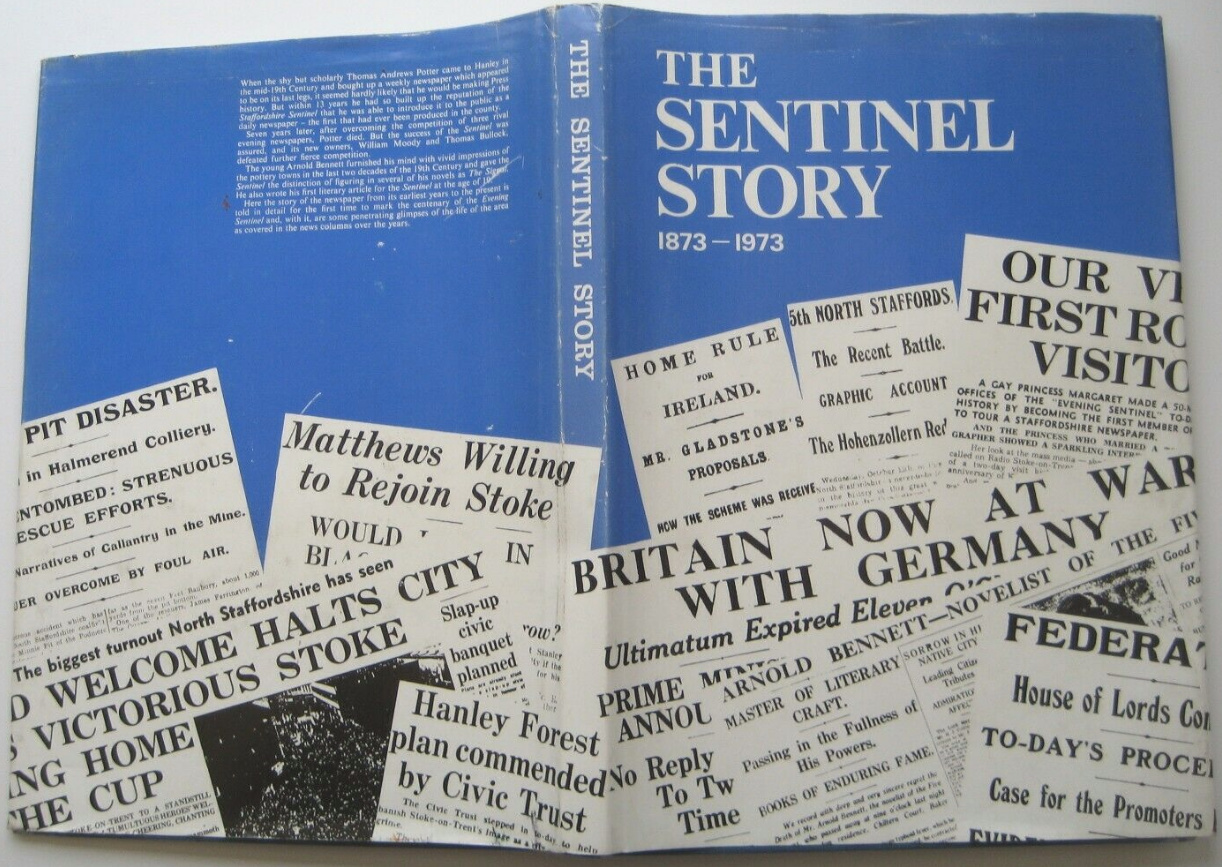
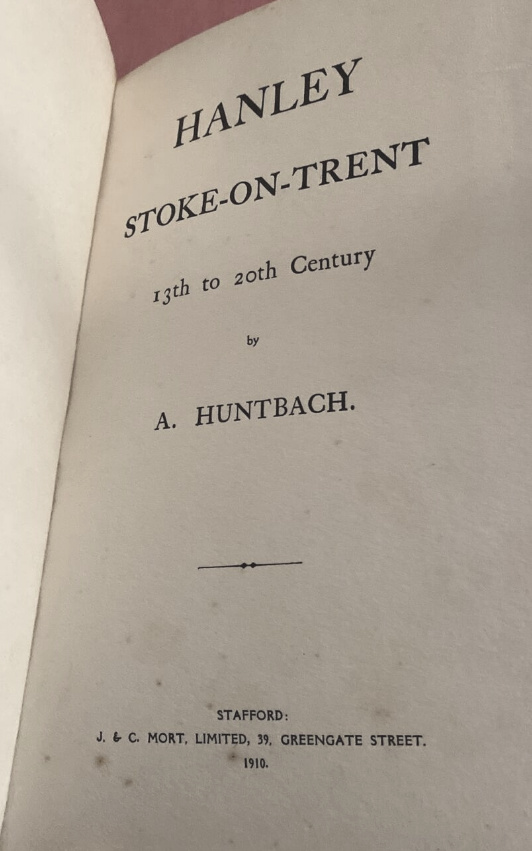
A couple of long-ago local history books I wasn’t previously aware of, which recently popped up on eBay. The 1973 story of the Staffordshire Sentinel, our local newspaper, from the mid 19th century onward. And a 1910 history of Hanley from “the 13th to 20th century”. Neither are on Archive.org.

You don’t know what you’ve got… ’till it’s gone.

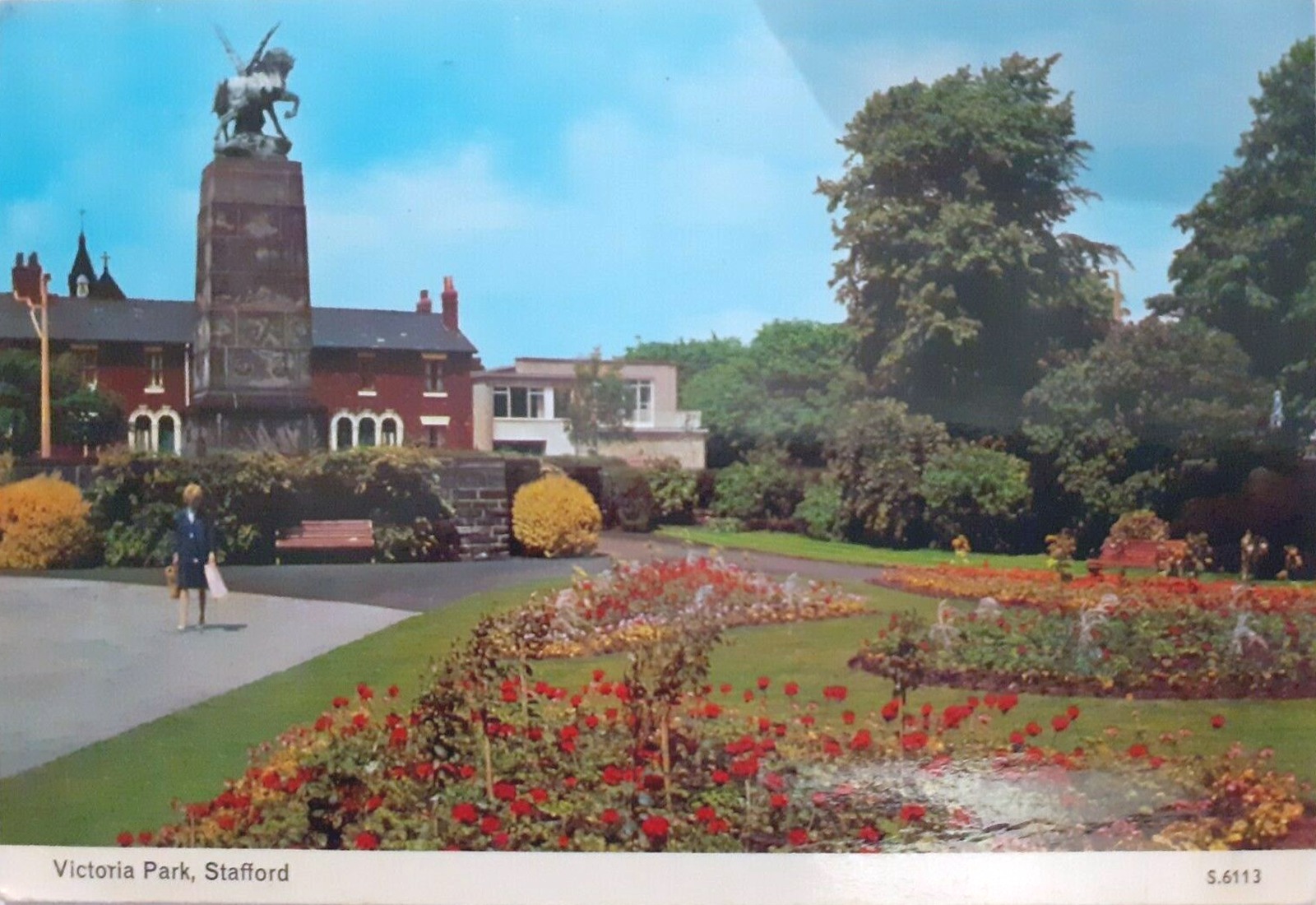
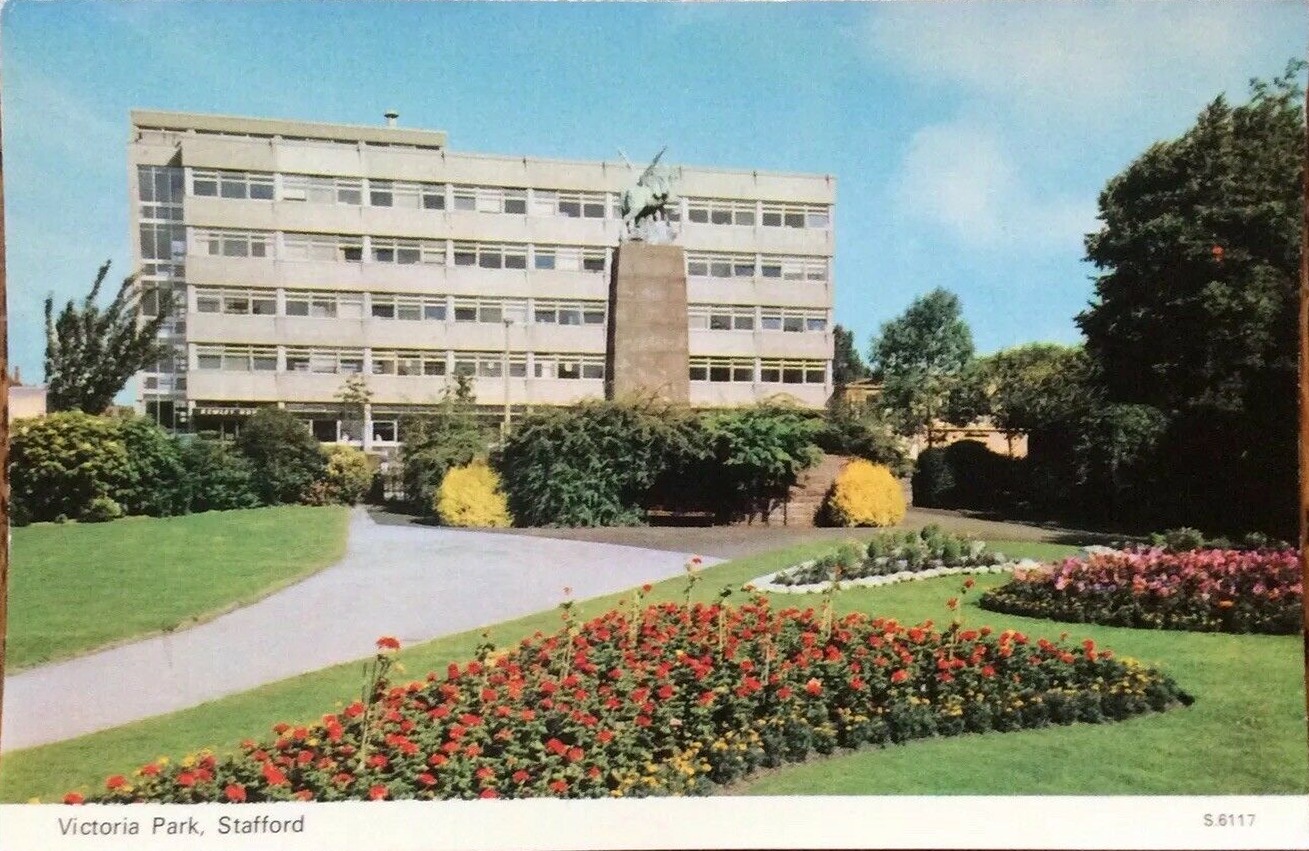
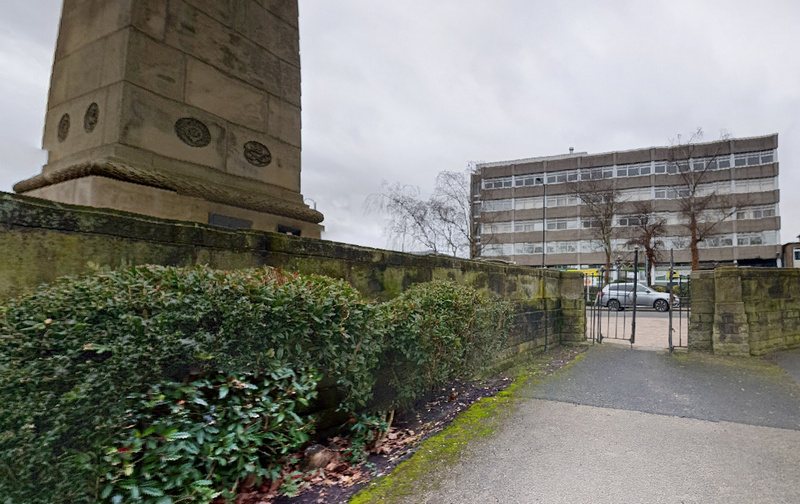
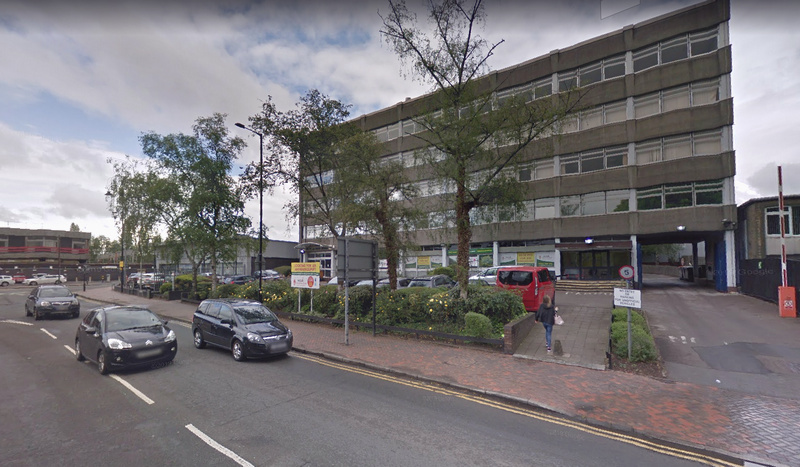
The site of the Staffordshire County war memorial in Stafford.

Before…

And after…

What the heck were the 1970s planners thinking? Were they so bamboozled by ‘architecture-speak’ and vague vision of a socialist utopia, that they were able to fool themselves into think that a concrete slab was somehow an ‘enhancement’ of the site’s character? Or did they just assume that the site was already so ruined by constant heavy traffic (a busy road runs between the park and the new building) and the new modernist British Rail station, that raising such a jarring concrete eyesore next to it wouldn’t matter much? They did at least clean the soot-stained memorial to better match the new building, but the modernist concrete of the office block soon weathered into a mis-matched dullness. It can’t have been the postcard-cheery sight seen above, on a dull grey day in the 1980s.

It’s still there today, accompanying that adjacent all-time classic of modernist concrete-horror, Stafford Station. Only a few scraggy and struggling trees serve to hide it, a bit, in summer.

For those unfamiliar with Stafford, I should add that this is somewhat unrepresentative of the county town, whose centre (a half-mile walk from the station) otherwise still has many appealing qualities for the pedestrian arriving by rail. It’s relatively easy for the savvy walker to avoid most of the modernist grot, both here and in the centre.

Meades on the Midlands

Jonathan Meades, on the Midlands, in his column in the latest edition of The Critic magazine…

My uncle, Harry Turner Meades, was Town Clerk of Burton-upon-Trent from the mid-1950s till the early ’70s. He was a committed Midlander, a seldom acknowledged species which does not advertise itself, nor does it travel. […] He loved, could recognise and mimic [the] many [West Midlands] accents, which are routinely mocked. […] He felt at one with [the Shropshire poet] Housman. He longed to hear Shakespeare’s work spoken as it would have been in 1600.

Being a Midlander is not something you shout about: people will affect not to understand thou. His definition of the Midlands and its precise if often redrawn border with the North was adopted with amendments by his nephew in a film about Birmingham 20 years ago. I attempted to delineate the Irony Curtain that stretches across England from roughly Lincoln to round about Chester. Essentially, with the exception of Liverpool, north of the Curtain it’s all “Me, I speak as I find, I do — I can tell you’re not from hereabouts.” Whilst the Midlands are more, much more, nuanced and modest. Black Countrymen’s stoic uncomplaining humour is at their own expense. Reticence and irony are in the blood.

[… For outsiders, the West Midlands] is a place that’s hurried through, unappreciated, on the way to somewhere else, which reveals itself [to them] by being excitingly self-caricatural, grossly self-parodic. Hence the name of that film: “Heart Bypass” [1998]. Even the inhabitants overlook it. They are perhaps not as centrifugal as they were but the ease with which Midland cities can be escaped is [still] held up as a magnet: Cannock [Chase], Malvern, Clent, Kinver, Lickey, Bredon, Clee…