I’ve found an interesting 1975 article which, in a roundabout way, throws a little more light on possible Sir Gawain routes into North Staffordshire…
Kenneth S. Painter, “A Roman Christian silver treasure from Biddulph, Staffordshire”, The Antiquaries journal: being the journal of the Society of Antiquaries of London, 55, 1, 1975, pages 62-69.
The Archaeology Data Service has a brief summary…
A 4th-century silver spoon with Christian symbols is the survivor of a hoard, originally of four spoons, from Biddulph. Notes by A. W. Franks in 1886 identify the find spot as Whitemore Farm [aka White Moor Farm, between Biddulph and Congleton]. Also discussed are the dating, place of manufacture, symbolism, and the significance of the find place for understanding the local Roman road system.
Sadly The Antiquaries Journal is not online for free, but the article is scanned and on Cambridge Core. There one finds the abstract from the article itself…
In 1972 the British Museum bought a fourth-century silver spoon with Christian symbols. An undated document acquired with the spoon showed that it was the survivor of a hoard from Biddulph, Staffordshire. In 1973 notes made in “January 1886, about the discovery of the spoon, were found in a notebook compiled by A. W. Franks. The newly acquired spoon proves to have been one of a hoard of four spoons found at Whitemore Farm, Biddulph. The find-place of the spoon [and another hoard at Wincle] suggests a possible direct link between Chester and Buxton, while its dating adds to the sparse testimony for late-Roman life in the north-west of the province. The style of the lettering may indicate that the spoon was made in the East Mediterranean, and the Christian symbolism adds to the stock of evidence about the cult in the western Roman Empire.
A recent eBay listing usefully furnishes this main picture of the spoon…
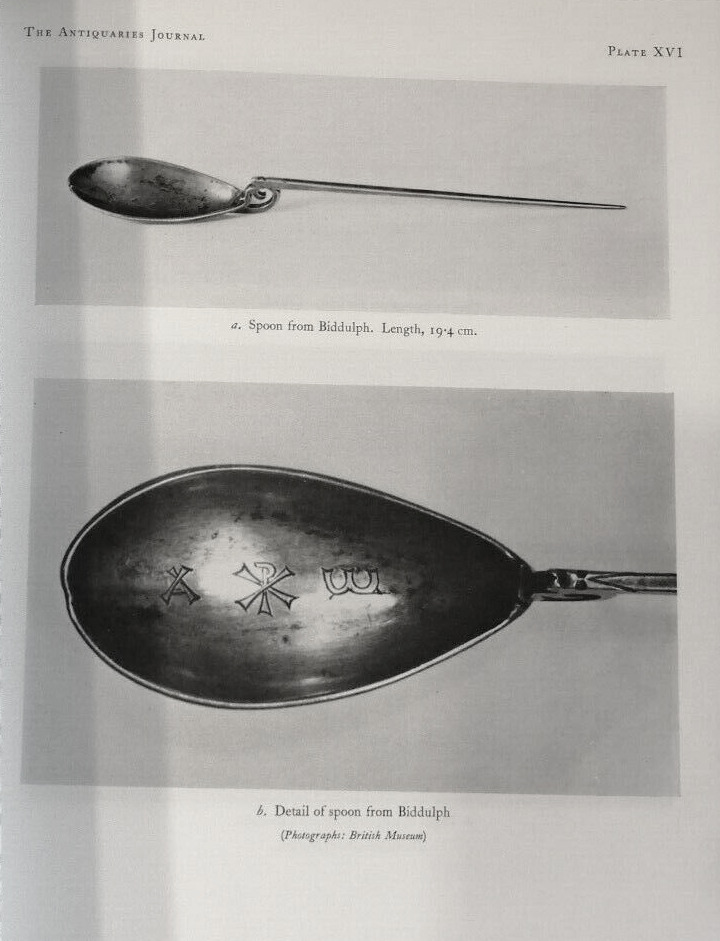
On the local Roman road network the article offers…
“the probable Roman road which crosses Congleton Edge at Nick i’Th’Hill and runs [west] via Astbury to Middlewich [… and, based on other finds] there may well have been a continuation of the Middlewich-Astbury Roman road on towards Buxton … This would have been a convenience … providing more direct communication from Buxton to Chester”.
Another, purely oral, survival from Roman times was published as a note in a book in 1913. The word tallet — meaning the hay-loft above a stable — had survived to the modern period from ancient Roman times…
the English word tallet, which is found to-day in common use in the dialects of Cheshire and all the W.Midl[ands] … The remarkable point about the preservation of this word is that it never once occurs in the whole range of English literature down to the nineteenth century, when Blackmore introduced it in his Lorna Doone. Through all these centuries it has steadily persisted in the spoken language without any help from the world of letters, linking the modern rustic to the early Briton and the subjects of Julius Caesar. (Rustic speech and folk-lore, Oxford University Press, 1913).