Prince Charles’s big Watercolour World charity is starting to bear fruit. The project aims to get all watercolour pictures properly scanned and online without watermarks or other encumbrances. The first batch is now online from The Potteries Museum & Art Gallery. They’re not all local scenes, but a few are and two of these are corkers.
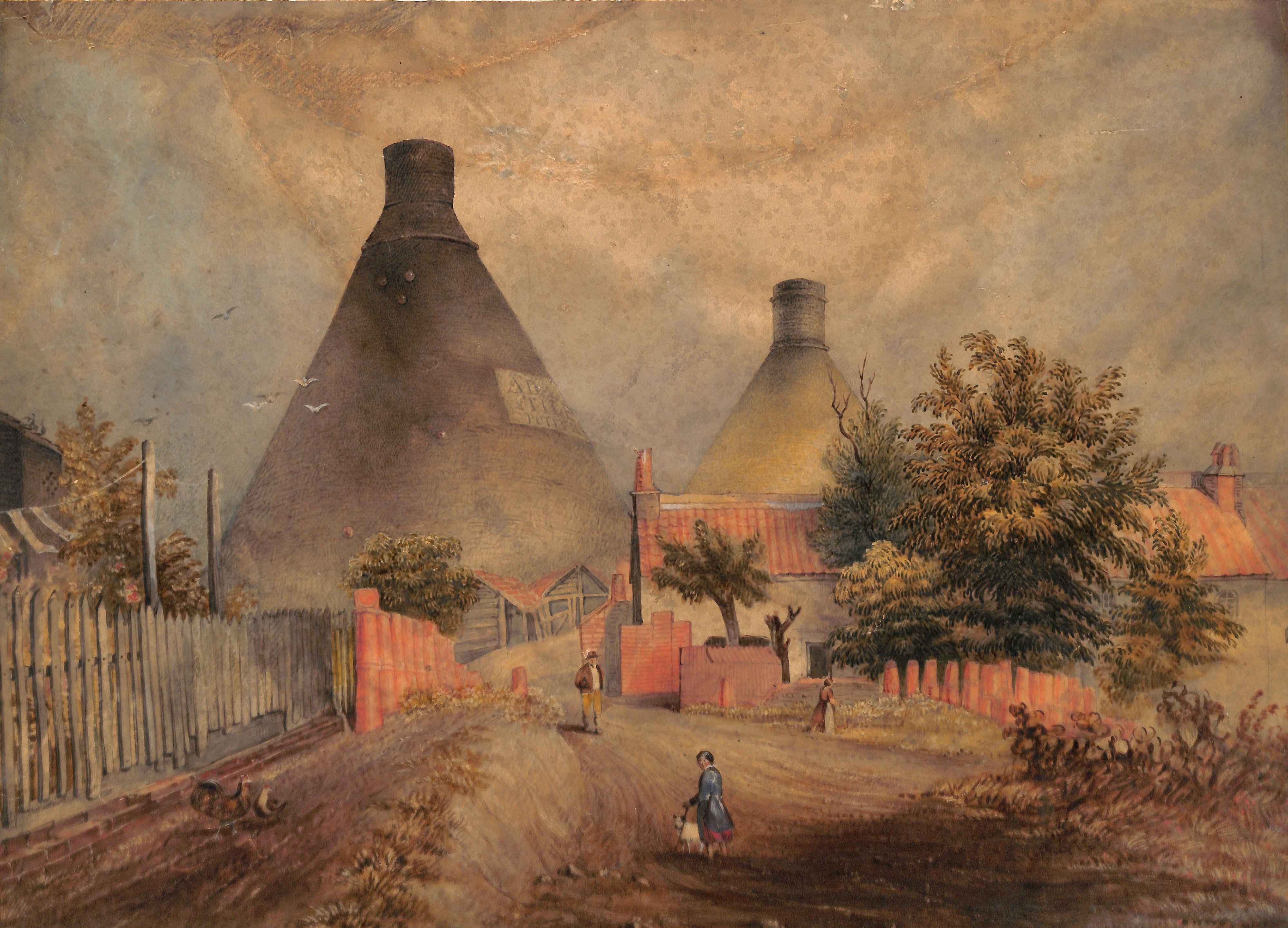
“Adam’s Tile Pottery c.1840-1890” by Anon. According to the un-zoomable map, this was at the top end of the London Road in Stoke, just before the turn up toward Hartshill. Roughly about where the new animation training centre’s going to be, opposite the former Woolworths.
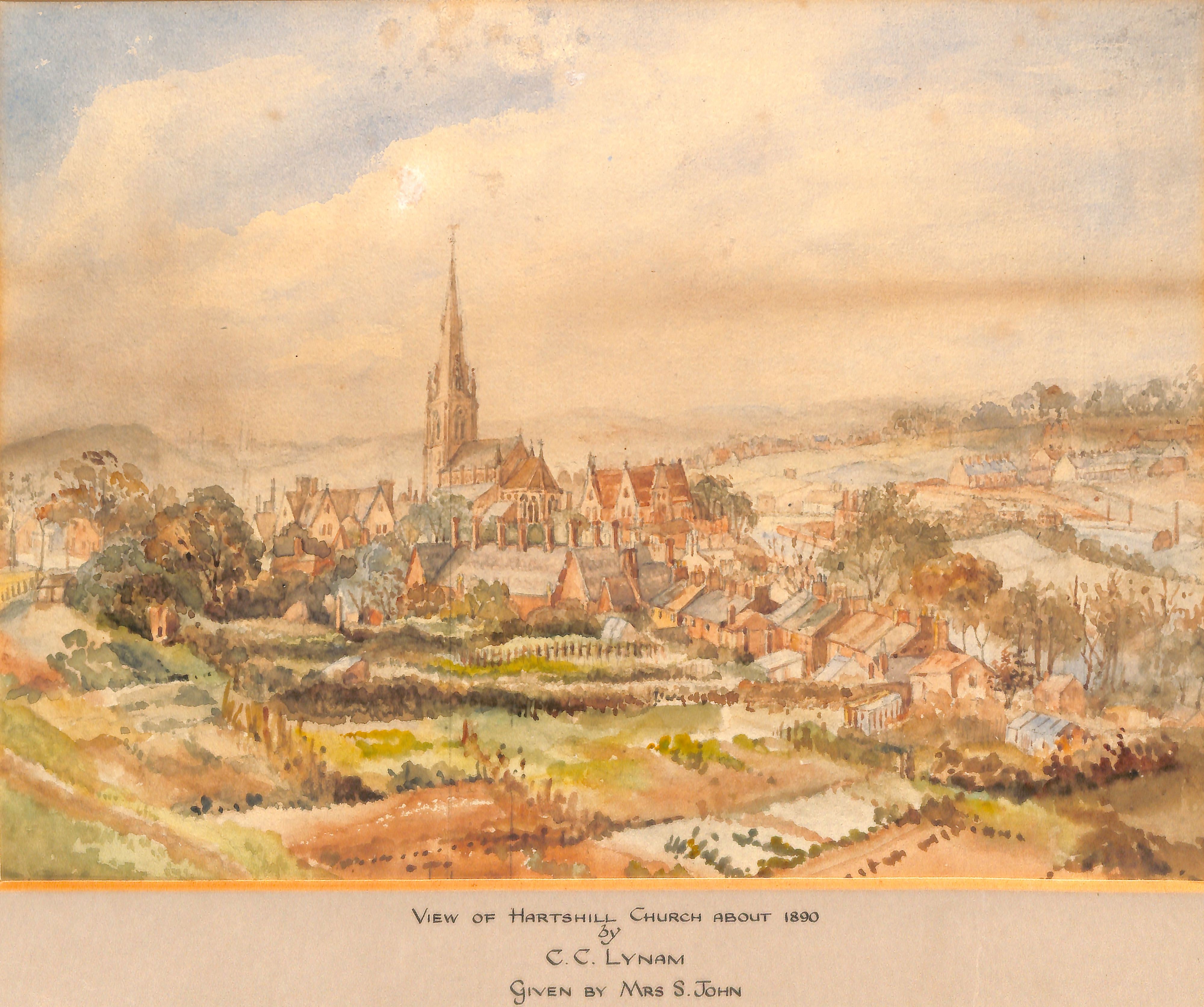
“View of Hartshill Church, c.1890.” Hartshill in Stoke-on-Trent. Looking over the back gardens and tucked-away allotments on the left hand-side of the road up from Stoke, as the road ascends toward the Church and the Jolly Potters pub. Neither building seen on either side of the church is the Vicarage, which is out-of-sight from this perspective except for its chimneys. One imagines a hot-air balloon and a precariously balanced painter, to get this view, or perhaps some temporary wooden scaffolding, or a small flet up in a tall tree.
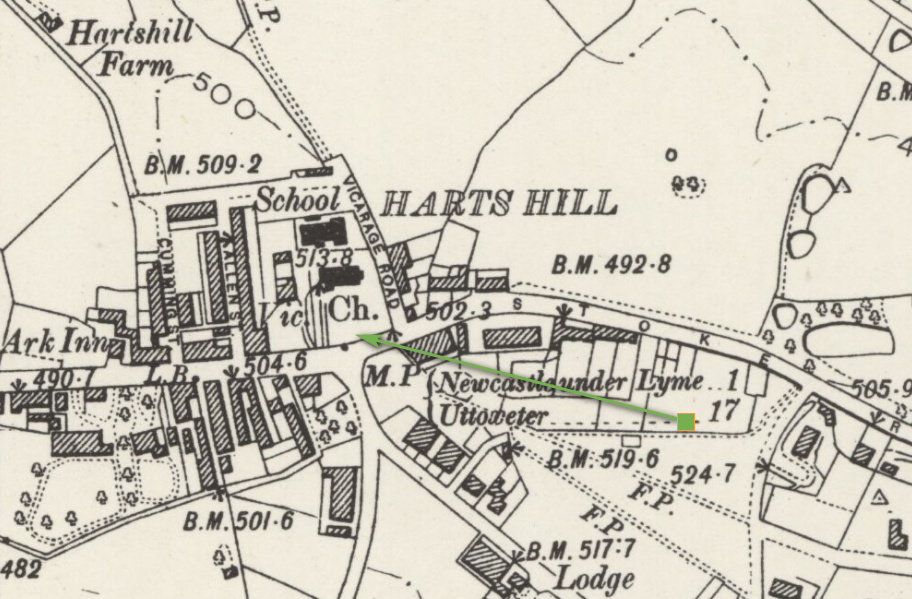
This 1890s maps shows the approx. vantage point of the artist, and his direction of view over to the church.
What of the credit? It is clearly labelled on the picture as by “C. C. Lynam”, although the museum’s record page has the painter as Lucy Lynam. At a guess, perhaps a sketch by C. C. which was then later coloured by his wife Lucy? But assuming the picture itself is correct, then was this “C. C. Lynam” the “Mr. C. Lynam, F.R.I.B.A. [i.e.: an architect]” who wrote the antiquarian essay “A few jottings on some Staffordshire Camps”? Of whom the North Staffordshire Field Club noted in 1892…
“his portrait ought to be painted with a drawn sword in his hand, keeping off the restoring vandals from our ancient camps [the old name for Iron Age hillforts and Roman stations] and beautiful mediaeval architecture, all traces of which he so jealously guards.”
It might be. There was a Lynam family who lived at “The Quarry, Harts Hill, Stoke-on-Trent”, interested in architecture and antiquities. Indeed a Congress of architects took place at their home in 1895…
“The final meeting was held in the garden at the Quarry, Hartshill, about a mile out of Stoke, the residence of Mr. C. Lynam, where, beneath an ancient timber roof now covering a large pavilion, the concluding business of the Congress took place”.
The Quarry was “on the corner of Hartshill Road and Quarry Road”, meaning that it was only a few yards from the vantage point taken by the artist of the above picture. One wonders if the roof of the “large pavilion” in timber might have had a viewing tower from which the picture above was painted?
One can also note that a Stoke-on-Trent architect was central to Arnold Bennett’s famous story “The Death of Simon Fuge” (written March-April 1907).
Anyway, the picture is certainly from the family of the architect Charles Lynam, who designed many of the better late Victorian buildings in the Potteries, such as the Public Library down in Stoke. Although I can find no trace of him ever having used a middle-name starting with C., so I can’t quite be sure that the “C.C.” of the picture does not indicate his son. He had 14 children, and apparently his eldest son was a Charles C. Lynam, aged in his 30s when the picture was painted. My feeling is that the picture’s record sheet mis-attributes it, and that this younger “C.C. Lynam” was the painter.
Watercolour World also has a geo-located map, which reveals a picture of “Long Bridge, near Shugborough” near Stafford. This being the Essex Bridge, with Haywood glimpsed on the left.
The British Museum also contributes “Untitled (Mow Cop)” by John Charles Robinson, a rather pleasing massing of mossy foliage, lichened rocks and distant views, in which the artist avoids the folly castle entirely.