Now in expanded ebook – Strange Country: Sir Gawain in the moorlands of North Staffordshire

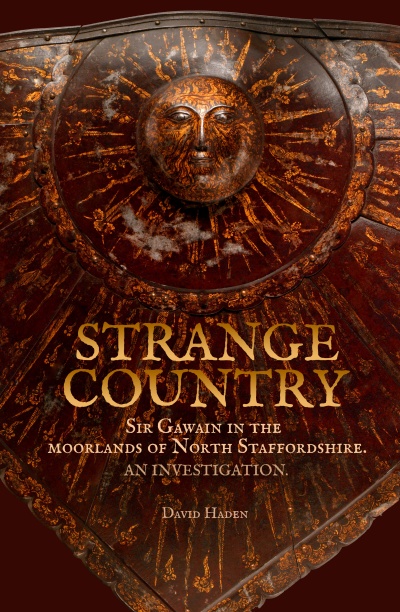
An expanded ebook of my book Strange Country: Sir Gawain in the moorlands of North Staffordshire, an investigation is now available on Amazon, at an affordable price. Sir Gawain and the Green Knight, you’ll recall, is one of the most famous supernatural tales in English literature.

This book offers a concise overview of the existing Gawain research relating to North Staffordshire, and then adds a wealth of new detail and facts drawn largely from previously overlooked sources. The case is clearly made that one of the most famous works of English literature belongs to North Staffordshire. Obvious new candidates for both the Gawain-poet’s patron and the Gawain castle are suggested, and these are found to fit naturally and almost exactly when compared with the expected dates, castle features, dialect location, social status and life-story. A wealth of surrounding detail is also explored, such as: the history and role of the King’s Champion; English contacts with full-blooded paganism during the Prussian crusades; the two lavish courts at Tutbury; and the history of the Manifold Valley. This ebook is well illustrated and copiously referenced with linked round-trip footnotes.

Available to buy now!

The show goes ever on…

I thought the ‘Tolkien in Staffordshire’ touring exhibition had finished touring. But the Express & Star today brings news, URL-dated as 27th May 2019, that it’s just opened at Cannock Chase Visitor Centre. They’re not very clear on specifics though, and offer no finish-date.

Initially I wondered if this report was actually a press-release re-writer bot, erroneously re-writing a press-release from 2018? The website at staffordshiregreatwar.com has died and the Staffordshire Council events pages are giving me 404s, so no luck there in terms of discovering more.

But a recent press report on the biopic movie, in the neighbouring Shropshire Star, mentions the exhibitions and gives an inkling as to the current situation for the show…

“Part of that new exhibition has now found a new home at the Great War Hut at the Marquis Drive Visitor Centre [on Cannock Chase] where people will be able to visit every weekend, and Bank Holidays”

I suspect that that’s it, and that it’s now opened as a cut-down permanent exhibit, perhaps with the information boards in leaflet form.

Another Tolkien biopic review

Another review of the new Tolkien biopic has landed, and this time it’s a long one that’s not behind a paywall. Tolkien — A Review is pithy and very well-written take, whose summary line might well be…

the film’s connect-the-dots literalism obscures and diminishes the daunting richness of creativity behind Tolkien’s construction of his Middle Earth fantasies

The reviewer sees not just a minimization of his Catholic faith, as some other reviews have suggested without specifics, but an outright blanking of it. I guess this might have seemed to the scriptwriter to be somewhat justified by the historical record, since the practice of his faith (if not his actual faith) does seem to have been rather lost in the initial boisterous phase of his encounter with Oxford. Specifically he was somewhat cursory or hasty in observance, from October 1911 until very early in 1913. Carpenter’s biography states that Tolkien said his first years at Oxford saw… “practically none or very little practice of religion”. This does not mean that faith had died in him, but rather that his observance and church attendance was probably minimal at that time. Nevertheless, when he did attend it may have meant a good deal to him. The key evidence for this is that Tolkien required that Edith become a Catholic for him.

It is also true that Tolkien’s very late letter to his son Michael (Letters, No. 250, 1963) recalled that throughout the busy 1920s he “almost ceased to practice” Catholicism. But letting one’s formal practice lapse is of course not quite the same as letting one’s belief lapse. Nor does it indicate that he ceased to cherish the various church rituals in his memory and on special occasions such as Easter. But here is another indication that during the early and formative period of the legendarium he was not always as suffused with a burning nimbus of Catholicism, as some modern adherents of the faith might now wish him to have been. Interestingly, this implies that Tolkien, at periods during the 1910s and 1920s, may thus have been more open to playfully holding in his mind certain textual pagan concepts and alluring ‘tricksy lights’ emanating from rare pagan perhaps-survivals, the better to try to get at the nub of the language and the meanings involved.

But back to the review, which bluntly notes that the portrayal of his wife-to-be Edith… “skirts perilously close to hectoring Virginia Woolf-style feminism”. A portrayal which, so far as I’m aware, goes against her real character.

The reviewer stresses the Worcestershire angle a couple of times, in a rather boosterish way — but appears unaware of the tight conjunction of several county lines as they enter Birmingham, and the local patriotism that set Birmingham above county origin. My guess is this is perhaps a function of the movie having apparently set up a sharp and dramatic dichotomy between a Mordor-like urban Birmingham and its Shire-like rural fringes, and as such may be an example of the way that a film can skew one’s perceptions of the topography of a place. Perhaps it’s also a function of trying to map the elder Tolkien’s understanding of his family and place-histories in 1941 (“any corner of that county…”) back onto what the teenage Tolkien would have understood of the same. Again one senses a subtle distortion perhaps induced by Tolkien-promoters, this time the ‘it was all inspired by Moseley’ brigade in Birmingham.

The reviewer also rather lumpenly suggests an intended conflation of Gandalf’s “Stand, men of the West!” with the folk of the West Midlands. Ouch. What was that you were saying about “connect-the-dots literalism”? Still, it’s another useful and thoughtful review and in a high-quality journal.

As for Birmingham, one can observe that South Birmingham (there is a clear divide between ‘north’ and ‘south’ of the city) is and was surprisingly leafy, and yet we know that the young Tolkien walked to the centre and back, to school each day. The family could not afford the tram fare for a long while, and only later did he move up to be near the Oratory. Thus as a youngster he did have the formative experience of walking through the industrial sections (Sparkbrook, Deritend) from a more semi-rural outskirt area, which he would have had to do to reach New St. in the city centre. He would also have walked up to New St., on the final approach, through the morning-markets area (Bull Ring, rag market and meat markets) on the southern edge of the city centre. Later, he and his brother cycled (“getting on our bikes to go to school in New Street”, Letters).

Dimitra Fimi reviews the new Tolkien biopic

Dimitra Fimi’s sympathetic review of the new ‘young Tolkien’ biopic feature-film has appeared in the latest TLS ($ paywalled). Fimi opens by picking up on some of the many factual errors, omissions and storytelling shortcuts, and notes that Tolkien’s Catholic faith is minimised in favour of making space instead for musings on the nature of language and Philology. Lucky Philology.

I read that one of his tutors at Oxford, the great Joseph Wright, appears and is played by Derek Jacobi no less. I’m sure Wright would have been tickled by that. I hope Jacobi did the correct accent rather than played it as Gandalf, and I assume he got the accent right. As for the other characters, Tolkien’s future wife Edith apparently becomes a sharp intellectual (she wasn’t) and his friend G.B. Smith is made out to be gay (he wasn’t, so far as I know).

As with several other expert reviewers of the film, Fimi concludes that it is best understood as being about a Tolkien-like character with many of the same interests, but not the real Tolkien. Regrettably this is now part of how popular culture works, and every well-loved and/or real character is taken and mutated into a changeling replacement.

Fimi ends the review by pointing out that the film does broadly get the emotional arcs about right, and it may thus be useful in nudging some of the more intelligent and sympathetic members of a new generation toward a deeper appreciation of Tolkien in his historical context…

It opens the door for many more potential readers and viewers to appreciate Tolkien us a writer of his time, shaped as much by his experiences and historical context, as by the literary tradition he knew so well as a scholar.

I’ll be interested in how well the film portrays Birmingham, Oxford and mid Staffordshire, but no review I’ve yet seen is from someone able to comment on the topographic and architectural aspects of the film-making.

I haven’t seen the film yet, and I’m not even sure it’s managed to wend its way to the cinema here in Stoke-on-Trent. I shall probably hold off seeing the DVD (extended cut?) until my book on the young Tolkien is out, so as not to risk any ‘skewing’. Apparently there’s another biopic on the same ‘young Tolkien’, which hasn’t yet been released. So this film is just the first of two.

From velocipede to motorcycle

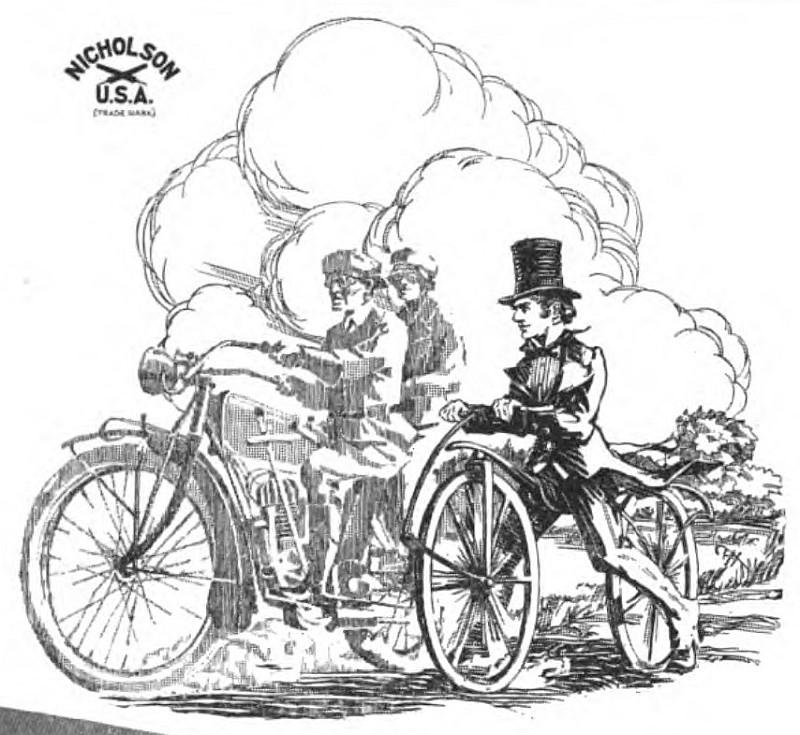
A nice 1920s illustrator of the rapid shift, in three generations, from the first push-along velocipede bicycles (1860s-1870s) to efficient elegant motorcycles (1920s) and the paved roads to ride them on. My family history followed the same trajectory, from making bicycles to making and refining motorcycles.

Tolkien’s Worlds: The Places That Inspired the Writer’s Imagination

Announced and on Amazon UK now, a new book-length survey of Tolkien’s places. It’ll be by John Garth, with the cooperation of the Tolkien estate. We’re going to have to wait a bit for it to appear, though, as Princeton University Press won’t be publishing Tolkien’s Worlds: The Places That Inspired the Writer’s Imagination until 17th March 2020 June 2020.

If every place in his life were to be covered then that’s a lot of ground to cover, and at just 192 pages (inc. pictures, bibliography, index etc) I’d guess the book might then be more of a gazetteer with short precise entries and inset mini-maps.

But I suspect, from the title, that it’ll just be the places which can be definitely be 100% tied to literary inspiration. In which case I can see how it could be done in the page-count. I guess the book may also be oversize, in which case there would be room to be more expansive. Possibly it’ll be a mix of the two approaches, with an expansive focus on the inspiring places, and a tighter but exhaustive listing of all the others — maybe each with a 1-to-5 ‘probability ranking’ for the various local claims of possible inspiration.

I assume Princeton University Press will have a crack team of picture researchers on such a prestigious job, so it’ll be interesting to see what they come up with.

Lulu.com goes into blocking overdrive

In my day, a book of horror stories by H. P. Lovecraft was on the school’s official ‘book pick’ brochure for 12 year-olds. In fact that was how I first encountered him…

Today, on Lulu.com, the hand-wringing prudes say “no” to accessing any book tagged with ‘Lovecraft’, even the many scholarly works on the master…

Prince Charles’s Watercolour World – the first fruits

Prince Charles’s big Watercolour World charity is starting to bear fruit. The project aims to get all watercolour pictures properly scanned and online without watermarks or other encumbrances. The first batch is now online from The Potteries Museum & Art Gallery. They’re not all local scenes, but a few are and two of these are corkers.
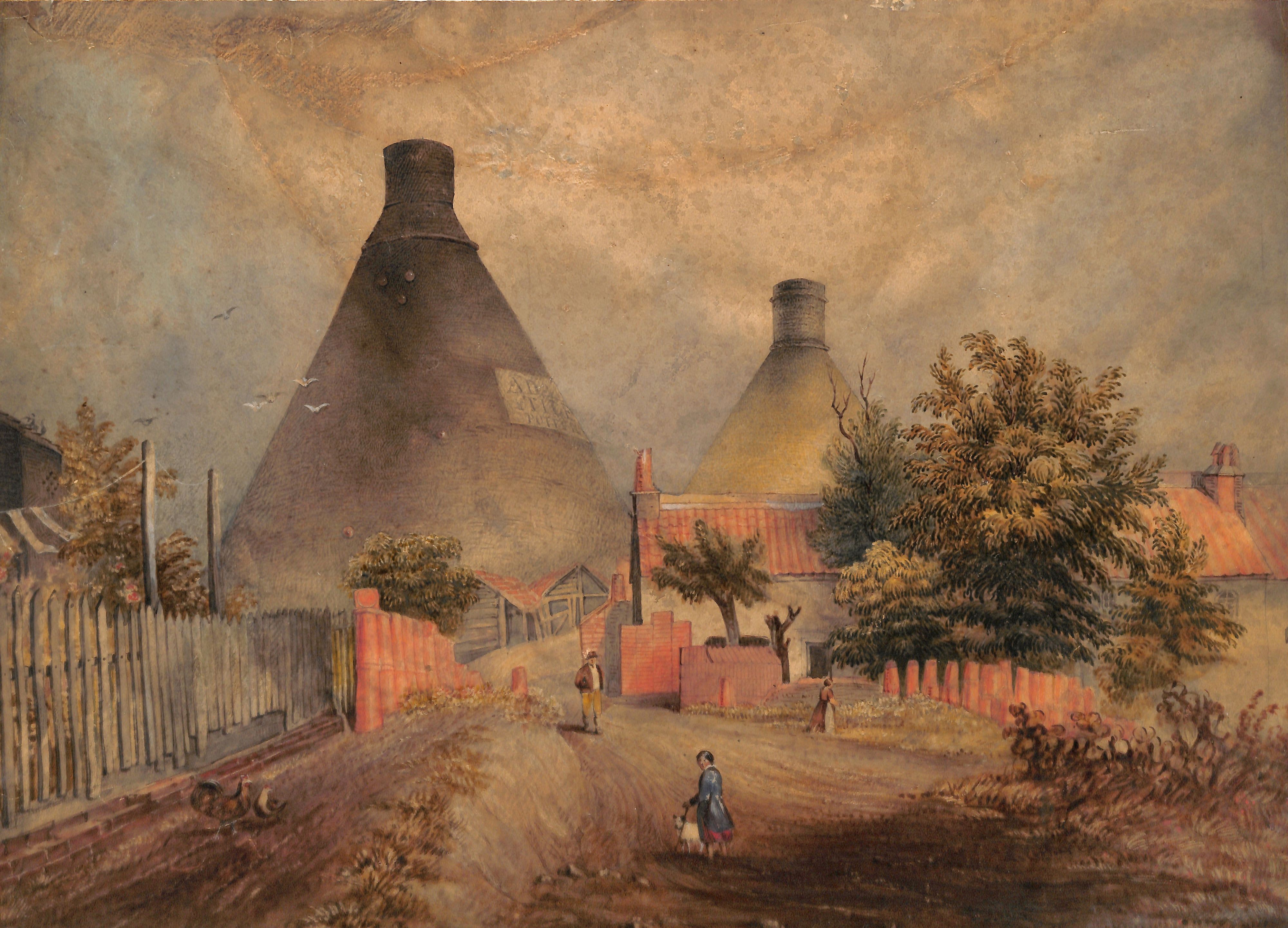

“Adam’s Tile Pottery c.1840-1890” by Anon. According to the un-zoomable map, this was at the top end of the London Road in Stoke, just before the turn up toward Hartshill. Roughly about where the new animation training centre’s going to be, opposite the former Woolworths.
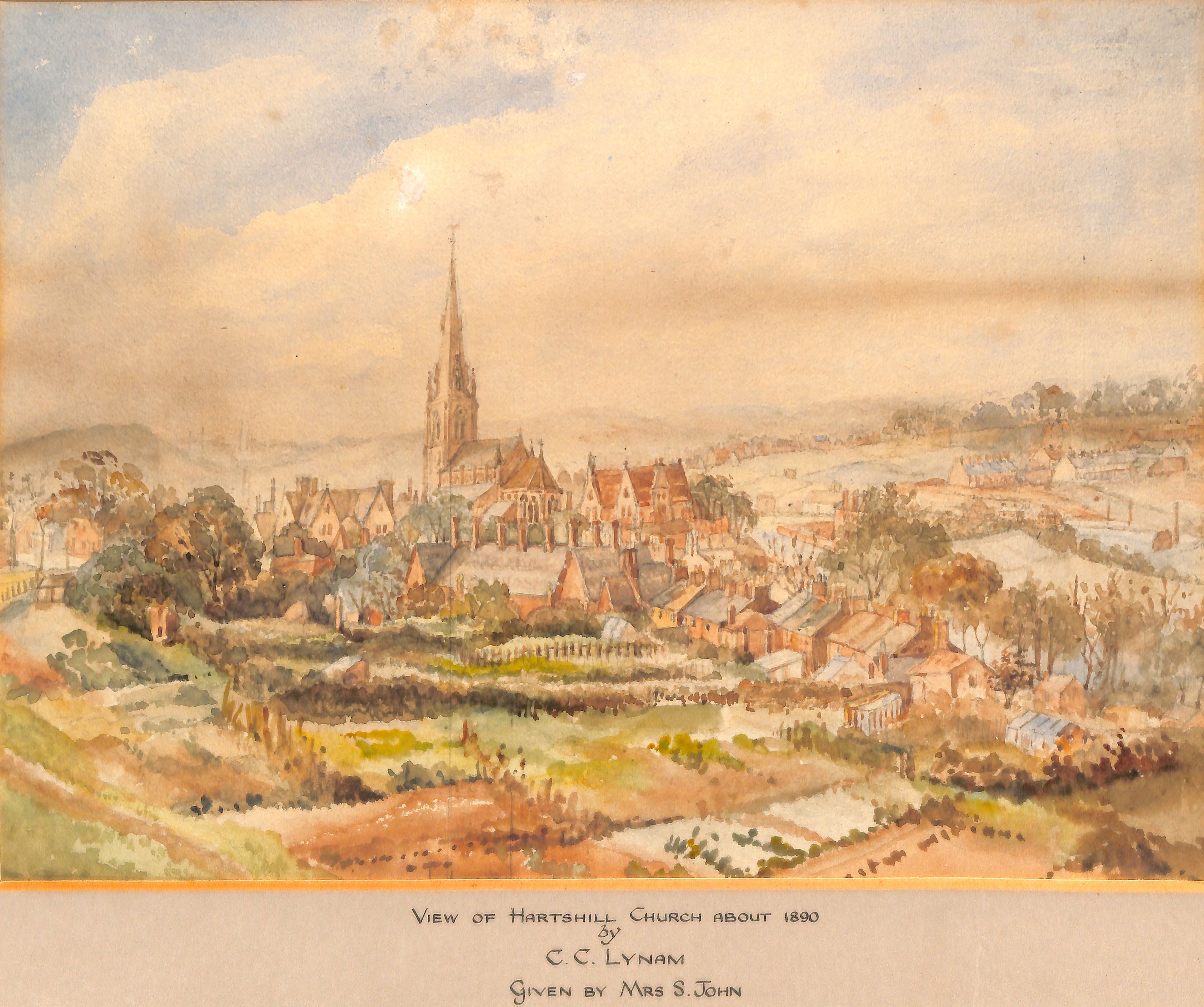

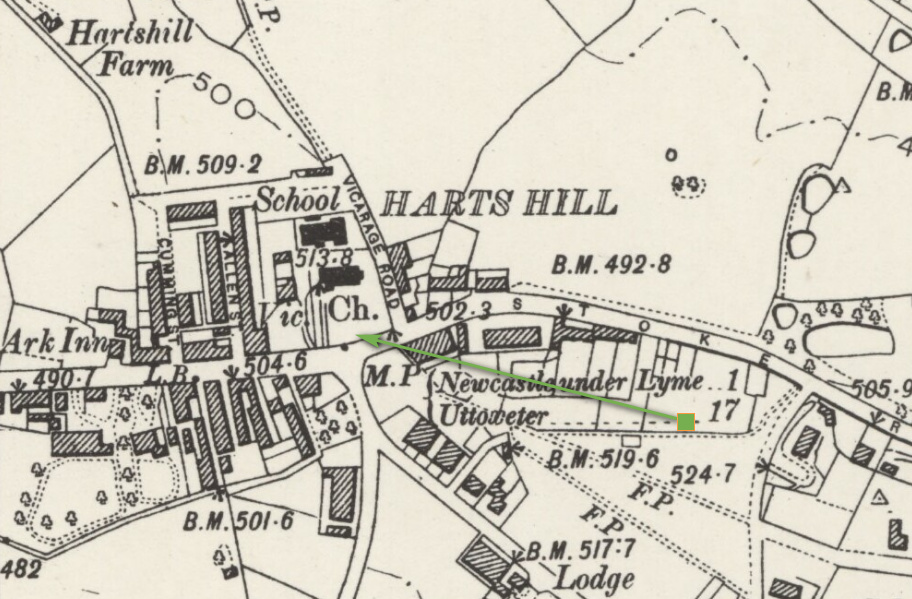
“View of Hartshill Church, c.1890.” Hartshill in Stoke-on-Trent. Looking over the back gardens and tucked-away allotments on the left hand-side of the road up from Stoke, as the road ascends toward the Church and the Jolly Potters pub. Neither building seen on either side of the church is the Vicarage, which is out-of-sight from this perspective except for its chimneys. One imagines a hot-air balloon and a precariously balanced painter, to get this view, or perhaps some temporary wooden scaffolding, or a small flet up in a tall tree.

This 1890s maps shows the approx. vantage point of the artist, and his direction of view over to the church.


What of the credit? It is clearly labelled on the picture as by “C. C. Lynam”, although the museum’s record page has the painter as Lucy Lynam. At a guess, perhaps a sketch by C. C. which was then later coloured by his wife Lucy? But assuming the picture itself is correct, then was this “C. C. Lynam” the “Mr. C. Lynam, F.R.I.B.A. [i.e.: an architect]” who wrote the antiquarian essay “A few jottings on some Staffordshire Camps”? Of whom the North Staffordshire Field Club noted in 1892…

“his portrait ought to be painted with a drawn sword in his hand, keeping off the restoring vandals from our ancient camps [the old name for Iron Age hillforts and Roman stations] and beautiful mediaeval architecture, all traces of which he so jealously guards.”

It might be. There was a Lynam family who lived at “The Quarry, Harts Hill, Stoke-on-Trent”, interested in architecture and antiquities. Indeed a Congress of architects took place at their home in 1895…

“The final meeting was held in the garden at the Quarry, Hartshill, about a mile out of Stoke, the residence of Mr. C. Lynam, where, beneath an ancient timber roof now covering a large pavilion, the concluding business of the Congress took place”.

The Quarry was “on the corner of Hartshill Road and Quarry Road”, meaning that it was only a few yards from the vantage point taken by the artist of the above picture. One wonders if the roof of the “large pavilion” in timber might have had a viewing tower from which the picture above was painted?

One can also note that a Stoke-on-Trent architect was central to Arnold Bennett’s famous story “The Death of Simon Fuge” (written March-April 1907).

Anyway, the picture is certainly from the family of the architect Charles Lynam, who designed many of the better late Victorian buildings in the Potteries, such as the Public Library down in Stoke. Although I can find no trace of him ever having used a middle-name starting with C., so I can’t quite be sure that the “C.C.” of the picture does not indicate his son. He had 14 children, and apparently his eldest son was a Charles C. Lynam, aged in his 30s when the picture was painted. My feeling is that the picture’s record sheet mis-attributes it, and that this younger “C.C. Lynam” was the painter.


Watercolour World also has a geo-located map, which reveals a picture of “Long Bridge, near Shugborough” near Stafford. This being the Essex Bridge, with Haywood glimpsed on the left.

The British Museum also contributes “Untitled (Mow Cop)” by John Charles Robinson, a rather pleasing massing of mossy foliage, lichened rocks and distant views, in which the artist avoids the folly castle entirely.
Tolkien, time and stars

Anna Smol usefully rounds up the papers set to be presented Tolkien at Kalamazoo 2019. Of interest to me, re: my forthcoming book, and being noted here for my future reference (I’ll see if I can find open access versions in nine months or so) are…

* Two on time…

“Of Niggle and Ringwraiths: Tolkien on Time and Eternity as the Deepest Stratum of His Work”. Robert Dobie.

“The Eschatological Catholic: J. R. R. Tolkien and a Multi-Modal Temporality”. Stephen Yandell.

* Three on stars…

“Who maketh Morwinyon, and Menelmacar, and Remmirath, and the inner parts of the south (where the stars are strange): Tolkien’s Astronomical Choices and the Books of Job and Amos.” Kristine Larsen.

“‘It Lies Behind the Stars’: Situating Tolkien’s Work within the Aesthetics of Medieval Cosmology”. Connie Tate.

“Cynewulf, Copernicus, and Conjunctions: The Problem of Cytherean Motions in Tolkien’s Medieval Cosmology”. Kristine Larsen.

* And one of personal hobbit-ish interest…

Queer Hobbits: Language for the Strange, the Odd, and the Peculiar in Tolkien’s The Lord of the Rings. Yvette Kisor.

Archaeologies and Cosmologies in the North

Relational Archaeologies and Cosmologies in the North, coming soon. Some dunderheaded cover-bot at Routledge has given it a most misleading cover photo of a moose crossing a road. Either they’re hoping for the Northern Exposure crowd, or the bot’s auto-semantics module confused animistic with animal.

Surely Routledge makes enough profit on its over-priced academic books that it can afford some proper cover designers? But apparently not. It’s time that authors started demanding oversight of their cover designs at academic publishers, I’d suggest, as the trend toward robo-designers increases.

Anyway, despite the misleading cover, the book is actually a survey of… “animistic-shamanistic cosmologies and the associated human-environment relations from the Neolithic to modern times” in the far-north, which incorporates the latest thinking and discoveries. Looks fascinating. No ebook, but the paperback looks somewhat affordable at about £30. It’s due toward the end of July 2019.