The ebooks of the latest edition of the J. R. R. Tolkien Companion and Guide are now rather more affordable than they were at launch…
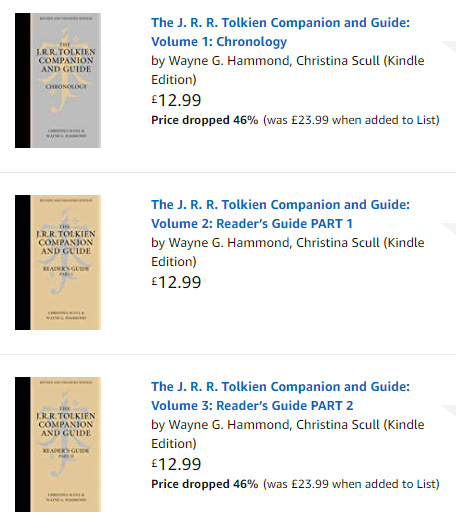
I still can’t afford £39, but this work is looking more feasible to obtain at some point.
The ebooks of the latest edition of the J. R. R. Tolkien Companion and Guide are now rather more affordable than they were at launch…
I still can’t afford £39, but this work is looking more feasible to obtain at some point.
Considering an expanded ebook edition of my June 2018 book on Sir Gawain, I undertook a quick hunt for the scholarly work produced since then. I came back with a plump catch-bag of new scholarly works on the (North Staffordshire) hunting scenes in Sir Gawain:
* ABSTRACT: The Hunting Scenes in Sir Gawain and the Green Knight Revisited…
“this essay explores the hunt scenes in terms of the poet’s representation of the hunted animals — the deer, boar and fox — and demonstrates that the descriptions of the hunt are designed to arouse our compassion for the quarries. The sympathy for the hunted serves to both clarify and highlight the direct connection between Gawain and the hunted animals.”
* OPEN ACCESS: The human animal: strange transformations in fourteenth-century Middle English romance…
“the second chapter explores the depiction of Sir Gawain’s courtly test as a hunting sequence all its own in which Gawain ultimately skins himself of his hide.”
* OPEN ACCESS: Sir Gawain and the Green Knight y la restauracion literaria de un heroe Arturico: de las artes venandi al romance caballeresco (in Spanish)…
“the narrative functions assigned by the poet to the long descriptions of the hunting adventures of Sir Bertilak, pointing to the close relationship that links it to the artes venandi composed during the period and the models of virtue and masculinity proposed by its texts.”
* SHORT ABSTRACT: Hunting and fortune in the Book of the Duchess and Sir Gawain and the Green Knight…
“Some Middle English narratives juxtapose representations of hunting and histories of aristocratic loss. The Book of the Duchess and Sir Gawain and the Green Knight redirect anxieties about the contingency and precariousness of lordly advantage in a world that sometimes seems to be ruled by Fortune.”
* OPEN ACCESS: A detailed ‘in progress’ 2018 paper on the seasonal feasting that followed the hunt, Feasts and feasting in the fourteenth century — Gawain and the Green Knight at Christmas.
* ABSTRACT: Tangentially relevant to the topic is a new and partly Tolkien-related article which ambitiously considers… “to what extent Germanic mythology may inform the representation of magic, nature, and wisdom in Sir Gawain“, “Etaynez þat Hym Anelede of þe Heӡe Felle”: Ghosts of Giants in Sir Gawain and the Green Knight. (Broadly plausible on the ‘Thor and the giants’ — Gawain similarities, and builds on the 2013 article “A Scandinavian Link to Sir Gawain and the Green Knight?”).
* OPEN ACCESS: Also a 2017 article, Sounding the Hunt in Sir Gawain and the Green Knight on the sounds of Gawain.
“Mystery surrounds ‘strange’ flash of electric blue light in skies above Stoke-on-Trent”…
“It was a green-turquoise flash. The lights in the house flickered”.
Yes, I noticed that too, a bit further down the valley at Etruria. Sometimes there’s the flash of an ambulance going past on the distant road, but it wasn’t like that, it was higher in the sky and more diffuse, a different colour, and not with such a regular pulse.
There was a possibly related phenomenon in 1896…
“The Earthquake of December 1896”: the North Staffordshire Naturalists’ Field Club, Annual Report and Transactions, 1897 offered a collation of reports from all around the district of the “earth-wave”. “Dr. McAldowie estimated that about two-thirds of the adult inhabitants of Stoke were roused [in their beds] by the shock.” Also reports of atmospheric disturbances, flashes of light like lightning. The Revd. G. T. Ryves was investigating the strange local reports of ‘lightning’, but he died before his investigations could be completed. A national report on the “luminous phenomena” was published by another researcher in the Meteorological Magazine, and a summary list is given of the observed phenomena noted in the article: at Bridgenorth the “streets seemed to be on fire”. A large collation of press notices of the earthquake is given, drawn from further afield.
This is a re-posting from my H.P. Lovecraft blog, Tentaclii. When posted the blog was private, but I thought this post should also be public. This seemed the most suitable place to post it in public.
S. T. Joshi’s blog has two new posts, both on the passing of Wilum Pugmire — delectable author and painstaking student of H.P. Lovecraft’s works. Joshi’s first post is a tribute, “My Friend, Wilum Pugmire”, and the most recent is “More on Wilum”.
The latter post brings news of a Memorial Event on Saturday 4th May 2019.
Joshi’s second post also usefully points to Brian Keene’s podcast ‘The Horror Show’, where the most recent episode is a “podcast full of tributes to Wilum”.
There are blog tributes to be found from his good friend David Barker, reporting the news that Lovecraftian author W. H. Pugmire has died. John D. Haefele sent an in memoriam statement to Don Herron’s blog and Herron himself posted Mort: Hopfrog Nevermore. Bobby Derie has penned the tribute W. H. Pugmire; and William Tea has posted a short goodbye. Possibly there are others, though I haven’t found them, and there will surely be more to come over the next few weeks and months.
The science-fiction news magazine Locus swiftly published a short obituary W.H. Pugmire (1951-2019) and his Wikipedia page has full details of his life and works. The Classic Horror Film discussion board has a less dry and, I’d like to think, rather more Pugmirish memory of him which seems fitting to end this post on. I only knew him through his audio interviews and some of his YouTube book reviews, and I don’t think he read my blog Tentaclii, but from hearing that audio I have the feeling that he might have enjoyed this being re-told (by one ‘Gef the talking mongoose’)…
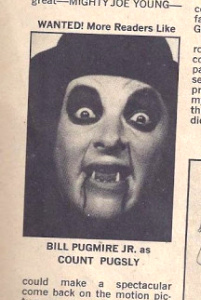
In probably his late teens & 20s he worked at an attraction in Seattle called Jones’ Fantastic Museum…
“For 13 years the museum featured a real live vampire named Count Pugsly who roamed around scaring children and adults alike, even outside the museum. Sometimes he would appear to be a mannequin, standing still until an unsuspecting visitor stepped in front of him. As soon as the realization struck the visitor that no activating floor mat was there, he would walk towards them, often eliciting loud screams of fright.”
That was Wilum.
ShakespearesWords.com is now in version 3.0 (Summer 2018). A complete easy-to-use glossary of the words used and their original meanings.
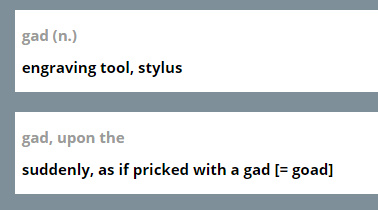
No ‘original pronunciation’ audio yet, for each word, but apparently that’s coming in due course.
Finland’s Minna Sundberg has a super new illustrative chart of the “Nordic Languages in the Old World Language Families”. The amount of leaves indicate the size of the current-day population speaking that language.
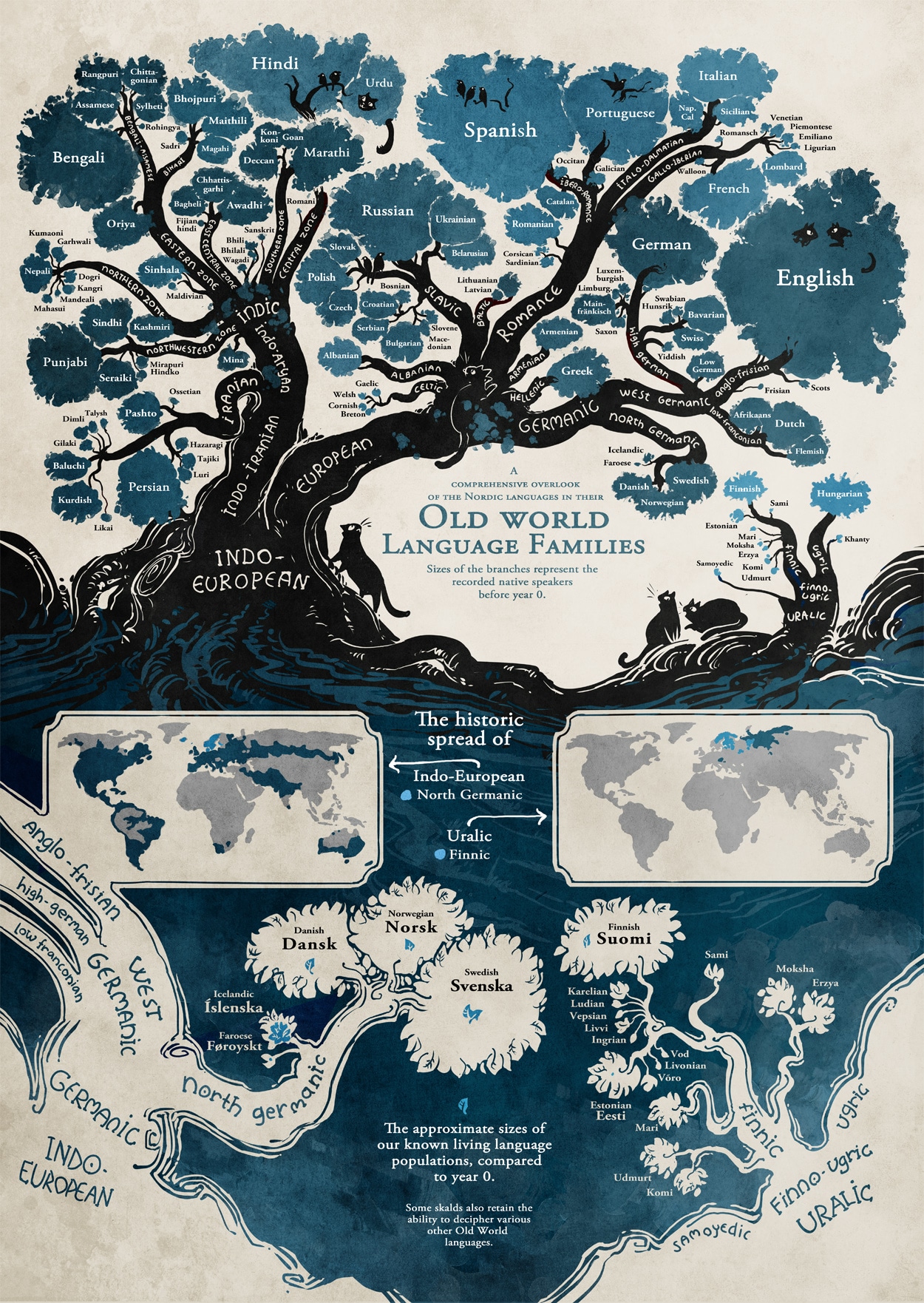
Useful for getting your head around what came from where. A small additional translator inset would be been useful for converting the sort of terms one encounters in deeply researching pre-LOTR Tolkien, such as “Old Norse”. It would have been nice to have just a couple of orienting dates. The Indo-European (Aryan) family had its origins in the Near East just over 8,000 years ago from today, for instance, with a big diffusion into Europe around 5,000 years ago.
Minna is the fine comic artist and storyteller making the ‘young adult’ graphic novels Stand Still. Stay Silent (ongoing – a future Scandanavia has returned to a state of Nordic mythology complete with monsters and magic), and A Redtail’s Dream (completed – a young boy of the North strays into the land of dreams).