Did slavery profits bankroll the Midlands industrial revolution, as local socialist M.P. Tristram Hunt (Labour) would have had you believe in his recent speech in Stoke?
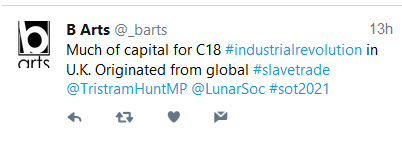
Erm, no. Slavery did not fund a major share of the capital that went into our industrial revolution. If you put together all the combined profits of the slave trade and the West Indian sugar plantations in general, together they did not even add up to five percent of Britain’s national income, either before or during the Industrial Revolution. Even a Midlands-specific claim doesn’t hold water — that exports to colonial settlers might have made huge profits for our early textiles and small metalworking industries. Such activity was at best of minor importance, and overall profits from the colonial trade were low…
“Profits from the colonies and imperial trade and capital accumulation in Britain”: [when put together, all of the] commerce with the ‘periphery’ [i.e.: with fringe areas of the world and colonies] generated funds sufficient to finance only 15 per cent of gross investment expenditures during the Industrial Revolution [… and such] external trade was only a small proportion of Europe’s economic activity and most industries did not depend upon imported raw materials … historians have argued that sugar did not furnish a sufficiently large total output to be a major contributor to the savings that funded the Industrial Revolution … It is equally difficult to prove that merchant capital amassed from colonial commerce [even taken as a whole] was decisive for British industrial growth.” — Kenneth Morgan, Slavery, Atlantic Trade and the British Economy, 1660–1800, Cambridge University Press.
The book is described by Cambridge University Press as… “An up-to-date synthesis of work on slavery, Atlantic trade and the British economy … essential reading”.
The socialist notion that that the industrial revolution was funded largely by slavery arose from the rabidly Marxist 20th century historian Eric Williams, about whose work…
“the majority of scholars working on British industrialization tend to be highly skeptical” [today, because…] “Eric Williams and his followers probably exaggerated the profitability of the slave trade and slave plantation complex.” — from a review of Slavery, Atlantic Trade and the British Economy, 1660–1800, in Reviews in History, June 2002.
Further, it’s more recently been determined that only around 7 percent of the UK’s historic national elites can be in any way connected with slavery. Indeed, far more of our elites actively fought against it.
[…] Yes he was an abolitionist and lent his name to petitions and suchlike, and even served on a committee, but a great many of his class did the same at that time. Overseas slave-holding was often presented as a practice incompatible with Christian and British values of personal liberty and freedom of religious-conscience, and framed in such non-radical terms. But my feeling is that a businessman would have had to ‘go above and beyond’ in his efforts, at that time, in order to be now claimed as a political radical (in the way that modern leftists think of such things). He also had a passion for Free Trade (the other great cause of the time), although that meant he sold to all comers — and thus today’s leftists can find a few Wedgwood pots in slave plantations if they dig hard enough. But the old false claim that the slave trade provided the capital for the Industrial Revolution, and thus set up Wedgwood for success, has been strongly debunked. […]