I saw the constellation Orion rising in the dawn sky, standing up and rather fine, this morning at 6.30am. So I thought I’d make a suggestion that might put right a misconception, about the nature of the “moor-stepper” found in the gnomic “Ur” Runic Poem (pub. 1705). Especially for the benefit of any pagans out there, who according to my cursory searches appear to think it was a Grendel-like monster or a wild auroch (extinct type of wild bull).
Runic Poem, original:
U | [ur] byþ anmod and oferhyrned,
felafrecne deor, feohteþ mid hornum,
mære morstapa; þæt is modig wuht.
Charles William Kennedy, 1910, in the “Introduction” to the best translation of Cynewulf:
U | [Ur] is headstrong and horned, a savage beast. With its horns the great moor-stepper fighteth; that is a valiant wight.
My translation:
U | is steadfast has horns above all,
a very savage beast, fighting with its horns,
great mere-stepper; that is greatly spirited.
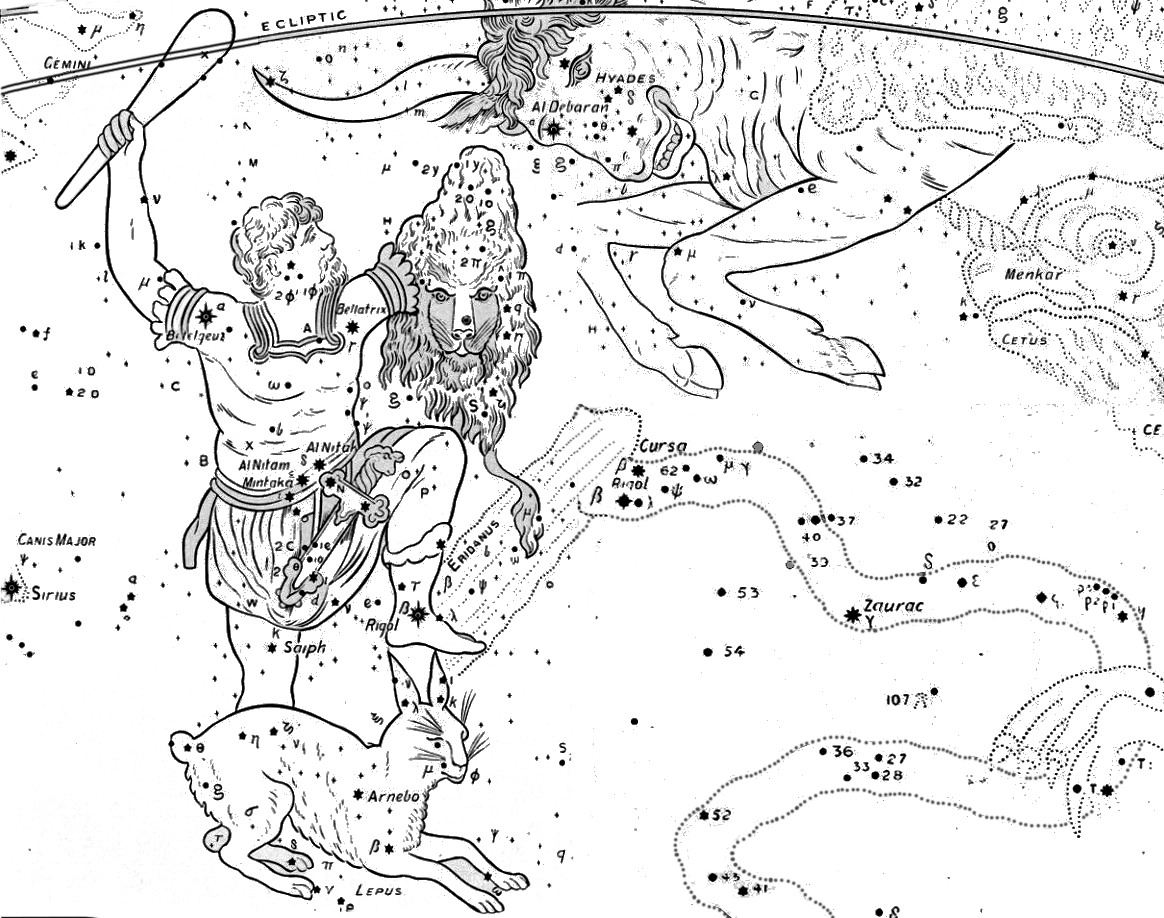 Picture: Simplified design based on Orion shown in the Firmamentum star atlas, 1690 AD. He steps into a mere, a spring-fed mere-pool that feeds the river constellation. (This is a .GIF image and may not appear if you have a GIF blocker).
Having seen Orion this morning I can say that his stepping pose is quite obvious to the star-gazer. So I’d suggest it’s not only a moor-stepping bull in the Runic Poem. It’s also Orion, who is frozen in the pose of stepping up. The “mere” is the (assumed moorland) mere-pond that feeds the river constellation, into which he steps in order to face the bull. He is at a disadvantage in the fight, due to the terrain, not to mention the gigantic bull. The trickster hare gives him ‘a leg up’ on her ears, and lets him borrow her back legs for a moment, with the implication that he may be about to spring over the bull’s horns.
My use of “greatly spirited” is more subtle than Kennedy — since the lines are meant to be a sort of night-sky riddle. So there’s no need to blatantly spell out that to the reader the supernatural aspects. The implication of the lines is that both the Bull and Orion are “greatly spirited”, and that they both exemplify the ‘fighting spirit’ in the rune Ur. The word “wight” was also avoided because modern readers now understand “wight” as being connected to Tolkien’s “barrow-wight”.
Orion’s rising (as a wintertime standing figure) traditionally heralds the autumn storms — “the storms that annually attend the heliacal rising of Arcturus and Orion” (Bede, drawing on Job in the Bible). Thus, the runic Ur is also the associated “greatly spirited” storms and winds. Thus we get the name, presumably, Ur-ion.
The Ur rune might be thought of in terms of man’s bravery and courage, in the face of implacable fury. Not in terms of the rather lumpen modern pagan suggestion that: “durh… Ur means a mad cow, dude!”
It’s then a dual-pronged rune in meaning as well as design: consider for instance the military distinction made between the two types of battlefield bravery: mad foolhardy rush-at-’em bravery, and considered bravery that is brought forth from within oneself in the face of an implacable opposing force. Only the latter type gets medals.
There is a sound-play in the rune poem (given above) between mǽre (‘great’, ‘monstrous’, ‘boundary’, ‘mere (pool)’) and the following word morstapa (‘ranger in-the-wilds’, ‘Orion’). If the Runic Poem was a mnemonic for teaching people the runic alphabet and then helping them to recall its subtleties, this would be a kind of test for them. The choice of meaning that a student has to bravely declare to the teacher (‘it’s just an angry bull’) thus encapsulates the choice a brave man must take in battle, in weighing the evidence and then pressing forward bravely regardless of the known risk. The correct student should emulate this type of subtle military decision-making, before he makes his brave call on the gnomic meaning of the lines (‘actually it’s the Bull and Orion, and is about the two types of bravery’).
Incidentally, “modig” = ‘spirited’ in the Anglian form. Which implies the Runic Poem may be Mercian, or at least copied there by a scribe, because in other territories modig was only used religiously and later. (The Cambridge History of the English Language, Volume 1, p. 343).
I can call an eminent philologist to my cause here. Bosworth obviously also thought the morstapa wasn’t the wild bull itself, but rather a man ranging into the wilds to fight it…
Mor-stapa, an; m. a moor stepper, a desert ranger (A Dictionary of the Anglo-saxon Language, 1838)
Compare also the Roman writer Manilus (d. 384 BC) on Orion (Jewish: gibbor, ‘the giant’; Arabic: ‘the hero’). To him this sky-deity makes… “Smart souls, swift bodies, minds busy about their duty (officium), hearts attending all problems with speed and indefatigable vigor”. (A.E. Housman trans.) Also Thomas Hood of Trinity College, Cambridge (1590)… “the reason why this fellow was placed in heaven, was to teach men not to be too confident in their own strength.” Horne, famed for his deep study of Orion and his three-volume epic poem on the topic, also has in his Introduction… “Orion is man standing naked before Heaven and Destiny, resolved to work as a really free agent to the utmost pitch of his powers…”.
Tolkien might have nodded to the -or part of Gibbor in The Lord of the Rings… “as he climbed over the rim of the world, the Swordsman of the Sky, Menelvagor with his shining belt. The Elves all burst into song.”
Finally, I’d also note that the bottom half of Orion with his ‘stepping’ leg looks like the shape of the Ur rune….
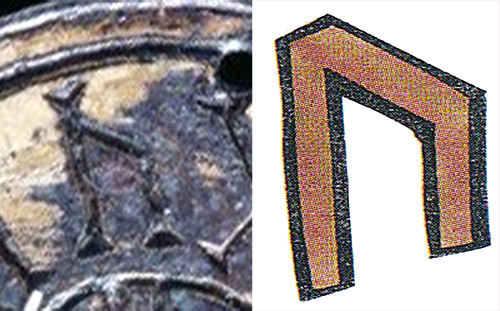 Picture: Malton Pin, 10th century northern England (my crop of the British Museum’s photo of the cleaned brooch); and a modern simplified version of the rune.