The hillfort at Bury Bank, north of Stone at Meaford, is a new addition to the 2016 official “at risk” register of historic sites.
“Declining: Generally unsatisfactory with major localised problems”, mostly arising from natural “scrub/tree growth”.
Since the time of John Leland’s travels in Tudor England the site has been known and written of as an ancient seat of the Anglian king of early Mercia, King Wulfhere (657-74 AD).
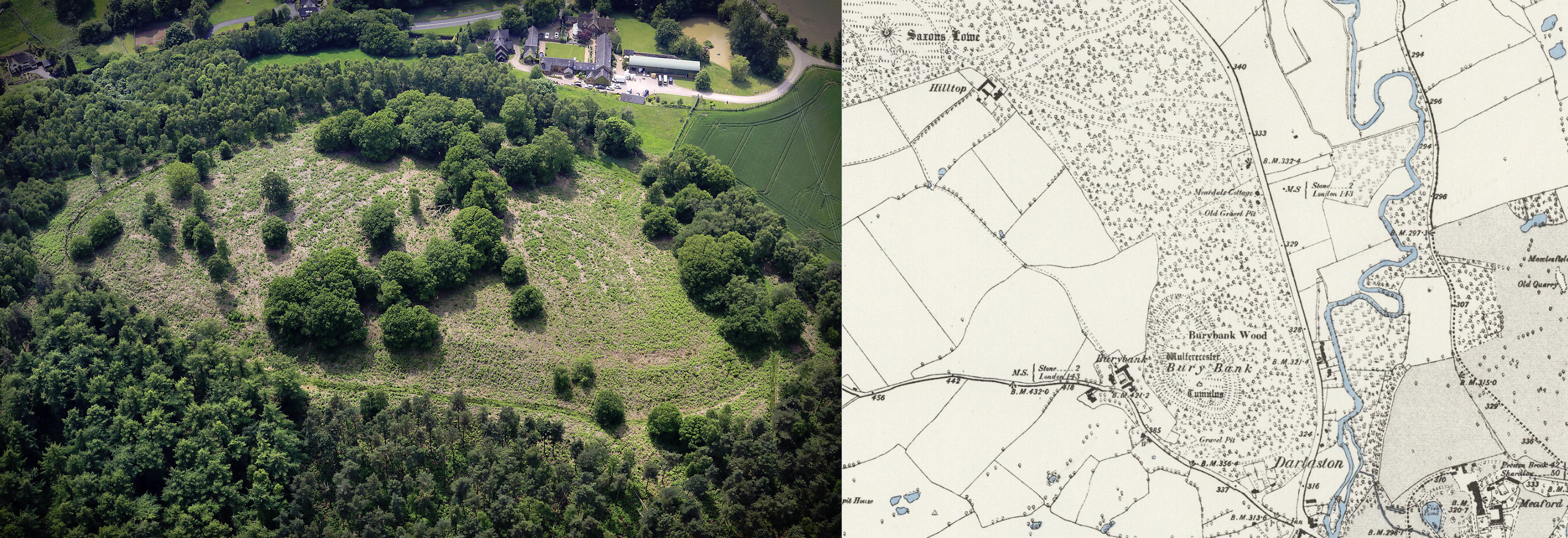
From “A few jottings on some Staffordshire Camps” in North Staffordshire Naturalists’ Field Club, Annual Report and Transactions, 1892. quoting Plot:
“Dr. Plot in his Natural History of Staffordshire, published in 1686, thus quaintly describes this place: “On the top of a hill there yet remains the ruins of a large castle, fortified with a double vallum and entrenchments, about 250 yards diameter, the gate seeming to have been on the west part of it where the side banks on each hand plainly appear : others fancy there was a second gate on the east side too ; though I could not perceive any probability for it, but on the south side there is a round conical hill, much like a tumulus cast up higher than all the rest of the work, which, according to the tradition of the country thereabout, was the seat of Ulferus [Wulfhere], King of Mercia …. Mr. Sampson Erdeswick asserts that he had seen an old writing relating to the foundation of the Priory of Stone [founded from c. 1138 – 1147 A.D.] that affirms as much : which may, perhaps, be that of R. de Suggenhill and Petronel his wife, whereby they gave to the Church of S. Mary and S. Ulfade of Stone Messuagium juxta montem qui dicitiur Ulferecester in terroris de Derlaston ; which index proves fully that this was the royal mansion of the said Ulferus who governed Mercia from the year of Christ 657 to 676, the Lowe (tumulus) adjoining being in all probability the place of his sepulture.”
Approximate translation of the Late Latin given above:
“A plot of land with a house, next to the great mound on the lordly castle of Ulfere [Wulfhere], the fierce warrior of Derlaston”.
On Derlaston, see map (above). On the name, The Place-names of England and Wales (1916) records: “DARLASTON (Wednesbury and Stone): St. D. 954 Deorlavestun, Derlavestone, 1004 ib. Deorlafestun, Dom. Dorlavestone. Wed. D. a. 1200 Derlavestone.”
Now, in Deor|lave|stun the deor was a deer (or, at that time, any other large hunted meat-animal), lave was ‘to wash’, and stun is presumably stone. Given the geography, possibly the name is then related to the stepping stones across the river, also a place where the deer / animals were cleaned and washed after the King’s summer hunts? The hounds would also need such a place to be washed in, and any wounds or scratches noticed and treated. And yes, there was deer-hunting before the Normans arrived.
The similarly-named Darlaston in South Staffordshire, near Wednesbury, has a comparable situation on the upper reaches of a river — being located where the three head-streams of the River Tame converge. The convergence of three streams was long regarded as a ‘special place’ for pagans, especially if at or near the head of a water that when lower down became a large river to the sea.
The recent scholarly book Lichfield and the Lands of St. Chad (2020) notes another textual source for the Wulfhere link…
Wulfhere’s fortress in the Passio [of St. Wulfhad, early 14th C.] is called Wlferecestria, a name that was applied locally to a hillfort a mile north-west of Stone, known now as Bury Bank, which is attested in early thirteenth-century entries in the Stone Chartulary.
Further, if we accept a relatively early date for the famous poem Beowulf, then the summer hunting palace of a King of Mercia would have a starting claim as the possible place where Beowulf was first written down by a scribe circa 700 A.D. — who we know originally used the Mercian dialect. There was a period of academic debate about the dating of Beowulf, but recent books now give fairly incontrovertible evidence for the long-assumed early dating.
Given such dating, a summer scribing at Bury Bank would have been after King Wulfhere’s time (657-74 AD), and would also have to assume that the site was also used later under the pious Aethelred (king from 675–704) or young Coenred (king from 704–709). The latter’s short reign was “blighted by numerous Welsh incursions into western Mercia”, which would suggest the need to have Bury Bank also become something of a strategic military site on the border with Wales. Though the reign of Aethelred is the more likely of the two, for Beowulf.
Tom Shippey however puts ‘the date of coining’ of the Beowulf tale a little after Coenred, at 710 A.D. — as a deft poetic melding of real earlier Scandinavian tribal history with supernatural elements and a Christian overlay — and puts the scribal copy-of-a-copy we now have at around 1000 A.D. He has elsewhere noted that the first known owner of the Beowulf original was the Bishop of Lichfield, which I would add is relatively near to Bury Bank in mid Staffordshire.
[…] have been at Stone. There Tolkien no doubt kept an eye out, on his map and on the road, for the early Mercian hill-fort (of King Wufhere, whose chief priest was named Jaruman) that dominates the ancient river-crossing […]
[…] so ardently, its trees and gardens. Perhaps he also once or twice waded through the bracken to see King Wulfhere’s hill-fort near Stone, since he had an abiding interest in all things Mercian. Possibly he liked to use the […]
[…] be familiar to those who know the local history of early Mercia, and who have even perhaps visited his hill-fort between Stone and Stoke. The novel vividly tells his ‘life story’, and it originally […]