A new computer modelling analysis of European fairy tales claims to have found one or two that date to the Bronze Age. Like all ‘big computing’ modelling of complex systems with limited and skewed data inputs, the findings should probably be treated with strong caution. The researchers also applied their model only to a subset of story types, the “Tales of Magic” from the Aarne-Thompson-Uther Classification of Folk Tales. But their key finding on age is rather interesting, nonetheless…
“Our findings regarding the origins of ATU 330 ‘The Smith and the Devil’ are a case in point. The basic plot of this tale — which is stable throughout the Indo-European speaking world, from India to Scandinavia — concerns a blacksmith who strikes a deal with a malevolent supernatural being (e.g. the Devil, Death, a jinn, etc.). The smith exchanges his soul for the power to weld any materials together, which he then uses to stick the villain to an immovable object (e.g. a tree) to renege on his side of the bargain.” [this it seems, actually refers to the sub-variant of 330, 330A]
“a Bronze Age origin for ATU 330 [‘The Smith and the Devil’] seems plausible under both major models of Indo-European prehistory [i.e.:. competing theories that complex metal-working was brought into Europe with large migrations from either the Pontic-Caspian steppe (north-east of the Black Sea) or from Anatolia (south of the Black Sea)].”
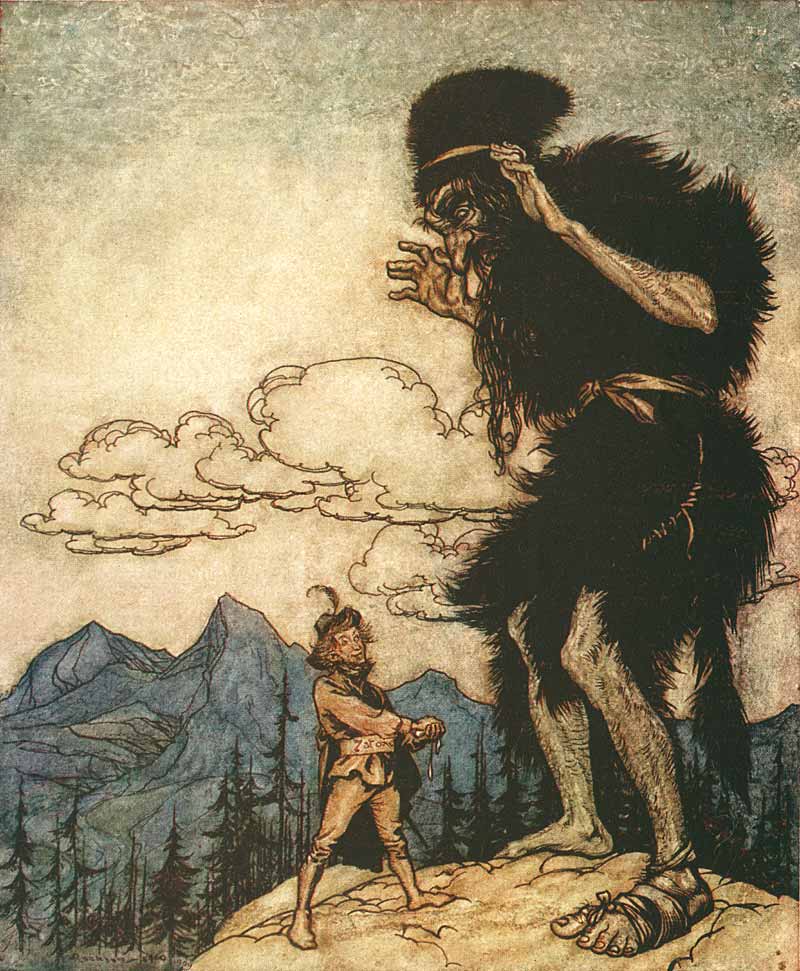
ATU 328 “The Boy Steals the Ogre’s Treasure” (the basis of “Jack and the Beanstalk”) is a story nearly as ancient, according to the model, and was presumably a story type that emerged when complex metallurgy enabled newly-portable treasure hoards, along with new trade routes that imported cut gem-stones and amber.
Though not magical, I’d imagine that “The Boy Who Cried Wolf” is perhaps even more archaic. Due to its sheep-herding subject matter it quite possibly pre-dates the emergence of complex metallurgy. My thanks to Nathan Fleischman for pointing out that this tale has been included as a tale type in Classification of Folk Tales as “Shepherd Who Cried ‘Wolf!’ too often” (ATU 1333), even though it is commonly casually attributed to Aesop. Presumably the inclusion is due to its popular fame in Europe since the 15th century, and now apparently also in India (presumably introduced by the British Raj?). I imagine that the listing implies nothing about its age or antiquity.
But what of the dates? One might at first think that Aesop had his “The Boy Who Cried Wolf” tale from Ancient Greece during the fabled Aesop’s lifetime, said to be circa 620 and 560 B.C. Though here we must be cautious, as ‘Aesop’ is more likely to have been a formulaic ‘once upon a time’ name. A name to whom any time-served fireside fable could be attributed, and which was later elided with a slave of the same name.
The early fairy-tale authority Joseph Jacobs states this fable can only be shown to derive from Babrius, who was later in time. Jacobs accepts as plausible the research suggesting that Babrius was probably a Roman who had adopted Greek ways and had become fond of versifying old Greek fables. Jacobs offers…
“Ultimately derived from Babrius: though only extant in the Greek prose Aesop. Gitlbauer has restored it from the prose version in his edition of Babrius, number 199.”
(Regrettably “199” does not translate thus, and is ‘Fathers and Daughters’. Nor is Gitlbauer’s index any help re: wolf/wolves (λύκος/λύκοi) and his cross-referencing to a “Halmianam” edition, which means the earlier author Halm, is of no help either. Similar numbers to 199 were tried in Gitlbauer, assuming a slip of the pen by Jacobs, and I even tried some footnote text. Nor is there any other edition of Gitlbauer. I eventually translated the whole thing and found it’s 161 not 199, and that Gitlbauer unhelpfully indexes it only as παῖc ψεύςετηc (Playing liar). Anyway, here’s my translation.).
Does this bring us any closer to dates? Well, the dates that scholars try to pin on Babrius are variable, and the 9th Ed. of the Britannica observes that various “dates have been assigned to him from 250 B.C. to 250 A.D”. The modern Britannica plumps confidently for “flourished 2nd century A.D.”, yet the modern Oxford Encyclopedia of Ancient Greece and Rome has his writing “dating probably to the third century A.D.” So we’re more or less back to around-about the dates of the first occurrence in an edition of Aesop, which is said to be in the Collectio Augustana, aka Augustana Collection in the 2nd century A.D. Though I read that “scholars have suggested many different dates for it” and it cannot be dated either internally or externally. Ho hum… so both sets of dates are very hazy.
Either way on dates, and assuming that the fable was gathered in an eastern Mediterranean sheep-market rather than invented in a scriptorium in Rome, then it is still from what is culturally the Ancient Greek world. Thus the fable seems likely to have emerged from the millennia-deep folk-culture of teaching-fables taught to shepherd-lads, though it cannot now be reliably placed as far back as ‘five centuries before Christ’ by attributing it to Aesop.