Tolkien at Leeds, July 2018

A wealth of Tolkien sessions, at the International Medieval Congress 2018 at the Leeds Hilton in the UK (2nd – 3rd July). The most interesting papers for me would be those on the deeper historical context, in “Tolkien: Medieval Roots and Modern Branches, II” on Tuesday 3rd July: “Tolkien’s Agrarianism in its Time” (hopefully surveying the verdant undergrowth of nature-thinking, land reform concerns and organicist living that informed radical politics from the 1920s onwards), and “A Man of His Time?: Tolkien and the Edwardian Worldview”. Rather too expensive for me, though, just to hear those two papers: £35 + a £45 train fare to arrive after noon = £80.

Free: “The mystical philology of J. R. R. Tolkien and Sir Israel Gollancz”

Excellent, I’ve found the essay “The mystical philology of J. R. R. Tolkien and Sir Israel Gollancz: monsters and critics”. It’s in full-text Open Access at the Oxford University Research Archive. No need to pay $70 for it, in a copy of the latest edition of Tolkien Studies where it forms the lead essay.

I also found a summary on the author’s blog of the other interesting essay “Visualizing the Word: Tolkien as Artist and Writer”.

Though sadly the volume also contains the desirable “The Year’s Work in Tolkien Studies 2014”, which isn’t going to be Open Access any time soon.

Map of the Arthurian Regions, 1910

Bartholemew’s 1910 map of the Arthurian Regions. Public Domain.

Interesting, but now seems a bit wayward in places. Chester as Caerleon? Some places, such as Wolverhampton, are presumably there only for orientation. The location of Sir Gawain and the Green Knight, the Staffordshire Moorlands, was only discovered by scholars many decades later.

Britannia

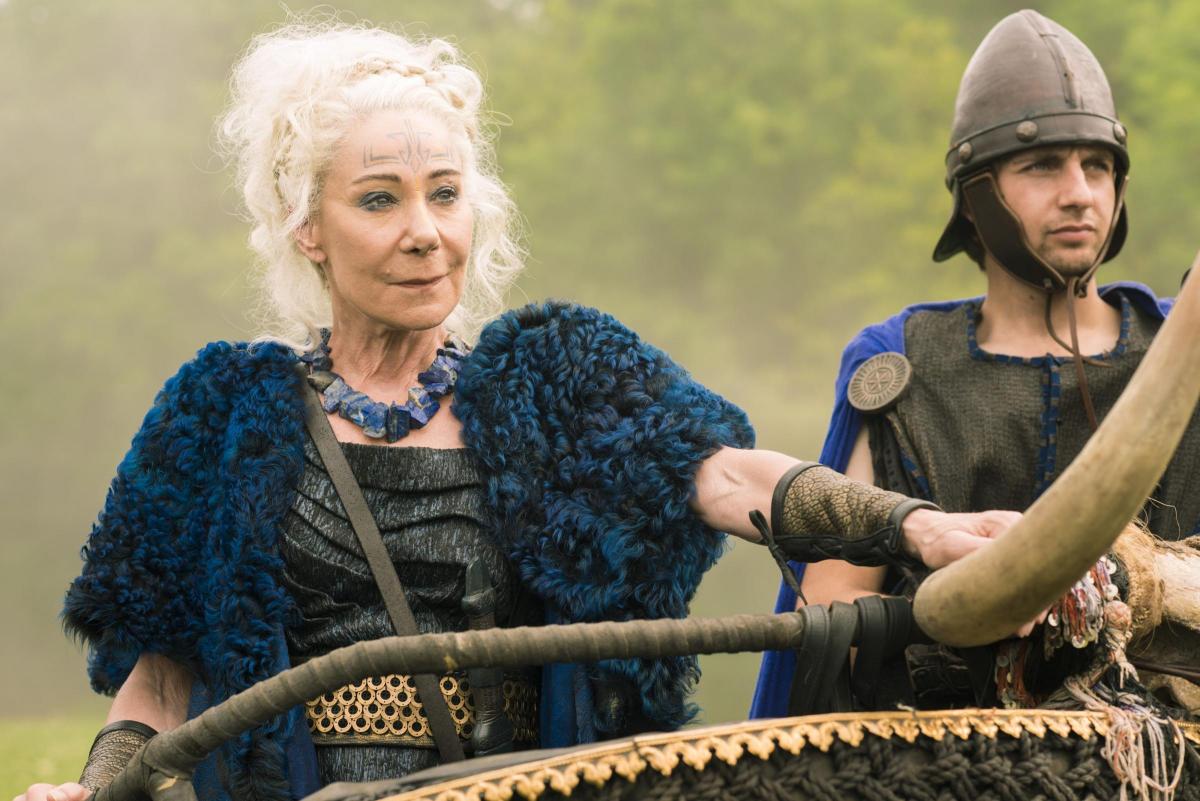
I’m usually very sceptical of me-too Game of Thrones knock-offs, but the new Britannia series (starting tomorrow night) intrigues. Sky Atlantic’s new series is about the Roman conquest of Britain. It’s from a very good writer and team, which is encouraging, but sadly the rival BBC’s Radio Times reports today that…

“there’s a decidedly contemporary feel to the drama”

Oh well. I guess the actors weren’t up to quite that much period acting, consistently and across the entire cast. That’s an understandable approach in terms of cohering a sprawling historical epic, I suppose.

The costumes and make-up and props do look fabulous. Lots of mud n’ blood, apparently, of course. No fantasy dragons, but fantastical special effects are said to come from the psychedelic mushroom-chomping of the two local tribes. It’ll be interesting to see how deeply the series explores and visualises the animistic and land-magic angles.

Sadly the quotas and subsidies mean that its nine parts (some sources say ten) had to be filmed in the Czech Republic, with only small bits filmed in Wales. But hopefully it’ll stimulate more public awareness of the Iron Age in the British Isles. The tribes in the first series are the Cantii (Kent) and the Regni (roughly Sussex and Surrey). So they’re actually fairly civilised continental tribes of the Gaulish type (from where modern Belgium is, roughly), who had crossed over and occupied that part of our south coast about 170 years before the Romans arrived, and who had thus displaced the native British (the latest genetic testing suggests, up toward what is now London and over toward Devon/Cornwall).

So the Romans in the series are first encountering Gaulish Belgic recent-incomer tribes, relatively civilised tribes of the sort they’ve already become very familiar with on the continent. As Julius Caesar had noted of the tribes some ten years earlier, from his first-hand experience…

“those that inhabit the lands of the Cantii [Kent] are the most civilized and it is a wholly maritime region. These Cantii differ but little from the [continental] Gauls in habits of life. But [by contrast,] many of the inland Britons do not grow corn. They live on milk and flesh and are clothed in skins. All the Britons stain their persons with a dye that produces a blue colour. This gives them a more terrible aspect in battle.”

So how historically correct Britannia will be remains to be seen. Will the wild indigenous Britons be lurking mysteriously in the background, or will the “most civilized” Gaulish Cantii and the Regni be given wilder British aspects for dramatic purposes?

Katherine Thomson (1797–1862)

I’ve found another Stoke writer. Katherine Thomson (1797–1862) was the seventh daughter of Thomas Byerley of Etruria. She compiled many ‘memoir biographies’, and wrote a string of historical novels. Here is The Chevalier : A Romance of the Rebellion of 1745 (1844), with a description of Hartshill…


“It was more than two days’ journey before the famous hill, called Mow Corp, at the foot of which lies Congleton, rose, darkened by the bilberry wires which dotted its sides, before the view of the travellers. They had journeyed along through what is now a defaced, and revolting country [the Jacobites had reached Macclesfield, but the town did not welcome the invading Jacobites and was murderously hostile]; amid hills, now obscured by volumes of the darkest smoke [a sign of pillaging Jacobites, seizing supplies], and vales … [They arrive at the industrialising Potteries, which in 1745 was pre-Wedgwood] standing on the ridge of the valley of Stoke, you may see countless chimneys vieing in height … The Trent [below was] narrow in this part of its course, where it has but lately quitted its source, wound through fertile fields, and beneath, at this point, a gentle rise, upon which, not many weeks since, wavy corn had been growing attracted the eye. A windmill stood on this fair bank, bearing the name of Harts-hill, just by a group of dark pines which rose against the blue sky. … Only a few days ago, the Trent had reflected that blue sky, that grove of pines, and the withies that grew on its bank. It was now fringed with a row of tents; the vale was speckled over with the [English army] camp, and its appurtenances. Horses were fording the shallow Trent; women were washing linen low down in the [Fowlea] stream; pennons [i.e.: war pennants] were waving in the breeze; the miller at Hartshill was weighing out his corn to the ravenous tyrants of the [English army] commissariat; beasts were penned in folds, in the grassy fields. The inconveniences of war were manifest … ”

The windmill was later the site of Holy Trinity church at Hartshill.


Thompson followed this two years later with a three-volume Memoirs of the Jacobites of 1715 and 1745, outlining from first-hand accounts the local manoeuvring of the armies…

The Duke therefore assumed the command of an army ten thousand strong [to prevent the Jacobites reaching Lichfield, and thus the road to London.] The Duke of Cumberland was by no means so ignorant of the force which he was now destined to attack [as he] had become acquainted with the peculiar mode of fighting practised by the Highlanders …

At Macclesfield, Prince Charles gained the intelligence that the Duke of Cumberland … was quartered at Lichfield, Coventry, Stafford, and Newcastle-under-Line.

The Prince then resolved to go direct to Derby; and it was to conceal his design, and to induce the Duke to collect his whole army at Lichfield, that [his man] Lord George Murray marched with a division of the army to Congleton, which was the road to Lichfield. Congleton, being on the borders of Staffordshire, was sufficiently near Newcastle-under-Line for Lord George to send General Ker to that place to gain intelligence of the enemy. General Ker advanced to a village about three miles from Newcastle [which would suggest Burslem?], and very nearly surprised a body of dragoons, who had only time to make off. … [Cumberland then decided to try to force a battle, meeting the invading Jacobites just outside Stone rather than Lichfield, but the battle there never materialised].

Upon the third of December, Lord George Murray with his division of the [Jacobite] army marched by Leek to Ashbourn; and the Prince, with the rest of the [Jacobite] forces, came from Macclesfield to Leek, where, considering the distance of the two columns of his army, and the neighbourhood of the enemy, he naturally considered his situation as somewhat precarious. It was possible for the enemy, by a night-march, to get betwixt the two columns; and, contemplating this danger, the Prince set out at midnight to Ashbourn, where it was conceived that the forces should proceed in one body towards Derby. “Thus,” remarks a modern historian, “two armies in succession had been eluded by the Highlanders; that of Wade at Newcastle, in consequence of the weather or the old Marshal’s inactivity, and that of Cumberland” … The young Prince [and] this gallant but trifling force was enabled to return to Scotland … scarcely ever was there a handful of valiant men placed in a situation of more imminent peril.

Holy Trinity church, Hartshill, Stoke-on-Trent

I happened to encounter the page on Holy Trinity Church, Hartshill, published by our local Council. Its description foregrounds an axe murder, of all things…

“Visit this magnificent church and listen to the gory tale of ‘Murder Most Foul’ – the story of an 1845 axe murder victim.”
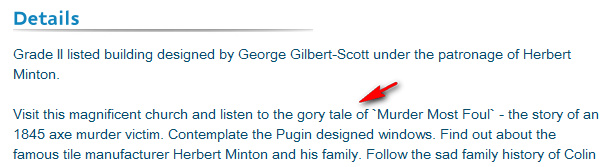
Very cheerful. But perhaps it’s a relic from the Council’s immiserated socialist years, now in the past.

Here is Nikolaus Pevsner on the church, in his masterly survey Staffordshire (1974)…

“HOLY TRINITY, Hartshill Road. Built at the expense of Herbert Minton to the design of George Gilbert Scott in 1842, i.e. an early work. And, thanks to Minton’s attitude, also a large work. It is entirely Camdenian, or rather Puginian, i.e. it appears with the claim to be genuine Middle Pointed. w steeple, windows with geometrical tracery. The chancel incidentally was given its apsidal end only about the 1860s or 1870s. The date of the plaster ribvault is not recorded. It obviously cannot be Scott’s. It need hardly be said that glazed Minton tiles are copiously used inside, especially for the dado zone. Scott also did the SCHOOL behind and the PARSONAGE to the west, and again Herbert Minton paid. The school is quite large and an interesting design. The parsonage has been totally altered. Again built with Minton money is the long and varied group of Gothic brick houses with black brick diapering more or less opposite the church. They must be of before 1858.”

The Ecclesiastical Gazette of 1843 noted approvingly that…

“The form and arrangement of Hartshill church are those of the ancient English parish churches : a chancel of good proportions, a nave, aisles, south porch, and western tower, with spire.”

Historic England’s record page for the church adds a little more. Saying of the “apsidal end” that had been noted by Pevsner, that …

“The chancel was added in memory of Herbert by his nephew Minton Campbell. Notable pew ends carved by apprentices and stained glass windows depicting Biblical stories.”

The survey report Minton Tiles in the Churches of Staffordshire (2000) has a short summary account of the tiles of the interior. There was apparently a severe fire inside the church in 1872, which occasioned new work. There are also more details in the 1992 150th anniversary booklet. The fire means the tilework is mostly 1870s, apart from the nave pavements. Fish tiles added at that time, referencing the ancient Christian symbolism of the fish, were made by the Campbell Brick & Tile Co. I’ve discovered that this early symbolism must echo the original ethos of the original design work. For instance, The Ecclesiastical Gazette of 1843 noted the original chancel ceiling was… “divided by wooden moulding into panels, which are filled by tiles of a rich blue, studded with stars of gold, in imitation of the ceilings of some early churches.”
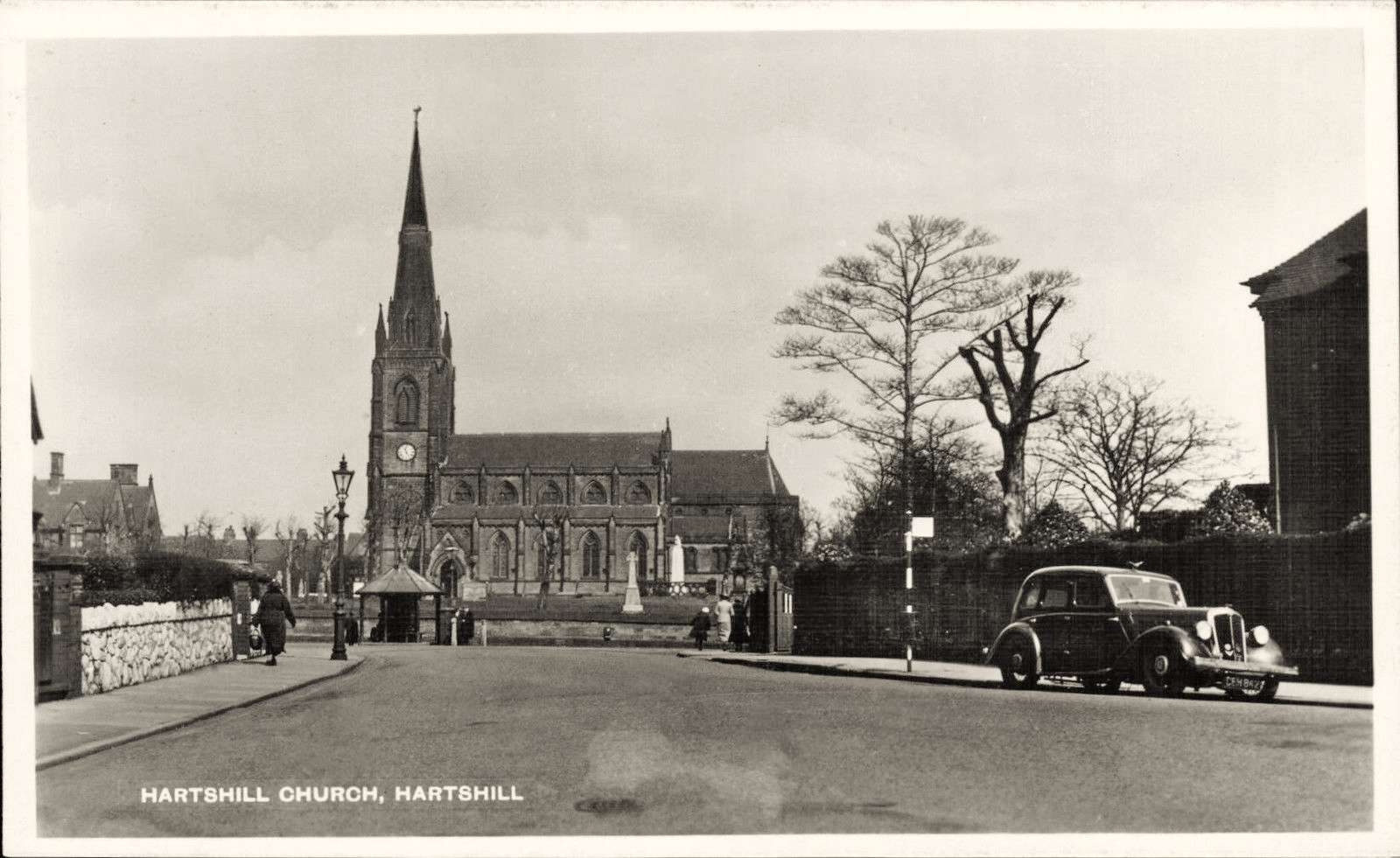
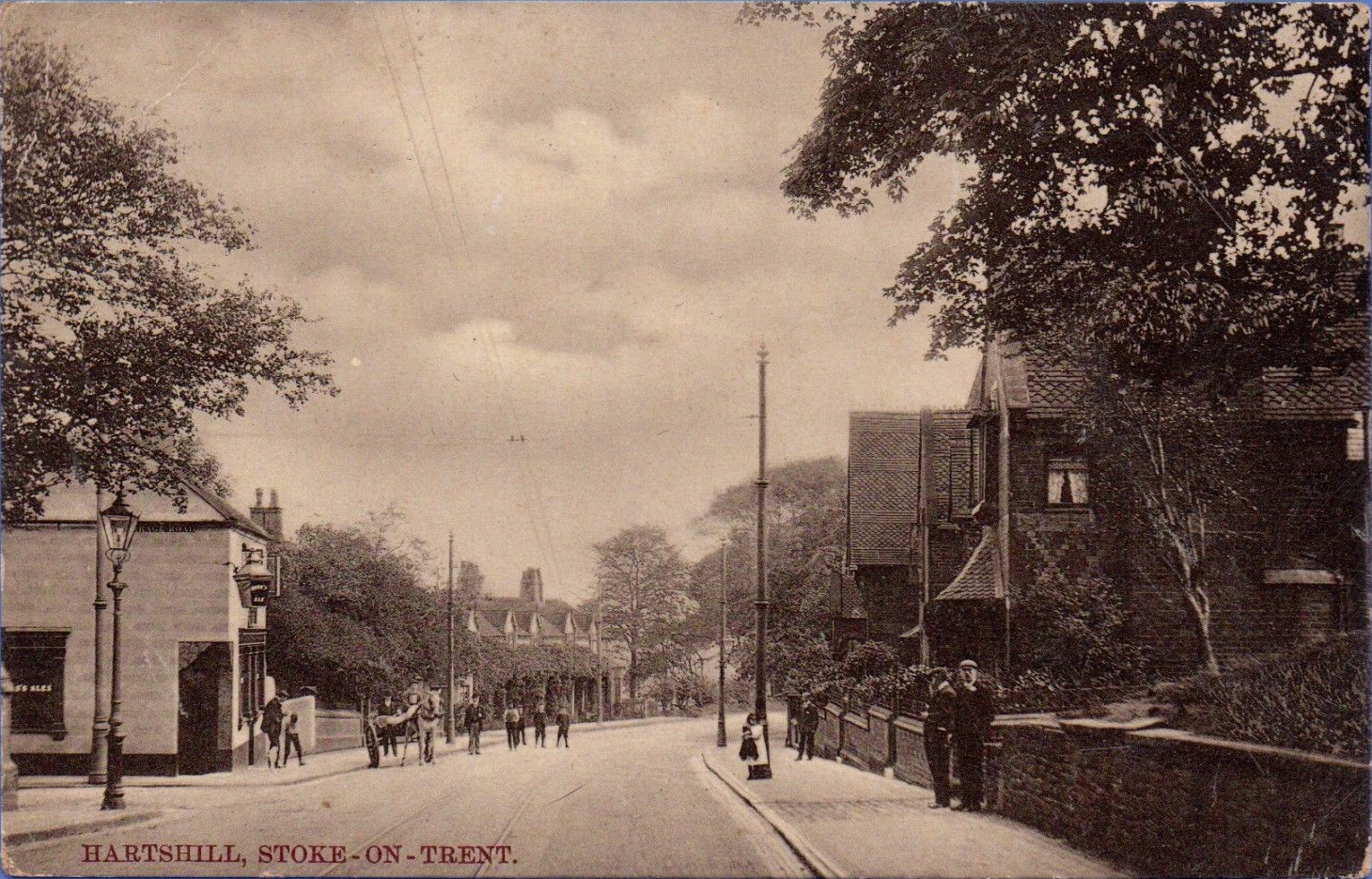
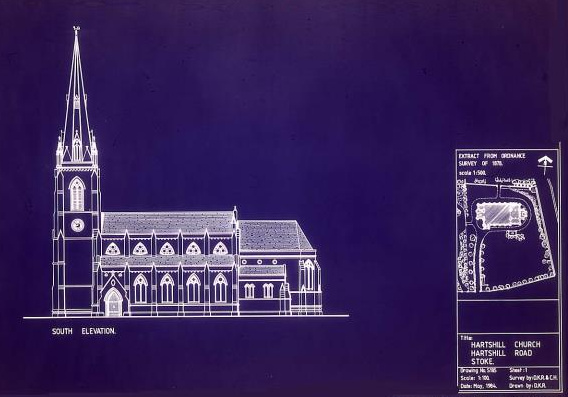
While undeniably plain when seen from the side at a distance (see above postcard), the book The Work of Sir Gilbert Scott (1980) suggests its fine interiors and windows were partly inspired by Lichfield Cathedral, and that these served to establish Scott’s reputation. These interiors, especially the “square-ended chancel” being…

“the first of Scott’s considered adequate by Victorian standards”
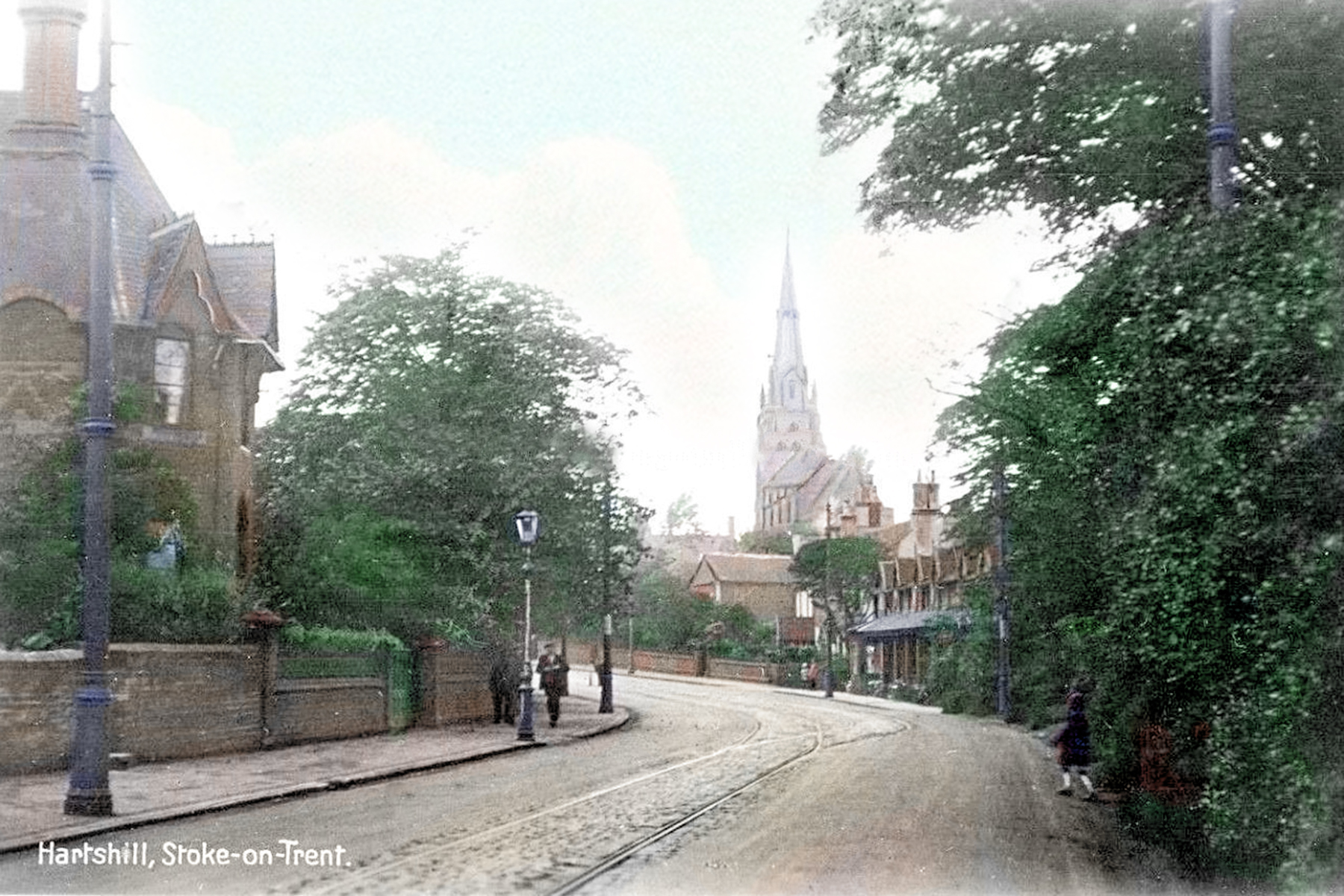
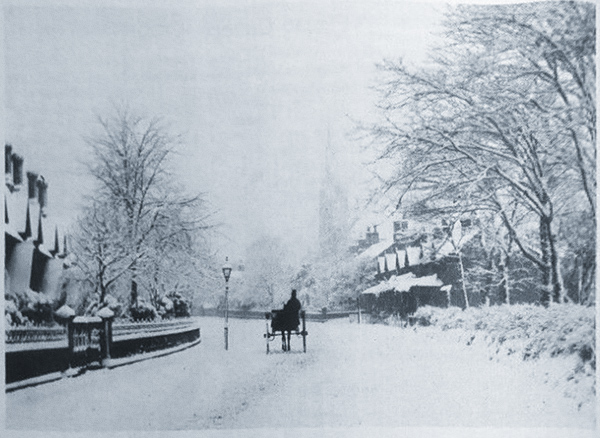
One can also see here (see above photos) how the exterior profile might have been designed to appeal more to those climbing up the road from Stoke in the valley below, rather than to those who saw the church side-on. Sadly Stoke-on-Trent Council (Lab) allowed the cottages on the right to be demolished. Labour allowed them to be replaced by a 1980s petrol station, delightfully flanked by a decrepit used-tyres dump. But the similar and larger buildings opposite have survived, and are still homes. Here these are seen from the opposite direction, with the church behind the camera and to the left…

The pub on the corner has also survived, and today is one of the best in Stoke.

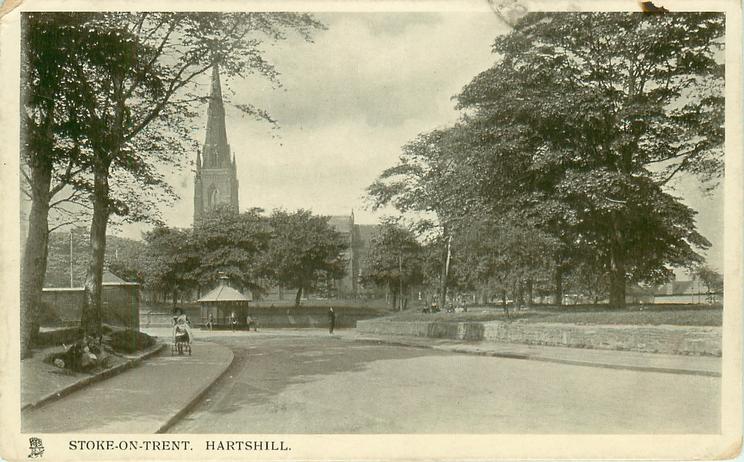
The Edwardians appear to have recognised the unappealing quality of the side-on view of the church, and they allowed trees to grow up to block it…
The potteries.org website cites Neville Malkin writing in the mid 1970s, on what was there before the church. This commanding crest of the hill was the site of a windmill.

“One of the few remaining windmills in the Potteries occupied this prominent site in Hartshill, until the late 1830s when it was demolished to make way for the church of the Holy Trinity”.

This is confirmed by Katherine Thomson‘s novel The Chevalier (1844), set in 1745. Thompson was a local writer who had grown up locally at Etruria…

“The Trent, narrow in this part of its course, where it has but lately quitted its source, wound through fertile fields, and beneath, at this point, a gentle rise, upon which, not many weeks since, wavy corn had been growing attracted the eye. A windmill stood on this fair bank, bearing the name of Harts-hill, just by a group of dark pines which rose against the blue sky.”

The Victoria County History has details such as the name of the Church’s first vicar, and details of its local mission houses in the Stoke valley below. It also adds just a little more detail on the size of the churchyard and who gave the churchyard land…

“The church of HOLY TRINITY at Hartshill was built and endowed in 1842 by Herbert Minton of Longfield Cottage (1792–1858). He also built the house for the incumbent to the west and the schools to the south and gave 2 acres of ground for the churchyard.”

Here is a view of some of the local people Holy Trinity would have served in the 1900s. The main-road gates of both the church and the vicarage are seen on the right of the picture, and the camera looks toward Newcastle-under-Lyme. Tram-stops are just out of sight on either side of the camera.
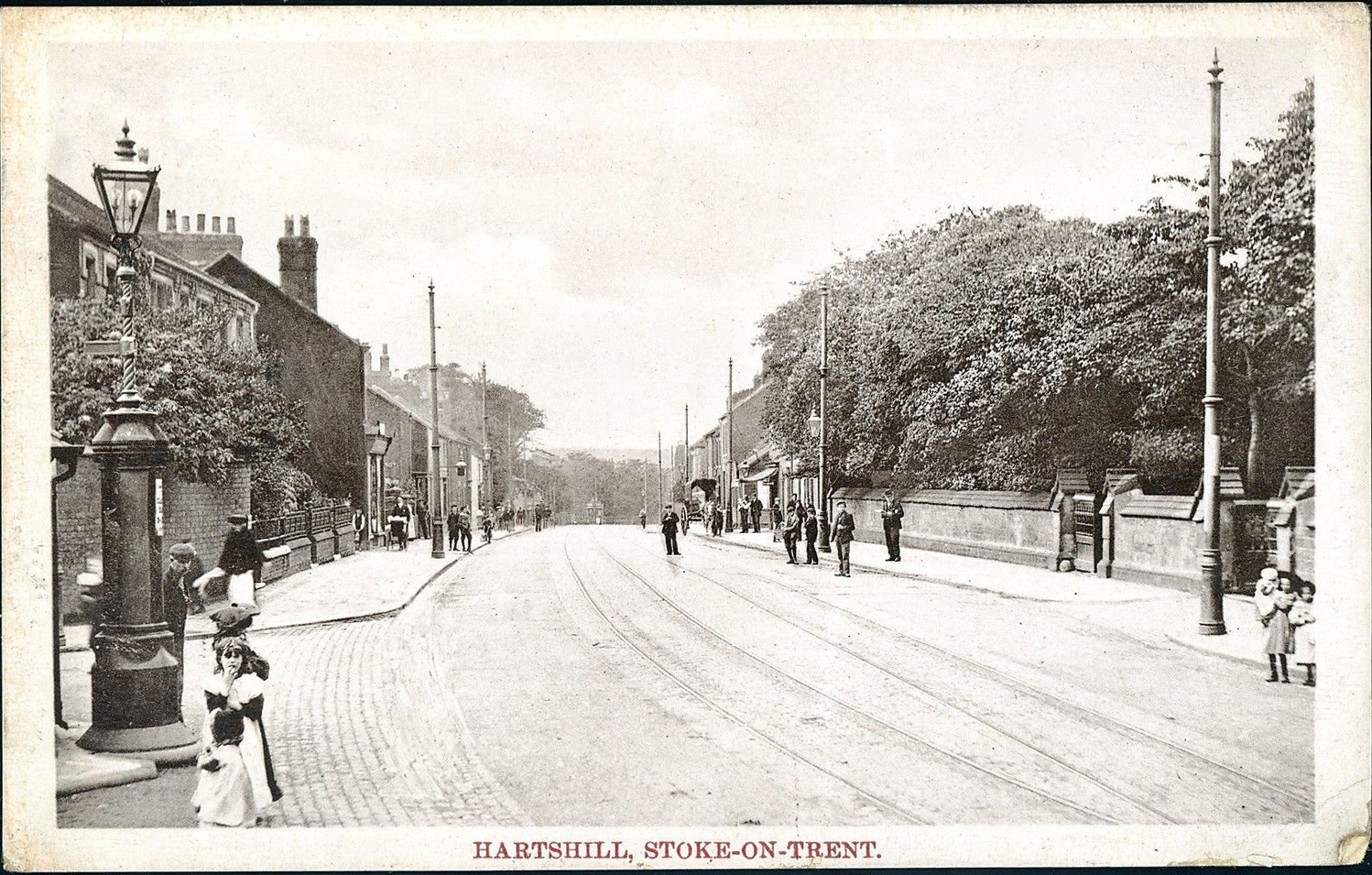
Many of these lads would have later served in the First World War. In the 20th century the potteries.org website notes the church had a …

“new organ (1948) to serve as memorial to those who fell in the two World Wars.”

According to the National Archives the newer 1948 organ was overhauled and rebuilt in 1973.

The original organ was designed by Edward Wadsworth of Manchester, built by Bewsher and Fleetwood. According to The Architect and Building News it was destroyed in the fire of 1872…

“Hartshill Church, Stoke-upon-Trent. This church … damaged by fire, has been restored sufficiently to allow some of the services being resumed. Besides other damage, the organ gallery was burnt and the organ destroyed.”

Today the church still appears to have its bells, and with a fine peal, since I heard them being rung a few years ago while passing by. There are occasional open days, usually about one a year. There are apparently windows high in the tower: The Ecclesiastical Gazette of 1843 noted the new church’s spire that it was “pierced midway toward the apex by canopied windows”, though today the chances of being permitted to ascend and open a window on Stoke are likely to be slim.

WikiMedia has several modern photos including one interior.

What of the future, for such churches in Stoke? The government has just published a major review on the upkeep of such parish churches. It suggests two new networks of professionals: a temporary national staff working to boost suitable local uses of churches, while also helping local people to carry on such work at the grassroots; and a dedicated national network of ‘church repair professionals’ and apprentices, to ensure that churches don’t fall into disrepair or become fire-risks through lack of routine repairs and neglect.
Stoke as the home of the first health food: “Hovis” bread

The journal Nature: “6th October 1886, The Hovis bread brand dates from the patent granted on this date to Richard Smith, miller, of Stoke-on-Trent.”

“Be it known that I, RICHARD SMITH, a subject of the Queen of Great Britain, residing at Stoke-on-Trent, in the county of Stafford, England, have invented a certain new and Improved Treatment of the Wheat-Germ and Broken Wheat … The objects of this invention are to produce a wheat-flour having the nutritive qualities and nutty flavor of the wheat-germ without the danger of discoloration and rancidity usually incident to the presence of the germ of the wheat.” — from his slightly later U.S. patent of 1887.

In the early years of public sale his new healthy loaf was said to have been sold as “Smith’s Patent Germ Bread” or “Smith’s Old Patent Germ Bread” and the flour as “Smith’s Patent Germ Flour”, germ here referring to the inclusion of the nutritious wheatgerm that had previously been discarded. A great example of someone taking a discarded ‘worthless’ by-product, building a great product from it, and making a fortune with it in a free market.

At that time there was seen to be a need to make brown bread enticing to the public in Britain, to improve the nation’s overall nutrition. This led to a Bread Reform League, which from 1881 championed the cause of brown bread over refined white bread, and called for nutritional/ingredient labelling of bread and other basic foods. It seems that brown bread was at that time associated with poverty and state-dependence. If they had money, people preferred to have refined white bread of the type eaten by the gentry and made with imported flour.

Picture: Heath Robinson’s version of the early years of Hovis production, from his Unconventional History of Hovis (1926).

Having proved his product among the hard-working people of North Staffordshire, Smith secured funding and the services of the Fitton & Son flour mills in nearby Macclesfield. The patent flour for his loaf was in production there from October 1887, but the product was still sold with the old name. It was not until 1890 that the loaf was re-launched with a more enticing new name, “Hovis”, this being derived from the Latin for ‘strength of man’ (hominis vis). National distribution only seems to have begun in 1893…

“By an arrangement with its Proprietor and Inventor, Mr. Richard Smith, it was taken up by Messrs. Fitton & Son, and introduced on an extended scale in 1893, since which date “Hovis” Flour and Bread have become widely known, and the produce of Messrs Fitton & Son’s Mills is to be found in nearly every home.” — Saturday Review of Politics, Literature, Science and Art, 1898.

“Smith’s Patent Hovis Bread” proved to be reliably healthy and tasty, the British population was booming, and by 1895 over one million loaves were being sold every week. There were 1lb and 2lb loaves, alongside 8 oz. “junior” loaves and even tiny “penny” loaves. There was also a line of biscuits in the 1890s, made from Hovis flour by Scottish biscuit makers Middlemass.

“The name of Mr. Richard Smith is intimately associated with the first successful attempt to treat the germ on a commercial basis, and since the advent of his patents numerous other methods have been invented. Hovis Bread is manufactured from a special meal made by mixing one part of germ prepared according to Mr. Richard Smith’s process, with three parts of flour by weight, and adding sufficient salt to obviate the necessity of the baker adding the latter ingredient. The bread is highly nutritious, and when properly made, possesses a delicious flavour. It possesses aperient [promotes digestion] qualities, without the slightest danger of irritation, the cellulose being of a very fine nature and evenly distributed through the meal.” — Elementary Principles of Breadmaking, 1896.

The Hovis flour was made between stone millstones, rather then the metal iron rollers that made white flour on the continent. Presumably millstones were thus important to the “very fine” grinding of the cellulose, and my guess is that it was probably very handy that the best-quality millstones in Europe were to be quarried very near at hand at Mow Cop. His emphasis on the use of stone in the process may have been why Smith was popularly referred to as ‘Stoney’ Smith. Or it could have been because he was born into the trade, being the third-generation son of a water-mill based milling family of the town of Stone (a few miles south of Stoke along the River Trent). Smith was aged about 50, and evidently living in Stoke-on-Trent, when he perfected and patented the Hovis method. This was then a good age for a man, on the edge of ‘old age’ even — something we often forget today, when a man’s life-expectancy has been substantially extended by many decades.

Like Josiah Wedgwood before him — who invented many aspects of the modern factory and marketing system here in Stoke — Smith and his local partners similarly helped introduce the development of modern franchising and marketing in food retail. Such efforts helped Smith’s loaf reach many corners of the British Isles. There was no retail sale of flour bags to the public, but only sale to bakers who would then use it locally in combination with national marketing…

“Bakers wanting to produce Hovis bread had to buy stamped tins, paper bags and the flour from Messrs Fitton, who insisted that only bread made from their flour could be baked in the tins and sold as Hovis, an insistence they were always prepared to back with court actions. Its advantage for the baker was that he did not have to bother with advertising or publicity as that was all handled by the company.” — The Agrarian History of England and Wales, page 1089.

The baking tins were stamped “HOVIS” and the capital letter “H” at each end of each loaf, thus ensuring strong and persistent in-home branding even before the era of wrapped bread and printed wrappers.

Sales were helped along by health claims, with Smith evidently roping local Stoke doctors into his advertising, the latter picture being 1894…

Smith also helped apply the new science of micro-photography to the wheat grain. Robert W. Dunham’s book The Structure of Wheat: Shown in a Series of Photo-micrographs (1892) states…

“I must not conclude this brief introduction without expressing my sincerest thanks to Mr. Richard Smith, the well known miller and inventor of Hovis bread, without whose aid this collection of photographs might never have been brought into existence”.

According to his gravestone Smith appears to have lived his last years in London, where he died in 1900. There appears to be no photograph of him, and no obituary to be found online. But his Hovis Bread Flour, Limited company (est. 1898) survived his passing and by 1914 the famous brand was firmly established in the public mind, its lesser competitors vanquished. It made enough for 50 million loaves a year, and had manufactories in London, Manchester and South Africa.

Thus Hovis was born in Stoke-on-Trent. Not that you’d know it. The famous Hovis TV ad was filmed in Gold Hill in Shaftesbury, Dorset — even though there are many North Staffordshire / Peak District villages that could serve as its double. Over the years the owners of the Hovis brand have obviously been assiduous in preventing the horrid name of Stoke-on-Trent from tarnishing the origin of the Hovis ‘brand story’. If Smith’s home place is mentioned at all, it’s just a vague “Staffordshire”.

Charlotte S. Burne’s paper “What Folkore is, and how it is to be collected”

Folklorist Charlotte S. Burne’s paper “What Folkore is, and how it is to be collected” was published in North Staffordshire Naturalists’ Field Club, Annual Report and Transactions, 1896. She had lived at Eccleshall and been active with Miss Keary of Stoke in collecting local folklore, until Burne’s move to Cheltenham in 1894.

Items of note in her paper…

i) “Cricker” was a Wrekin word for the driver of a packhorse. Possibly one packhorse, rather than a team.

ii) “Aqualate Mere, a sheet of water on the Shropshire border of the county, nearly two hundred acres in extent, is said to be inhabited by a mermaid. On some occasion there was an idea of draining it, but the mermaid put her head out of the water and exclaimed:— “If this mere you do let dry, Newport and Meretown I will destroy,” and the plan was abandoned. A similar tradition attached, I believe, to the Black Mere near Leek, where the mermaid threatened to “destroy all Leek and Leek Frith” if her abode was disturbed.”

iii) Tradition at Bagot’s Park of an especially large… “Beggar’s Oak, beneath whose branches, so the popular belief has it, any wayfarer has the right to a night’s lodging. [seems to indicate] some prehistoric common right, disregarded at the time of the enclosure, but still existing in the popular imagination”.

I hadn’t heard that before from other sources. Presumably then, the various “Beggar’s Bush” pub names of the Midlands arise from this forgotten ‘sanctuary’ tradition, e.g. the pub on what is now the edge of Sutton Park and on the old Roman road?

iv) “while the agricultural hiring-time in North Staffordshire is Christmas, the potters’ ancient hiring-time is Martinmas.”

Martinmas is 11th November, which was also the Derbyshire farm hiring time in the 19th century. Perhaps this indicates that the majority of the early pottery workforce were drawn in from the countryside on the Derbyshire side of the Potteries?

v) The character of the men of the mid and north parts of the West Midlands, in general: “The racy humorous speech, the shrewd sense, the genial hospitable temper, are found everywhere.”

That rings true, although there’s a distinct strain of grumpiness running alongside that in some places.

When her paper was read at the Cheadle meeting of the N. Staffs Field Club in 1895, the vicar, the Rev. G. T. Ryves…

“mentioned that when he first came to Tean the ‘guisers’ were in full force, and that he had got together as much as possible of the text of the dialogue. On piecing the fragments together, he obtained an interesting play, which had undoubtedly been handed down by tradition and memory for hundreds of years.” [and the paper also provoked comment that a belief in witches was still alive and spoken about in the district…] “within the last four years he met with a young farmer who positively declared that he knew a man who had bewitched all the cattle on the farm in order to spite the dairymaid.”

Found: another local author, Mary Howitt

Update: An updated, expanded and peer-reviewed version of this appeared in the journal Penumbra in 2022.

I’ve found another North Staffordshire book and author, My own Story, or the Autobiography of a Child (1845). The author Mary Howitt (1799-1888) was one of the top writers of the period. She grew up in Uttoxeter and the surrounding district. Her short book is very vivid and readable today, though sadly the chapter on “Town Customs” is short and notes only three of the Uttoxeter customs. One of these customs is, however, the town’s bull-baiting and a child’s view of it.

There is also her multi-volume Mary Howitt; an autobiography (1889) in which Chapter II is titled “Early Days at Uttoxeter”. After her marriage she and her equally literary-minded husband went to live in Hanley, Stoke-on-Trent, to take over a dispensing chemist shop of all things. This rather unlikely venture opens Chapter V, which also includes her eyewitness account of a lecture by the notorious Stoke preacher ‘Muley Moloch’ at his height. The couple lasted seven months in the quickly “despised” Hanley of 1821, before moving away and ending up in Nottingham (and then in the 1830s to Surrey, so as to be nearer the London publishers and magazines, then to London itself from 1843).

There is no survey-essay online, covering the whole of her vast output. But in the 1950s there was a joint biography Laurels & Rosemary: The Life of William and Mary Howitt (Oxford University Press, 1955), and a Kansas University Press volume Victorian Samplers: William and Mary Howitt (1952). Both are long out-of-print and not online. I have not seen them, but know that the title of the latter is misleading, as it is a biography rather than a sampler drawn from their output.

I made a brief search-based examination of the output. This unearthed a range of interesting local material. For instance, the early joint poem The Desolation of Eyam (1827), which describes a deadly 17th century outbreak of the plague in the Peak District. Later Mary wrote at least one fairy poem set in the Staffordshire Moorlands…

  And where have you been, my Mary ?
  And where have you been from me ?
  I’ve been to the top of Cauldon Lowe,
  The midsummer night to see.

This is from “The Fairies of the Cauldon Low”, found in the collection Ballads and Other Poems (1847). I see that the book also has other faerie poetry such as “Isles of the Sea Fairies”, “The Voyage with the Nautilus”. These seem lively and well done, but the bulk of her poetry is Victorian and unpalatable today. Her book collections of poetry can certainly appear off-putting, padded with too many cloying Victorian ‘religious sentiment poems’ of the sort paid for by Annuals, and generally displaying the ornate thee-and-thou style of the time. One can understand why Howitt wasn’t much remembered for her mainstream poetry in the 1890s-1900s, the decades after her death. Her conversion to Catholicism in old-age (1883), complete with a move of residence to Rome, probably didn’t help her reputation to survive.

She does appear to have had quite a taste for the macabre, despite her staunch religious beliefs. For instance she was the author of the classic macabre poem “The Spider and the Fly” (1828), for which she is still remembered today and which is still the subject of adaptation and illustration. Note also that Ballads and Other Poems has an interestingly macabre backwoods poem “The Tale of the Woods”. Possibly there are more such poems to be found in her output. There further appear to be interesting items of natural history such as “The Fossil Elephant” and the comic “True Story of Web-Spinner”. Possibly more are to be found in her book Songs of Animal Life (1843) and With the Birds (c. 1880s?). Her poems “Deliciae Maris” describes a lost temple in the arctic and its companion “Dolores Maris” a number of monsters under the sea.

She was also the first English translator of Hans Christian Andersen stories (Wonderful Stories for Children, 1846), apparently done on the basis of her having already translated at least one of his novels. The story collection was followed a year later by her translation of Andersen’s The True Story of My Life (1847), and Hans Andersen’s Story Book: With a Memoir (1853). Her first book of Andersen stories was done in a slightly toned-down form, acceptable to an English publisher and his purchasing public and reviewers. Only one of the stories in Wonderful Stories for Children is said to have actually had its plot slightly tweaked (so that storks did not deliver dead new-born babies to doorsteps). It appears that a certain continental Andersen scholar was later made apoplectic, on discovering ‘zis sacrilege by ze philistine Englisherz’, and in the 1950s he effectively destroyed her reputation as a translator by finding about 40 errors. Her translations may have been a little stiff compared to the originals, but how else could she have seen Andersen published and read by children in England and America during the early years of Queen Victoria’s reign? Howitt also translated many volumes of the work of Frederika Bremer, and also Icelandic sagas and Swedish folk-songs (see The Literature and Romance of Northern Europe, 1852).

Her attempt at publishing a paid journal-magazine Howitt’s journal of literature and popular progress lasted only two years, perhaps marred by an attempt to blend politics (pro Free Trade, anti the Death Penalty, apparently) with literary work and sketches. But even a cursory glance at it reveals an evident tendency to the macabre. For instance, Howitt’s journal published three tales which were later included in the modern Penguin Classics collection Gothic Tales. These were by Howitt’s friend “Cotton Mather Mills”, a pseudonym for Elizabeth Gaskell. Howitt had first met Gaskell on an 1841 tour of the Rhineland, where she is said to have aroused Elizabeth to an abiding interest in the macabre by telling her terrifying night-time stories — thus setting Gaskell on the path to writing such stories herself. Gaskell’s first gothic stories were published in Howitt’s journal. The journal also published Eliza Meteyard, another author who appears to have had a connection to the Staffordshire/Derbyshire Peak (see Dora and her Papa).

As if to confirm Howitt’s interest in the macabre, a few years later she and her husband — by now a veritable ‘writing-machine’ duo — also popped out a hefty two-volume translation from the German of The History of Magic (1851)…

Note that Mary has taken the opportunity to compile a new survey of true-life accounts of such things, which at that time must have taken quite some doing in terms of reading and research. She was in London at that time, so presumably had the British Library available for use. This interest paralleled… “the temporary immersion of both of them in the fashionable practice of mesmerism [hypnotism] and spiritualism of the eighteen fifties” (from a review of Laurels & Rosemary: The Life of William and Mary Howitt, 1955). Obviously her previously staunch Quaker beliefs didn’t preclude an interest in insidiously genteel cults like spiritualism. Later her husband published a two volume History of the Supernatural.

But, returning to her early years, I see that Staffordshire was the setting for her breakthrough adult book Wood Leighton: A Year in the Country (1836). Specifically, it is set in the once-vast Needwood Forest and the adjacent town of Uttoxeter. Her early poem “May Fair”, a vivid account of the May Fair day at Uttoxeter (“And these will go to see the Dwarf, and those the Giant yonder”) here gains a companion rendering in prose. As a child Mary had been familiar with the surviving parts of the ancient Forest. For instance her book Tales in Prose contains a section giving a number of more or less fantastical “Anecdotes” from her childhood — including one where she is in Needwood Forest…

“What a horror now fell upon us! The glade was like an enchanted forest: all at once the trees seemed to swell out to the most gigantic and appalling size ; every twisted root seemed a writhing snake, and every old wreathed branch a down-bending adder ready to devour us. The holly thickets seemed full of an increasing blackness, which, like a dreadful dream, appeared growing upon our imagination till it was too horrible to be borne. We felt as if hemmed in by a mighty wilderness of gloom that cut us off from our kindred…”

A North Staffordshire Field Club excursion report of 1896 suggests that her successful The steadfast Gabriel: a tale of Wichnor Wood (1848) was also set locally, but possibly the author was mis-remembering after a period of some 40 years. Because a 1965 survey book of Nineteenth Century Children: Heroes and Heroines claims her book was set in the Forest of Dean, noting that coal mining occurs within the forest. Yet the 1965 author was making a broad survey of thousands of books and thus might have been misled as to the setting. The steadfast Gabriel was a well-reviewed ‘woodland life’ book for children in middle-childhood and was said to be part of the “William and Robert Chambers’ series of ‘novels for the people'”. On the location, I would be inclined more to trust a member of the North Staffordshire Field Club. It is however difficult to confirm that Wichnor Wood does/doesn’t = Needwood Forest, because it’s not freely available online. Only Hathi has it, and even there it’s locked down. There’s almost no mention of it in her Autobiography, only a mention that it was written to order for the Chambers series. Perhaps it was effectively a children’s version/re-write of her earlier three-volume Wood Leighton?

Howitt’s Autobiography notes that her child-self delighted in places like Chartley… “It and its surroundings were all wonderfully weird and hoary”. Chartley was an enclosure of the ancient Needwood. She would later produce with her husband a sumptuously illustrated book of similarly “weird and hoary” places, the Ruined Abbeys and Castles of Great Britain (1862). A publisher appears to have heavily shaped this book, including the bizarre addition of the antiquated long-s throughout the text. Still, its presence in her output again suggests Mary’s interest in such gothic places and their lore.

Howitt did however write at least one remarkably vivid topographical / autobiographical article of local interest, beyond recalling her childhood in autobiography…

“… articles from Mrs Howitt’s pen appeared in the Eclectic Review, 1859, called “Sun Pictures”, a delightful account of a journey [three nights, on foot] through this country [into the high Moorlands], and giving a charming description of Alton, Ipstones, and the district. I remember the landlord of the Inn at Ipstones was very indignant at his portrayal, and breathed out threatenings and slaughter at the author of what everybody but himself thought a life-like picture.” (N. Staffs Field Club Trans., 1896)

I’ve extracted and compiled the “Sun Pictures” (1859) in PDF (100Mb), as it seems to have been totally forgotten. It’s well worth reading, and although it is certainly “charming” in a great many places, the charm is deliciously and seamlessly counterpointed by her obvious taste for the macabre — depicting things like encountering a creepy changeling boy on a railway platform, lovingly describing many grotesque and curious personalities, encountering gypsies carrying a strange mis-shapen woman in their sideshow caravan, and recounting a gruesome olde time murder in the wind-swept Moorlands. “Sun Pictures” has its share of dark among the light. It’s out of copyright and would make a fine graphic novel or even an Under Milk Wood style audio drama/reading.

Most of the real names in “Sun Pictures” are omitted or obfuscated under fictional names. She and her daughter appear to have first taken the train from Alton to Biddulph. The ornamental gardens and organ player are obviously at Biddulph Grange, though the place is not named. Then they took the train from Biddulph to Cheddleton or perhaps Leek; then walked up into the hills. After that presumably Waystones = Ipstones, Rams = Foxt; Foxholes = Swineholes; High Stone Edge = the Ipstone Edge; Wyver = Cauldon; then a walk across Wyver Lowe = Cauldon Lowe; across the unnamed Weaver Hills (“to the west … lie the great quarries”); Welstone = Ellastone; Sturton = Alton; they end the journey by entering The Dale = Rakes Dale adjacent to Alton Castle, and they arrive at their summer home base at what may have been the small village of Hansley Cross which is adjacent to Alton. Thornborough Hall may = Alton Towers or perhaps even the Castle, and terming it a “farm-house” may be some jest by the author or some allusion to a common local jest.


Further reading:

Quaker to Catholic: Mary Howitt, Lost Author of the 19th Century, 2010. By a local author, who lives in Uttoxeter.

“The ‘Airy Envelope of the Spirit’: Empirical Eschatology, Astral Bodies and the Spiritualism of the Howitt Circle”, Intellectual History Review, 2008.

Laurels & Rosemary: The Life of William and Mary Howitt, Oxford University Press, 1955.

Victorian Samplers: William and Mary Howitt, University of Kansas Press, 1952.

Her letters are at The University of Nottingham’s Department of Manuscripts and Special Collections, having been purchased in the 1990s. They also hold an East Midlands Collection which has many examples of the Howitt books.


A suggested contents list for a new locally-oriented print-on-demand/ebook anthology of her work…

* A new introductory essay.

* Selections from My own Story, or the Autobiography of a Child (1845).

* Selections from Mary Howitt; an autobiography (1889): Chapter II “Early Days at Uttoxeter”, the Stoke-on-Trent part of Chapter V, and other local passages.

* “The Desolation of Eyam” (1827) – a deadly 17th century outbreak of the plague in the Peak District.

* “The Fairies of the Cauldon Low”.

* “May Fair” (long poem on the Uttoxeter May Fair).

* The relevant “Anecdotes” from Tales in Prose.

* Extracts from Wood Leighton: A Year in the Country (1836), set in Needwood Forest and Uttoxeter.

* Woodland scene extracts from The steadfast Gabriel, probably reflecting her early experience of Needwood Forest.

* Any local items from the run of her magazine Howitt’s journal of literature and popular progress.

* “The Spider and the Fly” (1828) and any other curious animal / monster poems.

* “Sun Pictures” (1859) with annotation.

* Extracts from her letters, re: North Staffordshire, Uttoxeter and Stoke.

And any other newly-discovered locally interesting material from her vast output.