Shropshire jibes

A few of the lighthearted jibes that Staffordshire folk used to make of their neighbors living over in Shropshire…

“The idea of going to live in Shropshire! Why, the Shropshire man threw down corn to [en]tice the weather-cock off the [church] steeple!” (Wednesfield, about 1890.)

“The Shropshire people put a frog in a cage, and thought it was a canary.” (F.T., gunner R.H.A., Whitsuntide, 1896.)

“That’s a Shropshire present, giving away what you don’t want yourself.” (M.N., Norbury, 1888.)

From Folklore: a quarterly review (The Transactions of the Folk-Lore Society), Vol. XX, 1909.

The latter perhaps relevant to Tolkien’s practice of giving “mathoms” in the Shire.
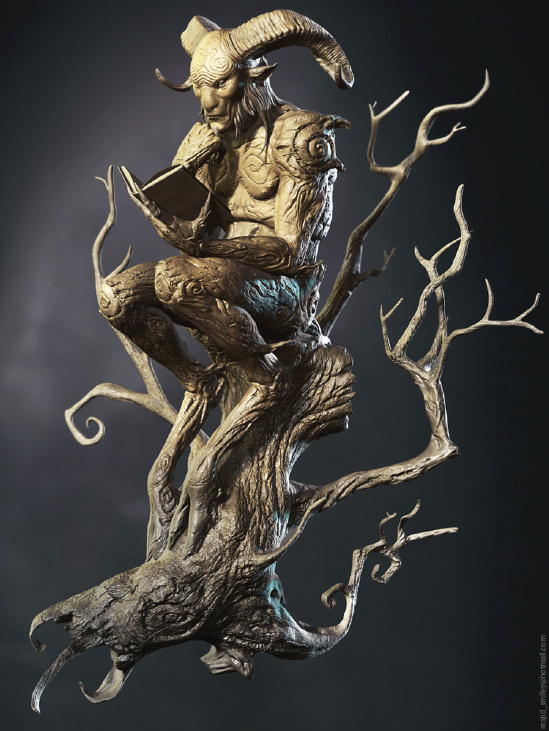
Majid Esmaeili

Majid Esmaeili’s virtual 3D sculpt of a faun, that gets close to how I imagined the character of Maddock in my new novel The Spyders of Burslem. Although with smaller horns.

It’s a pity that Stoke-on-Trent could not have transitioned a tranche of the city’s talented ceramics model makers into virtual computer-based 3D sculpting and model-making, when we had the chance in the 2000s. We could have turned our city into a world-centre for virtual character and model creation/painting, building on centuries of tradition in the ceramics industry. Which, with new developments in 3D printing and bespoke vinyl toys, would by now have come full circle back to the creation of physical products. Sadly the public-sector farce that was ‘Worldgate’ seemed to make the city’s officials averse to production schemes that are ‘digital’ and ‘creative’ and that required significant public money. And the highly insular nature of the city seemed to create a blind-spot, about the potential of global sales of virtual goods over the Internet.

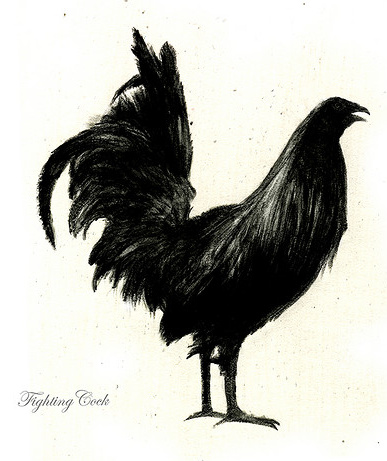
Cock measuring machine in Staffordshire

Dr. Plot’s Natural History of Staffordshire, written in 1686, makes mention of a machine then in use in this county for gauging the size of fighting-cocks. The writer designates this ingenious contrivance as —

“the nicest piece of art that ever I saw relating to the feathered kingdom, and, indeed, the ‘most curious was an instrument shown me by the Right Worshipful Sir Richard Astley, of Patshull, baronet, of his own invention to match game-cocks, discovering their size, both as to length and girth, to so great an accuracy that there cannot be easily the least mistake.”

[…] as a rule the lightest pair of cocks were fought first, then the next in weight, and so on till the heaviest pair were the last to be pitted.

— from Old English Sports.


Illustration: Bill Mayer.

Death and wildfowl in North Staffordshire

Another interesting addition about my theory on the links between North Staffordshire and certain beliefs about wildfowl, as explored in the central section of my book A History of Burslem and the Fowlea Valley

“A dying person should not be allowed to lie on a bed or pillow stuffed with feathers from pigeons or wild fowl.”

The source is unspecified, but is either The Folklore of Staffordshire, or Staffordshire Customs, Superstitions and Folklore.

Children and rainbows in Staffordshire

“Many folk beliefs went beyond merely avoiding the rainbow’s spiritual power [a rainbow was believed to harm anyone who pointed to it] — they try to manipulate it. […] Children in Staffordshire, England, attempted to [break the power of rainbows to harm a pointing person] by crossing a pair of sticks or straws on the ground and placing a stone or two atop them, the goal being literally to cross out [the power of] any rainbow they saw.”

   — from: Raymond L. Lee, Jr. and Alistair B. Fraser. The Rainbow Bridge: rainbows in art, myth, and science. Penn State University Press and SPIE Optical Engineering Press, 2001.

Mirrors and souls

My answer to a question Blood and Bone China asked on Facebook…

Q: Where does the myth about not being able to see a vampire’s reflection in a mirror come from?

A: The vampire is deemed not to have a soul, and hence no mirror will reflect him or her. The idea probably came originally from the prehistoric association of pools with sacred deities that were deemed to inhabit them, a widespread belief testified to by abundant votive offerings found by archaeologists at the bottom of ancient pools and ponds in the UK and Europe. Reflections seen in such places were thought to be reflections of the soul, not of the actual body, and hence to pose a danger of seduction. This could be either a danger of self-love (seen in the myth of Narcissus, etc), or a danger of the person’s soul being “taken under” by the watery deity. Possibly this had a root in a belief that one had to shed one’s selfishness when approaching such places, or risk calamity. Then, when mirrors came along in the Bronze Age, these would have been seen as having the similar capability to ‘steal’ or “embody” one’s soul, in much the same way as the similarly reflective dark watery pool. Modern tribal peoples often have similar beliefs, even today, about mirrors and camera lenses and their potential to “steal” one’s soul. As David Jones says, there are also several mirror folk beliefs around funerals and souls (i.e.: cover mirrors while laying out the dead body in a home) that have persisted to the modern day in certain places. The folk association of “bad luck” with breaking household mirrors probably also dates back to such antiquated beliefs. All these can be traced to the idea that the reflection in a mirror is that of the soul, not of the body.

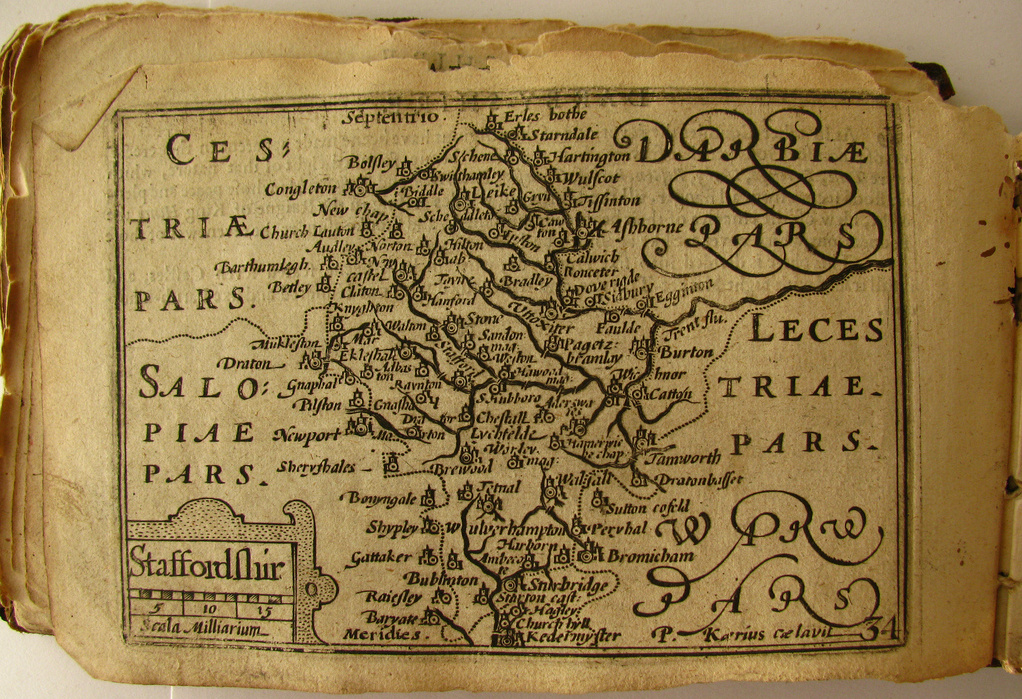
Staffordshire in the early 1600s

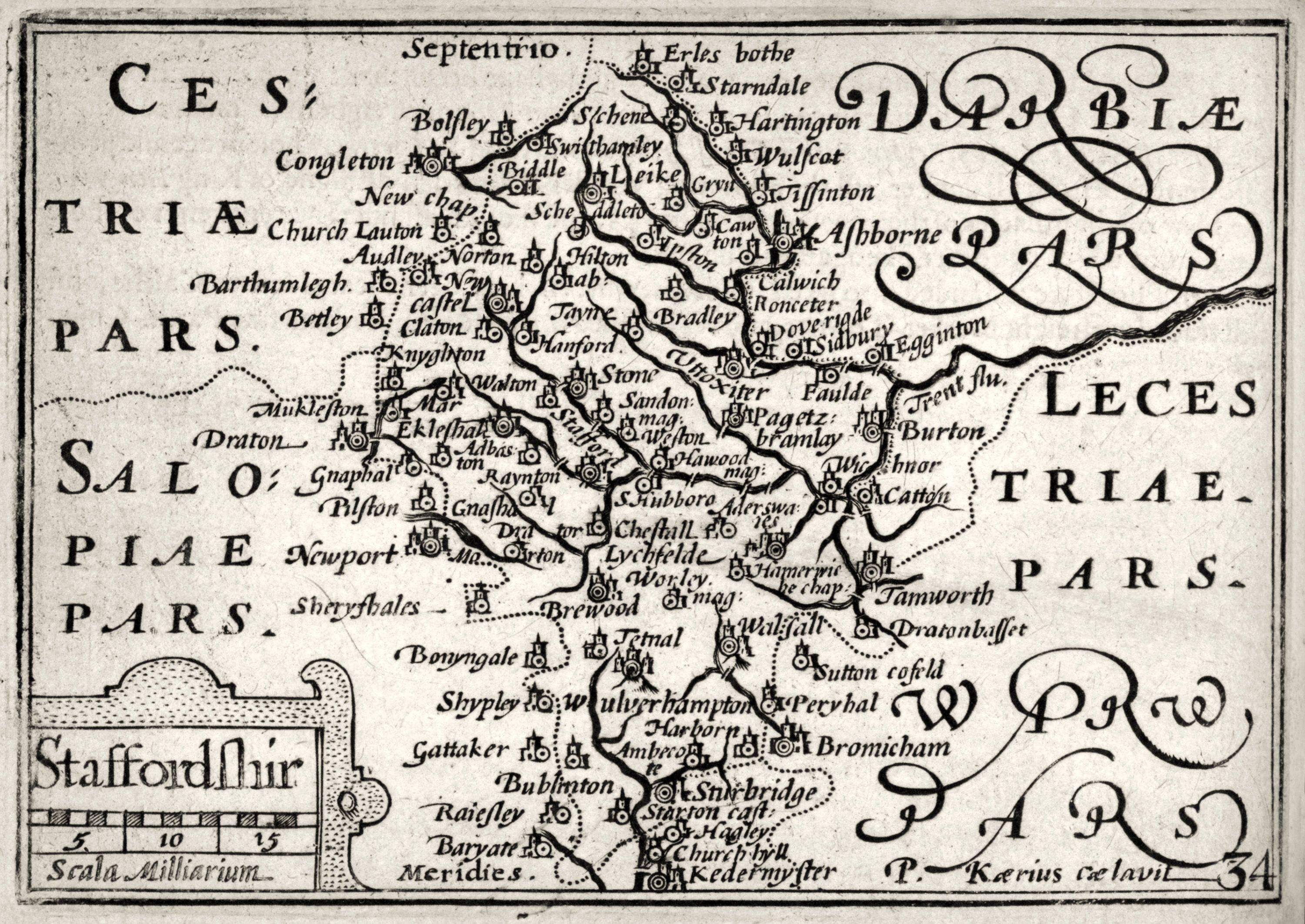
Staffordshire, as seen in the volume ‘England Wales Scotland and Ireland Described and Abridged with ye Historic Relation of things Worthy memory from a farr larger Voulume Done by John Speed. Anno Cum privilegio 1620’…

  [ Thanks to: SeriyKotik1970, who has a larger version ]

Apparently they were engraved in the early years of the 1600s, and also appeared in Camden’s Britannia in 1617.

Update, April 2018: huge version, non tatty…

* Old road expert, Charles G. Harper, in his The Manchester and Glasgow road Vol. 1 (1907), on the oldest post-road from Manchester to London in the district…

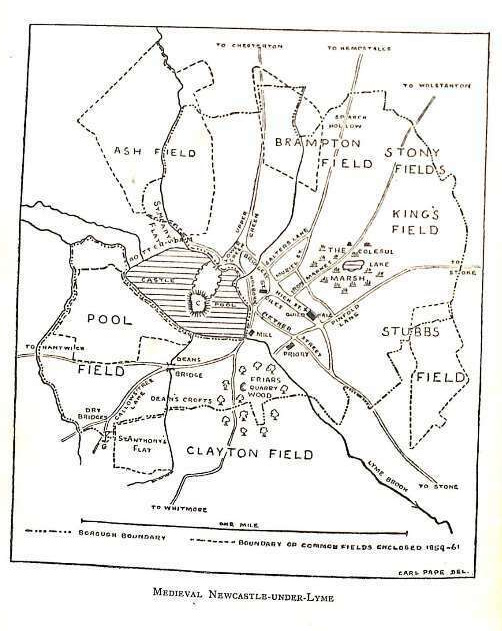
To go back to still earlier times [17th century, one saw only] horsemen, who were then your only travellers, jogging along from Manchester to London by way of the roundabout route of Warrington, Great Budworth, Cranage Heath, Holmes Chapel, Brereton, Church Lawton, [Red Street,] Newcastle-under-Lyme, whence they would generally proceed by Stone, Lichfield, and Coleshill. That was, with minor divagations suggested by taste and fancy, or by such circumstances as floods or highwaymen, the old original post-road.

Interestingly, Red Street to Holmes Chapel was later my suggestion for the likely route of Sir Gawain’s entry into North Staffordshire in Sir Gawain and the Green Knight.

The Etruria Valley landscape in the mid 1860s

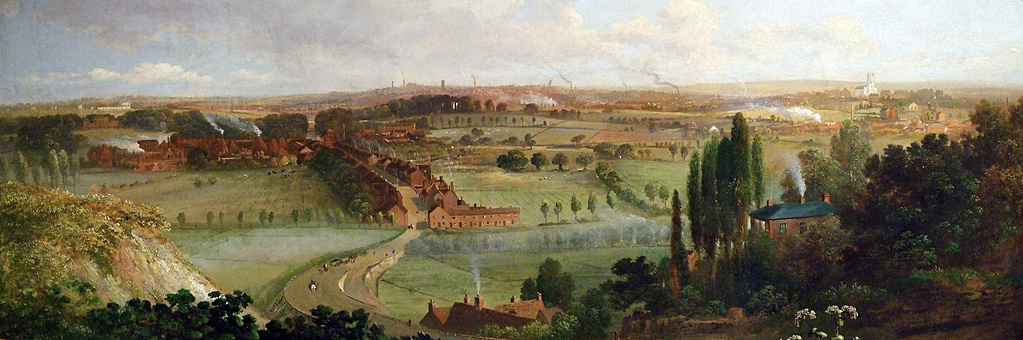
This was the sort of landscape you had in Stoke-on-Trent in the mid 1860s. This is a large oil painting by Henry Lark Pratt (1805-1873), “Etruria from Basford Bank”. Shelton Church can be seen in the distance over in the far right of the picture, Etruria Hall is on the left. This is the landscape through which the hero of the novel The Spyders of Burslem travels on the train from Stoke station to Longport station.

“I glimpsed [from the steam train] old women and girls out collecting sloeberries along the thick hedges of the rail line. I was obviously in one of those industrial districts where the countryside ways and the new manufacturing ways lived strangely side-by-side. It seemed a bucolic and rustic glimpse, but I had no doubt that each of those rosy-cheeked girls had a tongue in her head that would clip a hedge.” — from The Spyders of Burslem

It’s slightly cropped at the top and bottom, as can be seen from this thumbnail…

The new Basford Bank road was built 1828, alongside the older and much steeper Fowlea Bank road (seen here as the roofs paralleling the new road) which is the logical place at which the old Roman road at Wolstanton could have dropped down the side of the valley to reach what is now the Stoke station area (where it’s known to have run). Further down the valley was too likely to be flooded out in winter where the Fowlea met the Trent.