The Kidsgrove to Stoke Ridgeway

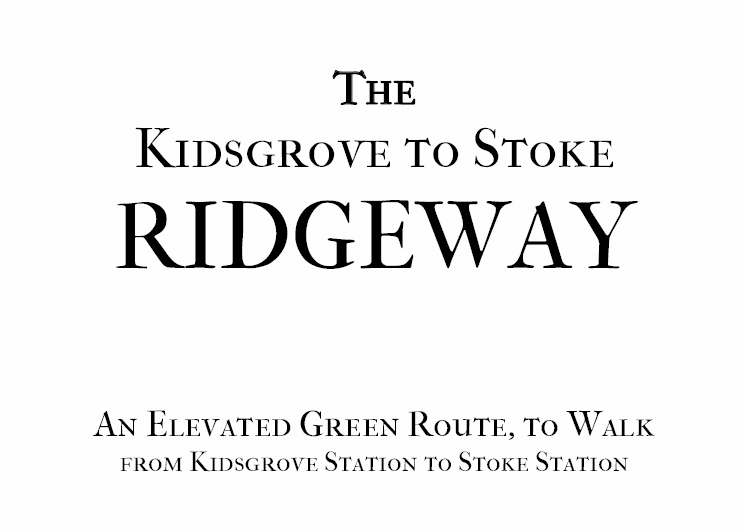
My new free ebook, of nearly 100 pages: The Kidsgrove to Stoke Ridgeway: an elevated green route, to walk from Kidsgrove Station to Stoke Station (5Mb PDF). It photographs and describes a new ten-mile ridge walk, going all the way down the western edge of the Stoke-on-Trent valley. I’d estimate that about eight miles of the walk are either wooded, pasture, or parkland. Be warned, it has a delicious mix of strenous slopes — and is not for the faint-of-heart! Some parts of the route, such as the Bradwell Wood bit, are very muddy in winter and spring. It’s an unofficial continuation of The Gritstone Trail, a similarly tough “up and down” long-distance path which currently terminates at Kidsgrove.

Update: Nine years old now, at spring 2021. So walkers should expect that some aspects of the walk may have changed. Especially on the approach from the north to Wolstanton churchyard. I welcome update reports – please post in the comments below.

Speaking tubes in North Staffordshire

An interesting sidelight on my portrayal of pneumatic speaking tubes in Burslem, in my novel The Spyders of Burslem. It seems such tubes were in use on the area, and over long distances, if only in the late 1600s. Around the year 1690 the Elers [redware potters] briefly settled in Bradwell Woods, near Burslem, to take advantage of the fine red clay there, and had…

“…a speaking-tube made of earthenware pipes, which they laid across the mile separating Dimsdale Hall and Bradwell Wood, and through which they conversed.” — “The Romance Of Old China: The Elers’ And Their Wares”, by Mrs. Willoughby Hodgson, circa 1910.

The earliest mention of this tube I can find via online methods is from The Athenaeum journal (1892). An account of a discovery of part of the tube was given in the book Staffordshire Pots and Potters (1906), which also gave an illustration of the tube sections found…

“The story was for many years received with amused tolerance as an old wife’s tale, more or less mythical, until accident revealed the actual existence of the pipes. […] William Wall, who afterwards became a builder, and was employed, during the year 1900, by a company of brewers to make certain alterations in a tavern called the “Bradwell House,” standing on the site of the Elerses’ pottery. […] during the excavations, in removing a wall, a number of pipes were found, together with a kind of cup, having no handle or bottom, evidently used for an ear or mouthpiece. […] They are at present exhibited in the Hanley Museum.”

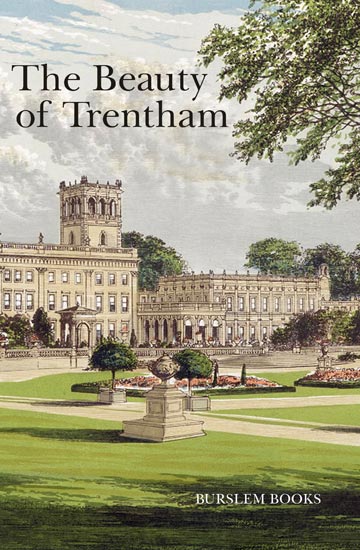
The Beauty of Trentham – second edition, revised and expanded

Now available as an ebook for the Amazon Kindle ereader, the substantially expanded and revised second edition of my The Beauty of Trentham

This special Kindle edition also contains additional historic texts describing the 19th century Trentham Park, Trentham Hall, and Trentham Gardens, not available in the paperback version.

As with all Kindle ebooks, a free sample of the first 10% of the book can be had on Amazon.

Painting Trentham Hall and Gardens, 1835-1935

Painting Trentham Hall and Gardens, 1835-1935 runs until Sunday 8th July 2012 at the Newcastle-under-Lyme Museum and Art Gallery. This new exhibition of the art and illustration of Trentham Hall and Trentham Gardens includes some new works purchased recently at auction from Christies, by Henry Lark Pratt and the Minton factory. The rest seems to be drawn from the local museum archives. There’s a leaflet but no catalogue, so visit while you can. There are a few interesting items missing, such as the picture from 1872 which is seen below. Also missing are the major paintings by E. Adveno Brooke; Plot’s image of the first Trentham Hall in 1686 (although admittedly that’s before 1835); the watercolour map of the gardens and the hall elevation plan by Sir Charles Barry; the engravings of the Hall interiors in the 1880s; and the many photographic images of the Hall in ruins in the 1910s.

The exhibition’s information boards rather oddly give the distinct impression that Trentham was not open to the public, but it obviously was…
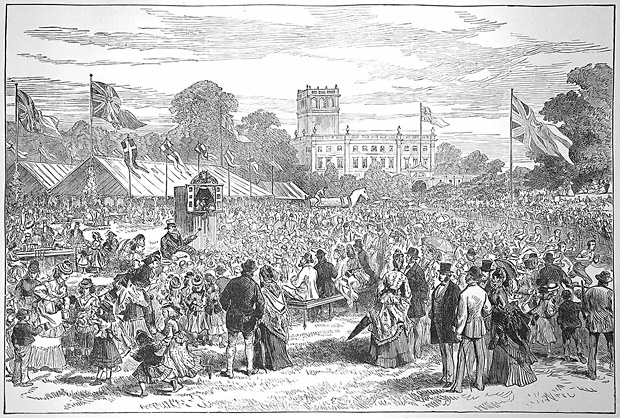

Above: Public fair at Trentham Gardens, 1872. Not included in the exhibition.

“The park and gardens are both open to the public; the latter on gala days, and the former at all times” — The History of the Tea-cup, 1878.

“A boon indeed to the densely-packed population that live in the Potteries such a park as that of Trentham must be, for the park is open to the public.” — Vanity Fair, 1882.

“All who have a shilling to spend have run away to spend it [at] a grand gathering of visitors at Trentham Park where all comers may freely enjoy themselves on the greensward. […] from eight in the morning until five in the afternoon, visitors poured in in a continuous stream; and at that hour the crowd in the park could not have numbered many less than forty thousand. Some of the young men engaged in cricket, prison bars, and other athletics games; but the majority preferred amusements in which the fair sex could participate; and many were the parties engaged heart and soul in the stirring polka, and other favorite dances. Picnic parties luxuriated beneath the shade of the noble trees skirting the park. Those who preferred “pairing off” wandered along the numerous glades opening out in different directions.” — report in Kidd’s Own Journal, 1853.

“North Staffordshire people have for so long enjoyed the privilege of walking in Trentham Park that it has come to be regarded as a public park” — North Staffordshire Journal of Field Studies, 1974.

“… on no green spot in England have more kissing rings been formed than in Trentham Park. If they could all have been marked, as the rings were marked where the fairies used to dance… ” — memories of the old potter Charles Shaw, who does not appear to be talking about making of the traditional Christmas Mistletoe ‘kissing ring’.
Older patterns of popular belief in the Midlands

“The persistence of older patterns of popular belief was much stronger than is commonly allowed [from the 1860s to the 1960s]. Reporting from a late vantage, Hoggart noted how his grandparents, moving into Leeds in the 1870s, brought with them and long retained the remedies, sayings and ‘superstitions’ of a rural life. Later still J. Seabrook [the sociologist Jeremy Seabrook] records the memories and beliefs brought by his country kin into the industrial settlements of the Midlands and long surviving there”
— Jason Marc Harris. Folklore and the Fantastic in Nineteenth-Century British Fiction. Ashgate, 2008. (quote is actually Footnote 47, which is from the following source: Joyce, Patrick. Visions of the People: Industrial England and the Question of Class 1848–1914. Cambridge University Press, 1991.)

New “Staffordshire Strange Tales” booklet

Stephen Harvey has a new Kindle ebook edition of his Staffordshire Strange Tales booklet. 34 pages of eerie and strange tales from North Staffordshire…

“North Staffordshire has a history unlike any other place in the United Kingdom. [Here are] … some very strange and some very true tales of the area including Molly Leigh who was a very real witch who lived in Burslem, the mermaid of Blackmere, the chained oak of Alton Towers, and the headless corpse of Harecastle Tunnel. There is even a haunted radish, that terrified a woman in Leek!”

Two Universities Way – new North Staffordshire walking guide

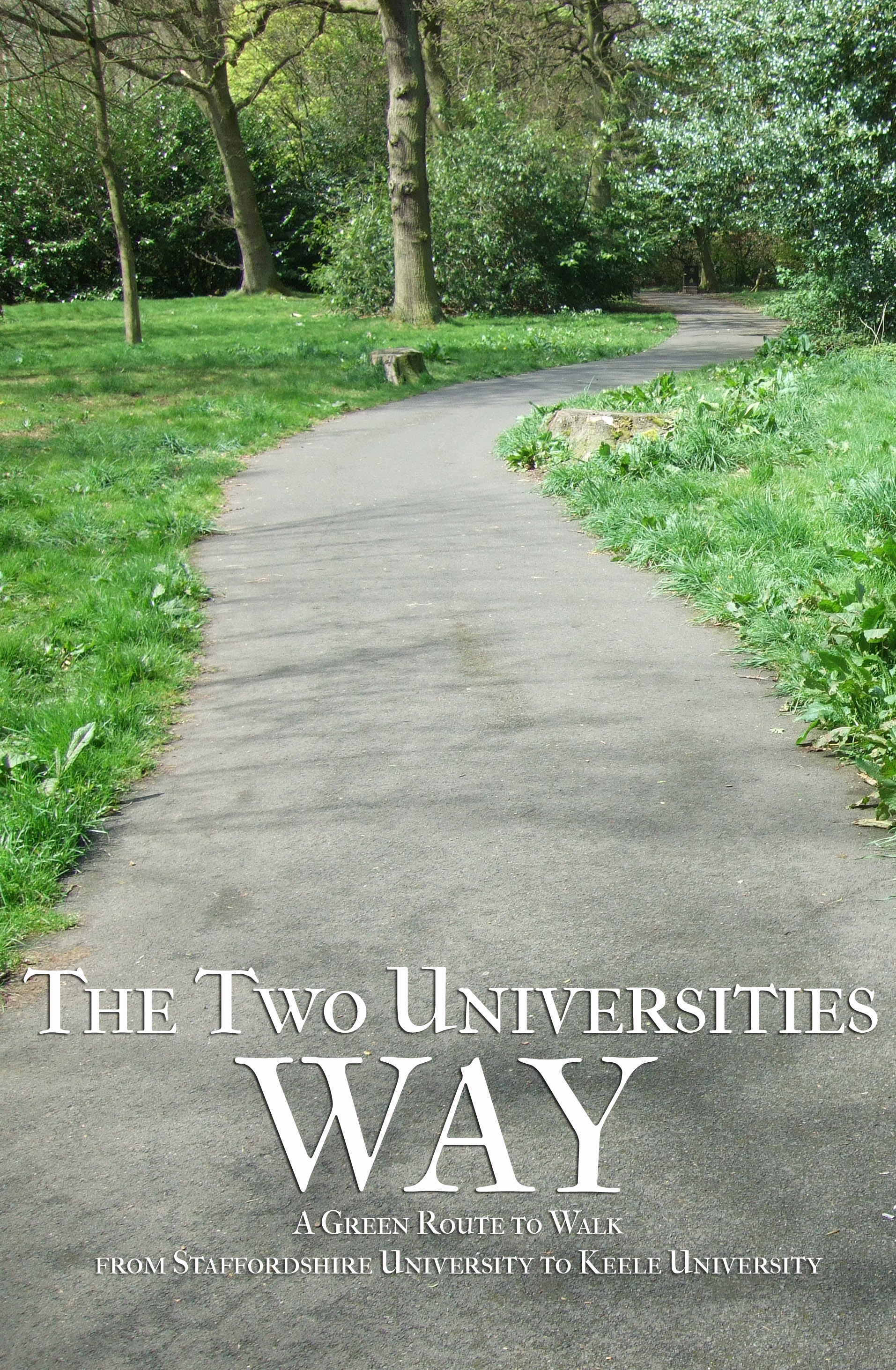
The Two Universities Way is a new photo-guide for walkers. It describes and shows a new green five-mile walk, between Staffordshire University and Keele University. Produced for the North Staffordshire Woodland Walks Week, May 2012. 46 pages / 4,000 words. Available now as a free PDF ebook (5mb), or as a cheap paperback to slip into your pocket while walking the route for the first time.

Update: Autumn 2024: The guide is getting on for 12 years old now, and may need updating in places.

Plot’s Natural History of Staffordshire – digital facsimile available

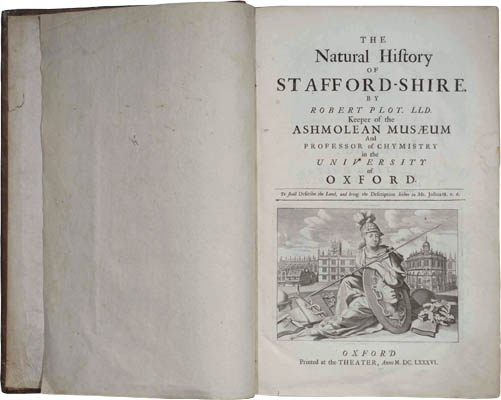
Interested in reading a copy of Plot’s Natural History of Staffordshire (1686)? In 2012 there doesn’t appear to be an online PDF of this public domain work, but there’s a digital CD facsimile available for a reasonable £12, from Midlands Historical Data. It’s not just about birds and beasts and plants, it also has good deal on folklore and customs. Original copies of the book seem to fetch over £1,500 at auction.

Update, November 2017: now available online, The natural history of Stafford-shire by Robert Plot albeit without pictures.

Update, June 2023: now available online, at Archive.org in hand-keyed HTML.

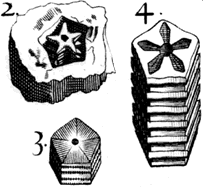
“Star Stones [seen above] were much discussed by the Oxford academic Robert Plot. Plot dutifully, and rather disdainfully, related how the commonfolk thought Star Stones came to be on Earth: “…the Stones [are] some way related to the Celestial Bodies, [and] descend next to such as (by the vulgar at least) are thought to be sent to us from the inferior Heaven, to be generated in the Clouds, and discharged thence in the times of Thunder and violent Showers…”.

Those who have read The Spyders of Burslem, and remember the “aetherstorm” and its curious hail may recognise a similarity. Also a link with one of the themes in the novel.

Also, note the book was “printed at the Theatre” in Oxford, which was founded by a man from North Staffordshire.

Family tree ebook now online

I’m pleased to say that an illustrated version of my family-tree book is now online. It might interest those working on family histories or novels set in the far reaches of South Staffordshire (specifically glass making in Kinver, Wordsley, Kingswinford, Oldswinford areas) during the 19th century, and also in north Birmingham (bicycle and motorcycle manufacturing in Hockley, Aston, Boldmere) during the late 19th and early 20th century. The online ebook omits about 20,000 words of microscopically detailed narrative family tree, and evidence footnotes. The basic tree is…

William Haydon? b. 1754?
|
Richard Haden (b. 1797 – d. 1843)
|
William Hamlet Haden (b. 1821 – d. 1866)
|
George Joseph Haden (b. 1851 – d. 1903)
|
Alfred Hamlet Haden (b. 1875 – d. 1940)
|
Sidney Francis Haden (b. 1901 – d. early 1970s)