T. E. Hulme

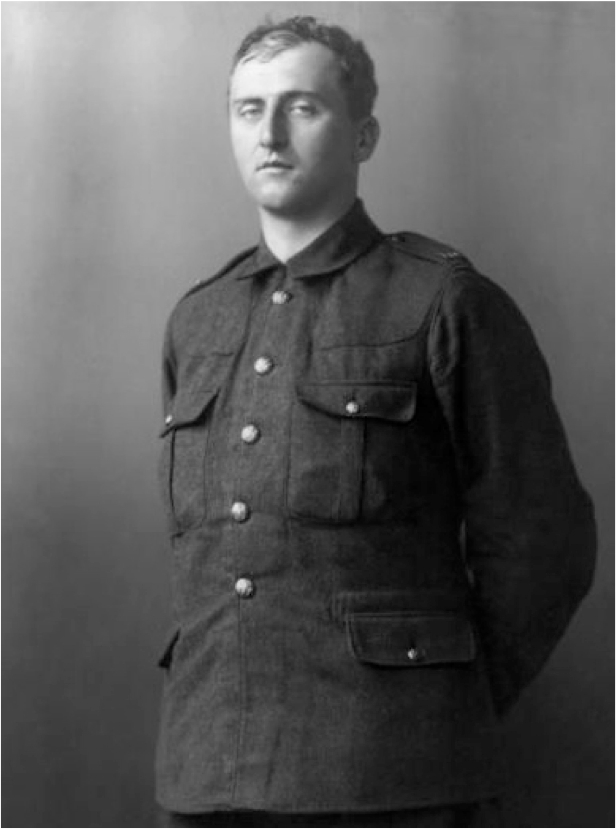
“T. E. Hulme: The First Modern Poet?” [link now dead] muses The Huffington Post today. Hulme was from Endon, his father a farmer who later worked in the pottery industry in Stoke. His son went to Newcastle-under-Lyme High School 1894-1902, and died in action in the First World War.

Hulme_1

There is also apparently “a memorial window to him in Endon church”. His papers are held at Keele.


A CITY SUNSET (1908, on the back of a hotel bill)

Alluring, Earth seducing, with high conceits
is the sunset that reigns
at the end of westward streets….
A sudden flaring sky
troubling strangely the passer by
with visions, alien to long streets, of Cytherea
or the smooth flesh of Lady Castlemaine….
A frolic of crimson
is the spreading glory of the sky,
heaven’s jocund maid
flaunting a trailed red robe
along the fretted city roofs
about the time of homeward going crowds
—a vain maid, lingering, loth to go….


Update:

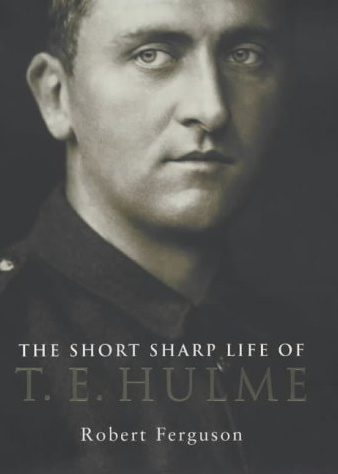
His poetry is now most easily found in good form in the back of Canzoni; & Ripostes of Ezra Pound, which is available online. The best biography is The Short Sharp Life of T. E. Hulme (2012), and there is also a 1982 biography which updated an earlier one of 1938.

A volume of his Selected Writings appeared in 2003, and the full writings are to be found collected in Speculations (1924) and Further Speculations (1955). There is also what appears to be a recent critical edition for universities, The Collected Writings of T. E. Hulme.

In recent years there have been a spate of book-length studies such as: T.E. Hulme and Modernism; T. E. Hulme and the Ideological Politics of Early Modernism; T.E. Hulme and the Question of Modernism; and T.E. Hulme: A study of his Poetry, Criticism and Influence.

Huge Plot uncovered!

Plot’s The Natural History of Stafford-shire (1686) has been freed from the archive shelves at last…

Get it free in digital facsimile at books.google.co.uk/books?id=T03JVJkdC9gC.

1. Hover (don’t click!) mouse cursor over the red “EBOOK – Free” button in the sidebar.
2. Click the PDF link inside the pop-up.
3. Enter the captcha check word, and then download.

The PDF is 50Mb. All hard scans, of pages done in the old “long s” style, but readable.

plot

Magic Methodists

Interesting to read about the curious entanglement of folk beliefs with early Methodism in North Staffordshire…

“One of the most graphic instances of Methodist involvement in the world of popular witchcraft […] occurred during the camp meetings of the Forest Methodists earned them a supernatural reputation, and the popular name of ‘Magic Methodists’. Writing in the latter half of the century, the local [North] Staffordshire historian Henry Wedgwood recalled that many of the local inhabitants at the time were terrified of the magical activities of an innkeeper named Zacchariah Baddeley [see: Henry Wedgwood, Up and Down the County, Hanley, 1880] […] The Methodist authorities were obviously well aware of the supernatural beliefs held by many of their members.” — from “Methodism, the Clergy, and the Popular Belief in Witchcraft and Magic”, 1997.

Folk-lore journal 1968 adds… “It is a pity that Wedgwood is not more explicit about the sort of magic that Baddeley professed to work”.

North Staffordshire “Witch Brooches”

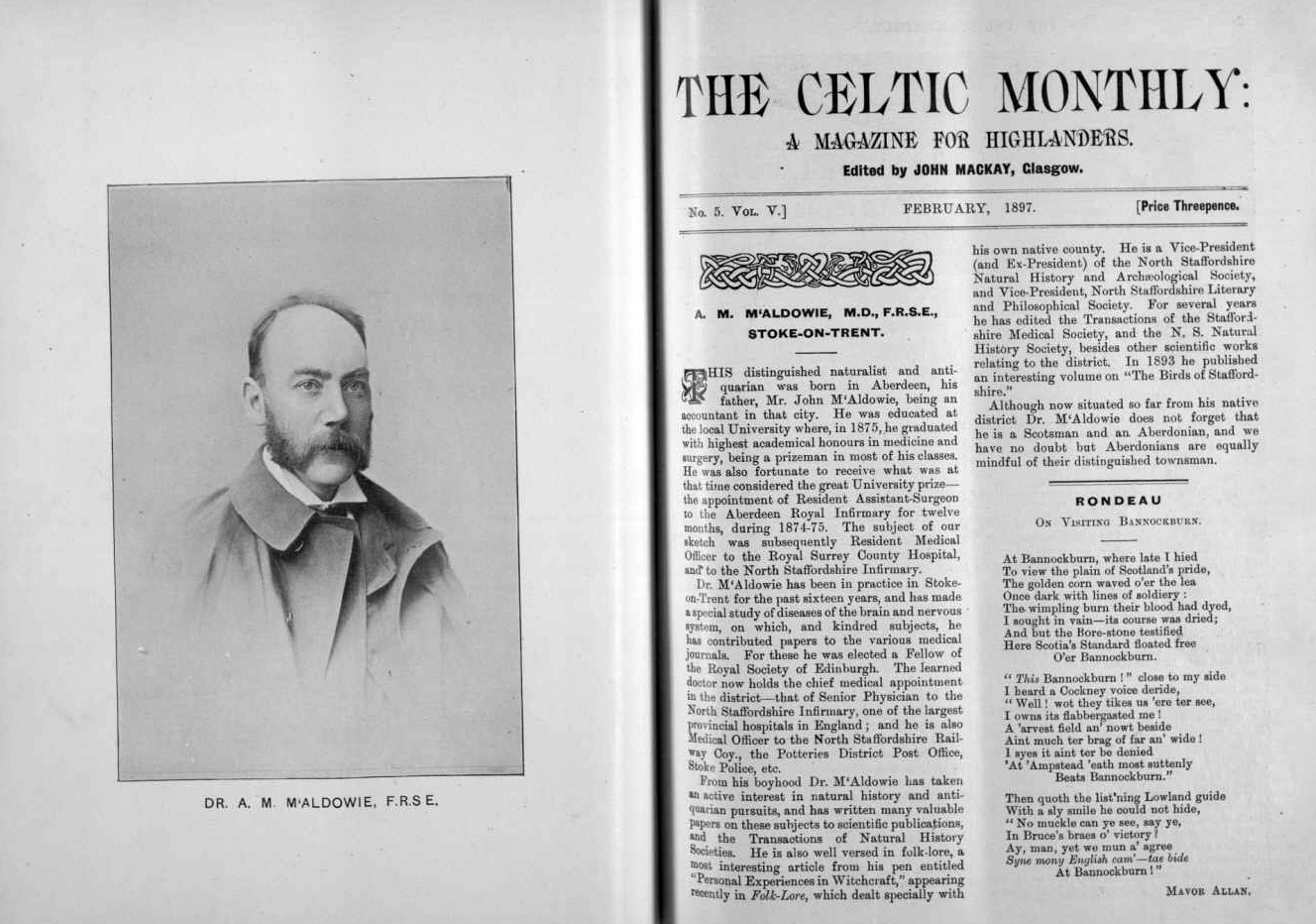
Alexander Morison McAldowie, from his article “Personal Experiences in Witchcraft”, Folk-lore journal, 1896…

“My first experience of witchcraft began at a very early age, before I was an hour old, in fact. My maternal grandmother, a pure-bred [Scottish] Highlander, held me close to the fire, and, taking care that she was unobserved, quietly fastened this witch-brooch beneath the ample skirts of my baby-garments. This form of brooch, fastened in the manner above described, was firmly believed to possess the power of driving the witches, which lay in wait for all newly born children, up the chimney. It protected the wearer from their malevolence, and brought good luck. The rite was practised universally in rural districts throughout the north in my grandmothers time. [His brother Robert had a small collection of witch-brooches] The two witch-brooches set in brilliants [i.e: set around with brilliant cut stones] [my brother] found in Staffordshire. One was the subject of a paper read before the North Staffordshire Field Naturalists’ Club in 1890 [Transactions, 1891]. It is interesting to note that the second specimen, which he obtained after the paper was read, is identical in every respect with “Shakespeare’s brooch,” found at Stratford-upon-Avon about seventy years ago.”

Alexander Morison McAldowie was the editor of Staffordshire Knots (1895), and Vice-President of the North Staffordshire Literary and Philosophical Society (c. 1897).

“Born in Aberdeen in 1852, Alexander Morison McAldowie moved to Staffordshire in 1876 when he was appointed House Physician at the North Staffordshire Infirmary. He later had a private practice at Brook Street, Stoke on Trent until his retirement in 1909. He then moved to Cheltenham, where he died in 1926. He was a member of the North Staffordshire Field Club from 1877 and was a keen amateur naturalist. He was also a Justice of the Peace for Stoke on Trent.” (from Staffs PastTack)
mcaldowie

Here is his brother Robert McAldowie’s 1891 North Staffordshire Field Club Transactions article on the “witch brooch”…


NOTES ON A STAFFORDSHIRE WITCH BROOCH.

BY ROBERT McALDOWIE.

The small brooch which is the subject of this notice is heart-shaped, not of the conventional shape seen on a pack of cards, but is unequal sided, one side being full or rounded, the other indented. In size it is one inch wide and a little more than one inch in height. It is made of silver and set with eighteen crystals in what is called a fancy setting, that is, each crystal is set separately in a piece of silver, and then the pieces are soldered together in the required shape. This is the first example of this kind of setting I have met with, all the other heart-shaped brooches I have seen, set with stones, had a plain setting, just a band of silver with the stones set in it. The most peculiar thing about this brooch is its method of fastening. The pin is hinged on the back, comes through the open loop in the centre, and then the point rests on the front, so that no catch is necessary. This is a particularly safe fastening, for once the brooch is fastened on a piece of cloth it will not become undone unless the fingers are used, and this was a very necessary requirement for this kind of brooch. It was not an ordinary piece of ornamental jewellery, nor was it always used in what we, now a-days, would consider a useful manner; yet in the age in which it was worn it was a very essential article to the peace of mind of a certain class of people—namely the superstitious, who believed in witches and in luck. From the peculiarities I have described I have no doubt this is an example of what is known as a “Witch Brooch.” They were usually bought along with the wedding ring, and were supposed to keep away witches and bring good luck to the wearers. The lady wore it first but not exposed to view; then it was transferred to her children by a trustworthy nurse, who put it on their little garments while sitting by the side of the fire-place, so that if a witch had got a hold of the child, that evil being would find a ready mode of exit up the chimney, unable to withstand the influence of this miraculous charm.

The wearing of this brooch was thought to be an infallible safeguard against all kinds of evil, and it was considered a very foolhardy thing if parents neglected to put one of some kind on their children’s garments. I have examples of home-made brooches of such common materials as brass and mother-of-pearl, which I found in Scotland, the people who made them being, very probably, too poor to buy silver ones, but determined to have a “heart” of some description to keep their children from being witched.”

[A section on the fading away on the tradition in Scotland, which was within living memory at 1891, followed by a section on the “Shakespeare brooch”]

One of the brooches I have here to-night has this word [“love”] engraved on the back of it, and I have seen them with a scripture text, usually there are the initials of some persons. This Staffordshire one has no inscription of any kind. I got it in Lichfield, in a jewellers, who had bought two of them from an old servant of a family once living near the town; the other brooch he could not find, he thought it had been melted down for old silver, sharing the same fate as many others of the kind. I have inquired at many jewellers in North Staffordshire for these brooches, several remember seeing them but long ago, others have had them and consigned them to the melting pot as useless, of no interest, and not worth keeping. I should be very pleased if these few notes should help to preserve, or bring to light in this neighbourhood, some of these quaint and interesting old brooches.


As his brother states in his article “Personal Experiences in Witchcraft”, Folk-lore journal, 1896, Robert later found another witch brooch from Staffordshire some years after this paper was published.
“Ding a dong ding, I heard a bird sing.”

From EXAMPLES OF FOLK MEMORY FROM STAFFORDSHIRE.
BY SAMBROOKE A. H. BURNE, M.A., BARRISTER-AT-LAW.

In The Transactions of the Folk-Lore Society, 1916.

[…] a lullaby or jingle which in 1892 was heard sung to a child at Harriseahead, a remote colliery village in North Staffordshire. The singer was an old woman, and there were several verses, but only one was noted :

” Ding a dong ding.
Ding a dong ding,
I heard a bird sing.
The Parliament soldiers have gone for the King.”

[…] This rhyme is not confined to North Staffordshire. A member of the North Staffordshire Field Club writes that she remembers it being sung to her in her childhood by a nurse, “probably a Cambridgeshire woman, and almost certainly from the Fens.”

North Staffordshire Souling Song

I’ve had a go at putting the North Staffordshire Souling Song c.1894 into a more singable form, added a rhyme back in on the fourth line, and stripped out the clunky Christianising of the end lines…

“Soul, soul, an apple or two
If y’ave non apples, pears u’ll do ;
Up wi’ your kettles, down with y’ pans,
Pray, good missus, a soul-cake, do!

Souling-day comes once a year
When it comes, it finds us ‘ere.
The cock sits up in t’ yew-tree,
The hens came cackling by,
I wish yer a merry Christmas,
And a good fat pig i’ the stye.

All us stand at yonder gate
A’ waiting for a souling-cake ;
One for sorrow, two for joy,
Three for a star to sail o’er all.”

The Mount (1909) by C. F. Keary

A newly discovered novel, set in the Potteries. Charles Francis Keary‘s The Mount (1909) is set in his home place of Stoke-on-Trent…

“The scene of The Mount is that part of Staffordshire where the towns lie beneath an almost unbroken pall of smoke, and the chemicals with which the air is laden bite into the face of Nature, pitting, discolouring, and withering everything. Those who were not tied to the place by industrial connexions have fled before the blight, and a new ‘aristocracy’ has arisen…” [the novel not for everyone, such as] “the hasty reader whose palate cannot taste fine shades of flavour will perceive no reason for the insistence on minute differences of tone and meaning. Mr. Keary does not write for him, and is, we suspect, splendidly indifferent to his judgement.” (The Spectator review, 4th September 1909).

Sadly the book is utterly obscure and unobtainable. Keele Local Collection doesn’t even have it. I didn’t even know about it, re: my recent survey of local novels (FactoryMag #1). There’s one copy in the British Library, and a Google-scanned copy in Hathi is on an annoying and unnecessary copyright lockdown.

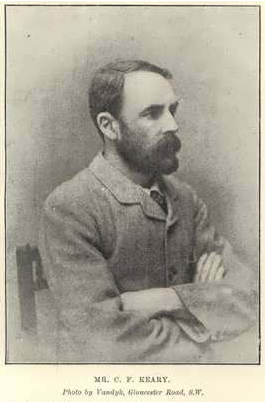
C. F. Keary was the son of the borough of Stoke-on-Trent’s first Mayor, and the brother of the local folklore collector Miss Keary. His book of weird tales Twixt Dog and Wolf was admitted by James Joyce to have been an influence on Dubliners.

From the Times obituary…

[His novels] “The Journalist” (1898), “High Policy” (1902), “Bloomsbury” (1905), “The Mount” (1909). Keary’s novels, aiming at depicting life, after the manner of the great Russian writers, in its chaotic reality and avoiding conventional selection and arrangement, never had a large popular circulation. They were, however, very highly though of within the limited literary set. Besides his novels proper two little books of Keary’s call for notice. One was a small volume “The Wanderer” (1888), published under the pseudonym H. Ogram Matuce, in which Keary strings together a number of disconnected thoughts and criticisms under the assumed person of a retired man of letters, somewhat in the manner of Gissing’s “Papers of Henry Rycroft.” This is perhaps the most perfect and charming of Keary’s prose works. The other little book is a series of short sketches in the weird and macabre, “Twixt Dog and Wolf” (1901), excellently done.

If there is perhaps another Stoke or Staffordshire setting hidden in these titles, other than The Mount, is unknown.

keary


Update, Feb 2020: The Mount is now online for free at Archive.org.

Miss Keary on the sing-song proverb-speech of the Potteries

Miss Alice Annie Keary, confirming in 1896 the habit of the Potteries people in the 1880s and 1890s to naturally speak as in sing-song proverbs and poetic epigrams, but not to realise that they were doing it…

“…proverbs I have for myself found very difficult to collect, owing to the Poyser-like habit of our people of expressing themselves in an epigrammatic and metaphorical fashion which may be proverbial, but is quite as often extemporised.”

Keary, though the key North Staffordshire folklore and folksong collector of the mid 1890s and presumably rather experienced at such things, thus found it very difficult to distinguish between ordinary speech and proverbs. Keary alludes above to Mrs. Poyser, a proverb-spouting character in the novel Adam Bede by George Eliot.

Keary had grown up in Stoke and at the time of her observation lived at Oakhill, Trent Vale.

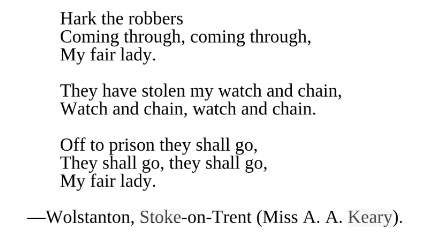
Sadly it appears her papers and work-books have completely vanished, and we are left only with bits that can be picked up from publications. Such as this Wolstanton children’s game-song, collected by Miss Keary and published in The Traditional Games of England.