Stafford Shakespeare presents The Tempest at Stafford Castle, in 2017. Apparently it’s going to be a politically correct version.

Stafford Shakespeare presents The Tempest at Stafford Castle, in 2017. Apparently it’s going to be a politically correct version.
Two more obscure locally-set novels, discovered. John Toft (b. Eric John Toft, 1933-), The Bargees (1969, J.M. Dent & Sons) and The Wedge (1972, W.H. Allen). Both book were from solid publishers of the time, indicating quality. The publisher blurb for The Bargees opens…
“Two Potteries children, Sheila and Ernie, are friends. Ernie is an orphan, and he and Sheila are friends of Liddy…”

I can discover no more, and the novel is decades out of print and unobtainable, though the cover art seems indicative. The last days of the genuine working life of the canals were a well chronicled topic in the 1960s, and served as a backdrop to a number of feature-films and novels.
The Wedge is a regional historical novel. A book review of the time stated it…
“describes life in the Potteries region in the 1920s and 1930s. … set in the Potteries in the period leading up to the Second World War, finds the provincial working class a delight to be among but grants its dilemmas.”
I also found a snippet of a review of The Wedge by a Midlands reviewer for Books and Bookmen. The reviewer had lived here in the 1930s, and though he enjoyed the writing style it seems he found the novel’s local colour and topography distinctly lacking…
“The setting is the Potteries, though apart from some exactly reproduced flashes of the local accent and the inevitable town names, it could be set anywhere in the industrialised Midlands.”
Toft was one of the many talented Potteries people who — while they could say they were “born in the Potteries” — left just as soon as the opportunity arose. One can’t blame them, but it may help explain the apparent lack of local colour in The Wedge. In Toft’s case he left via grammar school (presumably in Newcastle-under-Lyme), then Magdalen College Oxford, followed by “travel in the East” including a spell teaching English at the Malayan Teachers College. He wrote his fiction as “a lecturer at Brighton Polytechnic” and produced three novels in the late 1960s and early 70s, with The Bargees being his first. There was also a book of stories, The House of the Arousing (1974). A short account of him in Brighton is found in The London Review, 1981…
“Up in the attic of almost the last of those white terraces [in Brighton] lived the writer John Toft; we’d first met through a shared enthusiasm for [the Welsh Marches novelist] John Cowper Powys”
An addition to the “Characters page” for my novel The Spyders of Burslem, for Jimmy Tunnicliffe, the ‘cunning’ man. The picture is not quite my character, for reasons that reading the novel will reveal, but it’s certainly evocative of the sort of look and has a suitable slightly-fey pose — and the dress is certainly spot-on for the time the novel is set.
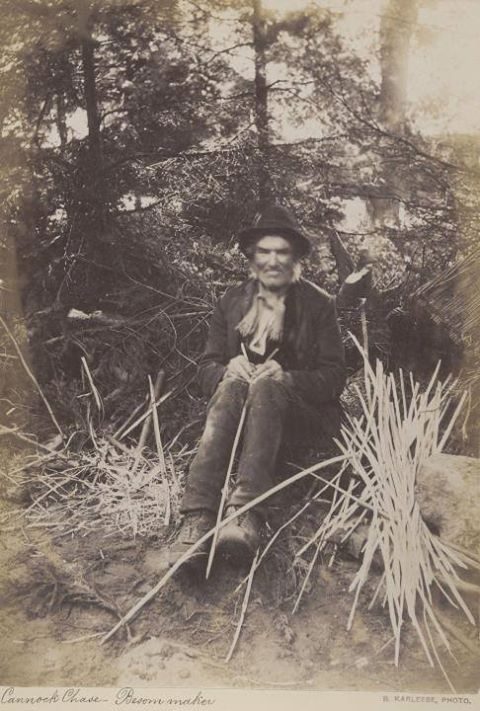
Picture: Besom maker on Cannock Chase, Staffordshire in 1867. From the collections of Staffordshire Record Office.
With air pollution from diesel car particulates and smog making headlines, and many people in Stoke still suffering from a lingering hacking cough, I thought I would take a quick look into how all this compares with risk from the past. Autobiographies and heavily retouched postcards often lead us to believe that the smoky sooty atmosphere of the Potteries (Stoke-on-Trent) in early 20th century must have been a deadly killer, and that large numbers of workers were consequently later coughing themselves to death from industry-induced lung cancer.
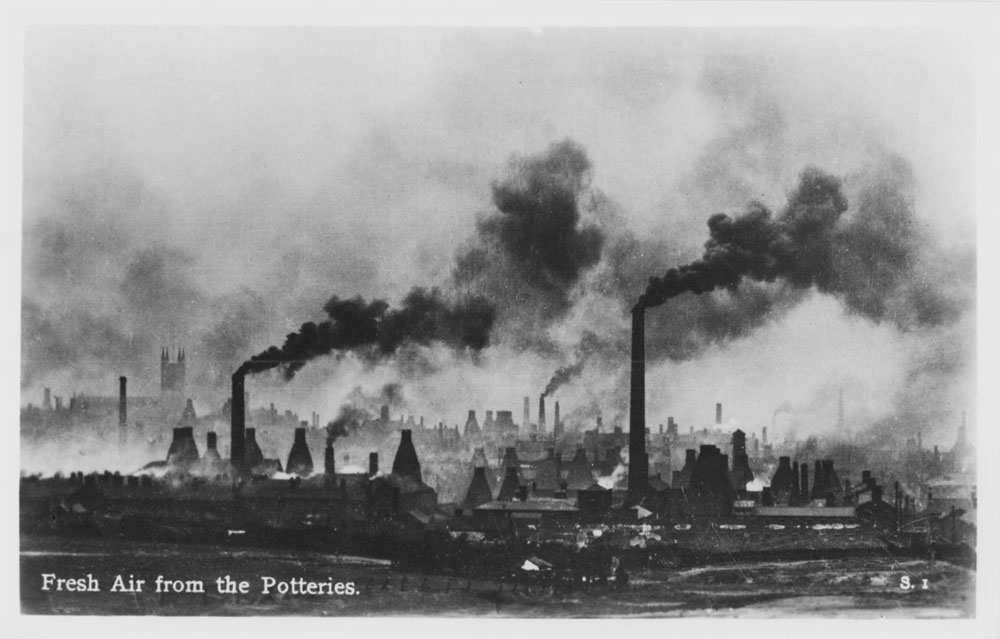
Ok, well let’s look at the workers most likely to be affected by such bad air quality. Let’s look at the working-class potters exposed for years to significant levels of scouring dust and other factory dust. Surely they must have been uniquely vulnerable to the often smoggy atmosphere of the city? There was a huge medical study of this very group, documented in a paper I found titled “Preliminary analysis of proportional mortality in a cohort of British pottery workers exposed to crystalline silica”, Scandinavian Journal of Work, Environment & Health (1995)…
“A cohort of 7,020 male pottery workers born in 1916-1945 was identified from all employees in dust-exposed trades … All but 256 (3.6%) were traced … death certificates were obtained for 940 (92.5%) of the fatalities”.
That’s a pretty good research sample and data set. So how many died from inhaling the fine dust for years, alongside living more generally in the city’s smoky atmosphere? Among this huge research sample the study could only find…
“fatalities – 122 from respiratory cancer.” And the study found that “lung cancer mortality was dominated by smoking and significantly affected by past asbestos exposure.”
Of the 122 only 47 of the deaths could be even tentatively tied only to silica dust exposure. That’s 47 too many, of course. But amid the smoky polluted air during the early and mid 20th century period, in one of western Europe’s most polluted cities and among workers in one of the most vulnerable trades… it’s remarkable that there were just 47 silica dust deaths from lung cancer among 7,020 men.
By contrast, today Stoke appears to have clean air but in actual fact has high levels of dangerous air pollution…
“The city features at number 14 in the list of places named and shamed by the World Health Organisation (WHO) for breaching air pollution safety levels.”
Overall, it’s true that the UK’s averaged level of the most dangerous PM2.5s particles has gone down a little since 1990 and are now actually below the WHO guideline level. However, this is a UK average and doesn’t matter much in terms of looking at hotspots in congested places like Stoke-on-Trent…
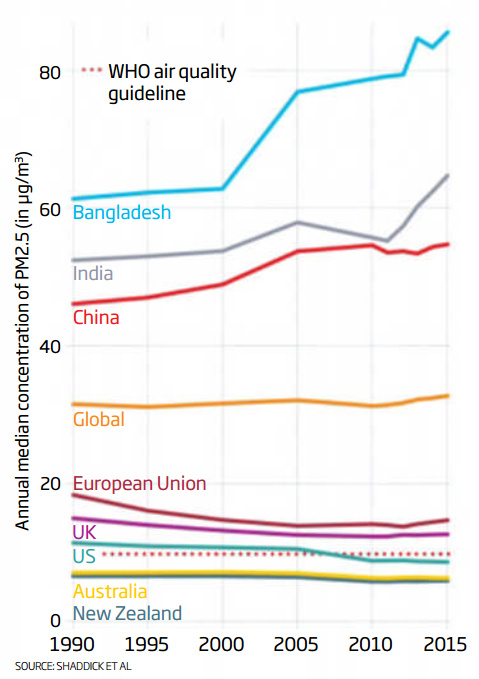
Mostly this is because of the large number of diesel cars and vans. From 2002 these were unleashed, by Gordon Brown under Labour, in what has proven to be a worthless attempt to cut carbon dioxide emissions and stop ‘global warming’. Purchases of diesel vehicles had sky-rocketed by the mid 2000s and since then they have been pumping out particulates that are currently reported in the UK press to be contributing to “40,000 early deaths a year in the UK”, with 9,500 of those deaths in London. There are about 80 large urban areas outside London, so those numbers equate to about 380 early deaths per year for each large urban area outside London.
That’s a very rough division of course. It’s also possible that the currently-mooted “40,000 early deaths” is inflated by including near-future deaths or is even an overestimate. Health and other scares often over-claim on the figures. A few years ago some UK medical experts were saying that diesel can only be clearly and firmly linked with 7,000 deaths per year, with the other deaths coming from other forms of vehicle fumes. But the UK government scientists’ best estimate for 2015 was that…
“In all the government estimates that particulate pollution from all sources kills 29,000 Britons a year.”
So let’s assume that current claims of 40,000 might well be too high, due to the usual media-scare ‘escalator’ which requires ever higher inflation of the statistical estimates in order to grab the attention of frazzled journalists. But even if we cut the 40,000 in half, Stoke would still be seeing around 200 early deaths per year across all age groups. Thankfully we have a huge number of mature trees in the city, and are fairly ‘well swept’ by winds from rural parts, which may help matters somewhat. I’d guess those additional factors may bring early deaths down to 150 a year.
But even so, that’s per year. Across the city’s population of 259,252 for the same time period encompassed by the 1916-1945 study (approx. 30 years), that would mean 4,500 deaths. That’s about 1.7% of the current population set to die early of particulates from 2017-2047. Even when using very cautious low-end figures, 1.7% is far higher than the approx 0.5% chance of getting lung cancer from working in an especially dusty bit of a mid 20th century pottery factory.
So where would you rather be: 1) walking to work for a mile each day along the Leek Road in summer 2016 at rush-hour; or 2) working each day amid dust as a pottery scourer in a Burslem factory from roughly 1936 onwards? On the figures it seems you’d be safer as the pottery scourer, sucking in dust at the factory — while also smoking heavily, socialising in smoky pubs, warming your hands on a smoking coal fire at home, and breathing in the then-smoggy air of Stoke when outdoors. Ah, those were the days…
John Lockwood Kipling, the designer of the front of the Wedgwood Institute in Burslem and a brief cameo character in my novel The Spyders of Burslem, has a major exhibition at the V&A in London until 2nd April 2017. You may have read that the V&A is set to introduce admission charges soon under the new director Tristram Hunt, and I’d suspect it may also offer his distinctively politically correct take on history. But this V&A exhibition is free and (according to The Telegraph) isn’t riddled with political correctness despite its subjects of British design and the Empire.
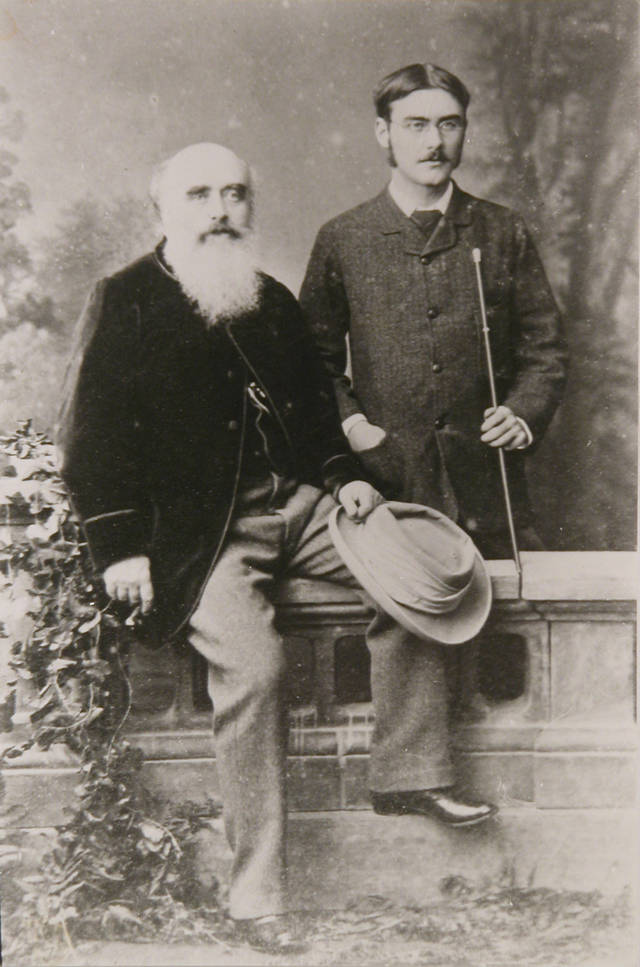 Picture: J. L. Kipling with his famous son Rudyard Kipling.
The new set of postage stamps, from the Royal Mail, celebrates the Ancient British…

“He is free of his horse, who never had one” — a saying by a wise-man named “Hendyng” who thrived in the mid 1200s, and was from what is now the south of the West Midlands (though he may have modified his language so as to be intelligible to a more southerly audience).
In April 2016, hearing about the new sci-art blue.dot festival which was set to happen at the nearby Jodrell Bank radio telescope observatory, I made a proposal on Facebook for some kind of Stoke-on-Trent fringe event that might link up with it. The core idea was a suggestions for a new “symphony” in 2018 called Skywave which would link our science heritage with ceramics. I’ve now remembered it again, and have found a little time to work it up as a poster proposal.

Slight correction: I’ve since found, during the research for my book on H.G. Wells in Stoke, that Lodge’s demonstration of electricity must have been at his new home at Wolstanton.
There’s an essay on “Romantic Quest in the West Midlands. Staffordshire and Cheshire Landscapes in ‘Sir Gawain and the Green Knight,'”, in the book collection of essays The Gawain Country: Essays on the Topography of Middle English Poetry, Leeds Texts and Monographs series, 1984.
The essay is not online, but the book may possibly still available by mail-order for £9 — according to this order page which dates from about circa 2011. (Update: no, still totally out-of-print and not online, at early 2019).
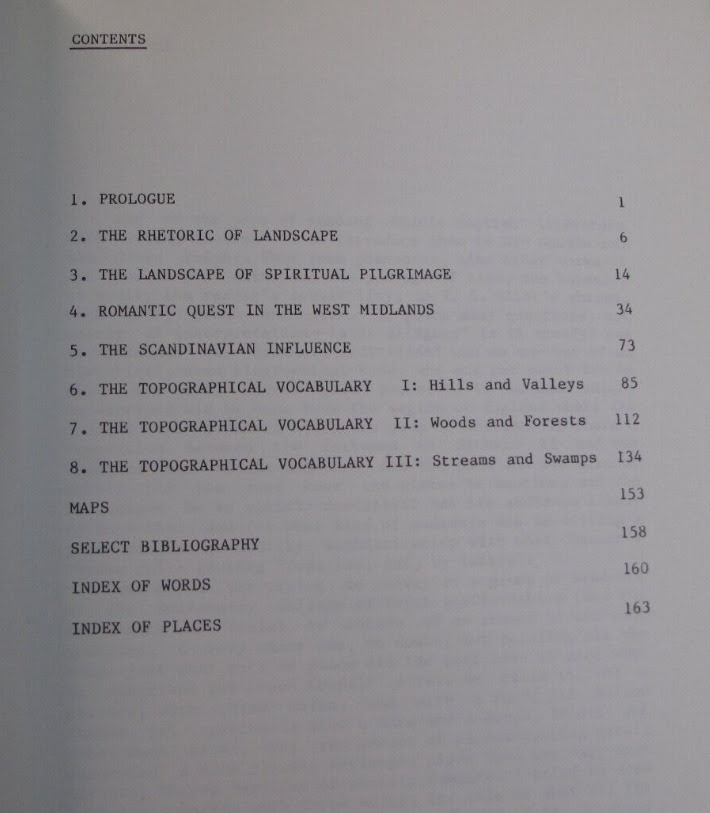
It also appeared as “Staffordshire and Cheshire Landscapes in Sir Gawain and the Green Knight” in the North Staffordshire Journal of Field Studies 17, 1977, pages 20-49.

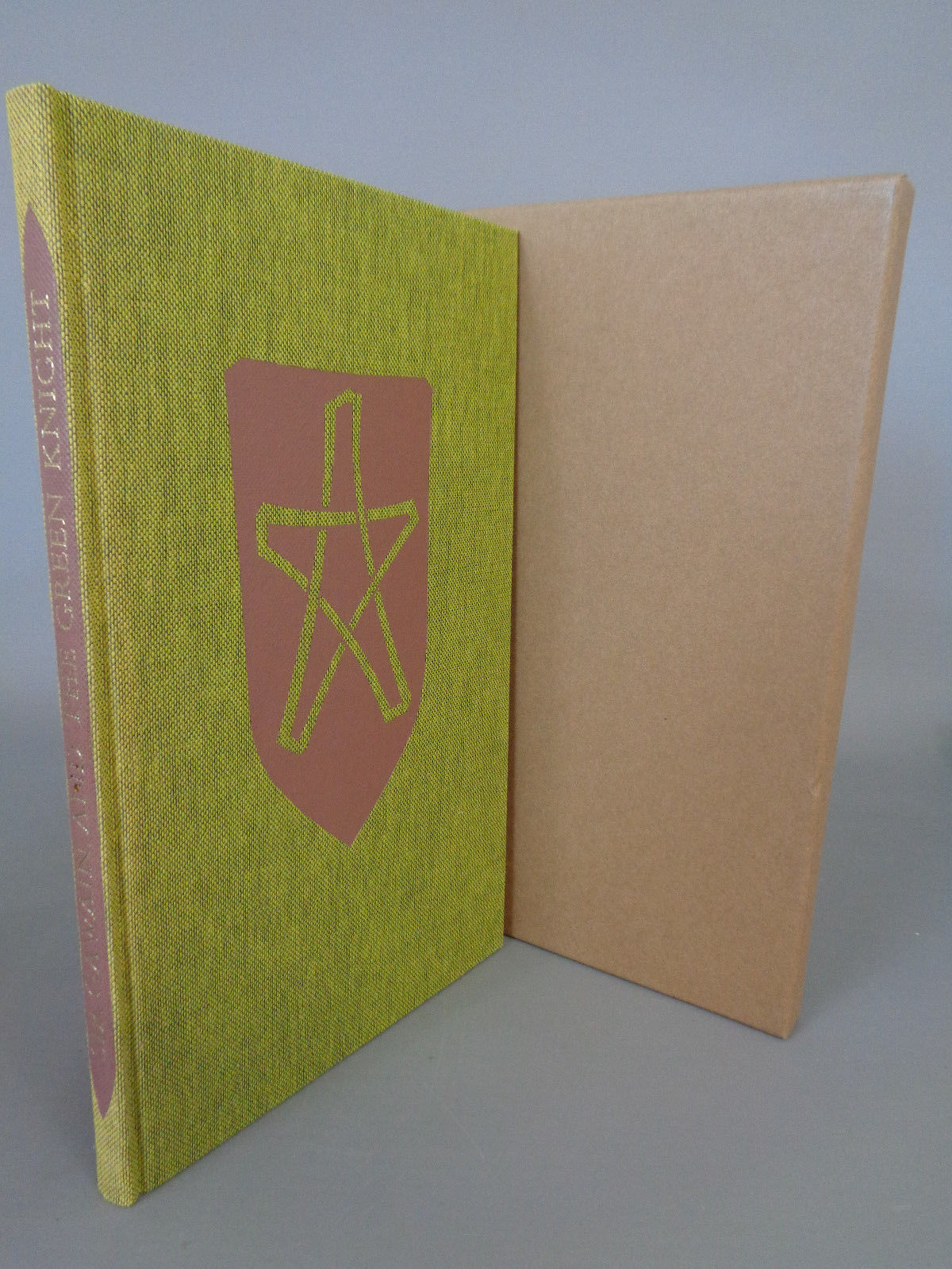
Incidentally, the pentangle on the shield (seen above) is not a pagan artist’s modern imposition on an ancient text, it’s something detailed in the text…
It is a symbol that Solomon designed long ago
As an emblem of fidelity, and justly so;
[…]
Therefore it suits this knight and his shining arms,
For always faithful in five ways, and five times in each case,
Gawain was reputed as virtuous,
The Folio Society found a way to detach the symbol from its contemporary “naff hippie-shop pentangle” connotations, by ingeniously and elegantly making it more like a figure…
My early-alpha version of a basic annotated catalogue of the contents of the North Staffordshire Field Studies journals and successors has been expanded to 1895. It’s currently a rough ‘finding aid’, rather than a proper polished bibliography to library standards. The gap in coverage of the main annual volume is now narrowed to: 1896-1959. Also, keyword search from the search-box is now enabled.
Did slavery profits bankroll the Midlands industrial revolution, as local socialist M.P. Tristram Hunt (Labour) would have had you believe in his recent speech in Stoke?

Erm, no. Slavery did not fund a major share of the capital that went into our industrial revolution. If you put together all the combined profits of the slave trade and the West Indian sugar plantations in general, together they did not even add up to five percent of Britain’s national income, either before or during the Industrial Revolution. Even a Midlands-specific claim doesn’t hold water — that exports to colonial settlers might have made huge profits for our early textiles and small metalworking industries. Such activity was at best of minor importance, and overall profits from the colonial trade were low…
“Profits from the colonies and imperial trade and capital accumulation in Britain”: [when put together, all of the] commerce with the ‘periphery’ [i.e.: with fringe areas of the world and colonies] generated funds sufficient to finance only 15 per cent of gross investment expenditures during the Industrial Revolution [… and such] external trade was only a small proportion of Europe’s economic activity and most industries did not depend upon imported raw materials … historians have argued that sugar did not furnish a sufficiently large total output to be a major contributor to the savings that funded the Industrial Revolution … It is equally difficult to prove that merchant capital amassed from colonial commerce [even taken as a whole] was decisive for British industrial growth.” — Kenneth Morgan, Slavery, Atlantic Trade and the British Economy, 1660–1800, Cambridge University Press.
The book is described by Cambridge University Press as… “An up-to-date synthesis of work on slavery, Atlantic trade and the British economy … essential reading”.
The socialist notion that that the industrial revolution was funded largely by slavery arose from the rabidly Marxist 20th century historian Eric Williams, about whose work…
“the majority of scholars working on British industrialization tend to be highly skeptical” [today, because…] “Eric Williams and his followers probably exaggerated the profitability of the slave trade and slave plantation complex.” — from a review of Slavery, Atlantic Trade and the British Economy, 1660–1800, in Reviews in History, June 2002.
Further, it’s more recently been determined that only around 7 percent of the UK’s historic national elites can be in any way connected with slavery. Indeed, far more of our elites actively fought against it.
Long unavailable except at huge cost, there’s now to be a second printing of one of the most important books for fantasy research. The cheap paperback edition of the collected correspondence by letters between R. E. Howard and H. P. Lovecraft. The two-volume set will be officially released on 22nd January 2017, albeit at a still-hefty $60 plus shipping for both volumes. Advance orders are now being taken at the Hippocampus website. Hopefully there will eventually also be a cheaper Kindle ebook version, in time.
