“The persistence of older patterns of popular belief was much stronger than is commonly allowed [from the 1860s to the 1960s]. Reporting from a late vantage, Hoggart noted how his grandparents, moving into Leeds in the 1870s, brought with them and long retained the remedies, sayings and ‘superstitions’ of a rural life. Later still J. Seabrook [the sociologist Jeremy Seabrook] records the memories and beliefs brought by his country kin into the industrial settlements of the Midlands and long surviving there”
— Jason Marc Harris. Folklore and the Fantastic in Nineteenth-Century British Fiction. Ashgate, 2008. (quote is actually Footnote 47, which is from the following source: Joyce, Patrick. Visions of the People: Industrial England and the Question of Class 1848–1914. Cambridge University Press, 1991.)
Author Archives: David Haden
New “Staffordshire Strange Tales” booklet
Stephen Harvey has a new Kindle ebook edition of his Staffordshire Strange Tales booklet. 34 pages of eerie and strange tales from North Staffordshire…
“North Staffordshire has a history unlike any other place in the United Kingdom. [Here are] … some very strange and some very true tales of the area including Molly Leigh who was a very real witch who lived in Burslem, the mermaid of Blackmere, the chained oak of Alton Towers, and the headless corpse of Harecastle Tunnel. There is even a haunted radish, that terrified a woman in Leek!”
Two Universities Way – new North Staffordshire walking guide
The Two Universities Way is a new photo-guide for walkers. It describes and shows a new green five-mile walk, between Staffordshire University and Keele University. Produced for the North Staffordshire Woodland Walks Week, May 2012. 46 pages / 4,000 words. Available now as a free PDF ebook (5mb), or as a cheap paperback to slip into your pocket while walking the route for the first time.

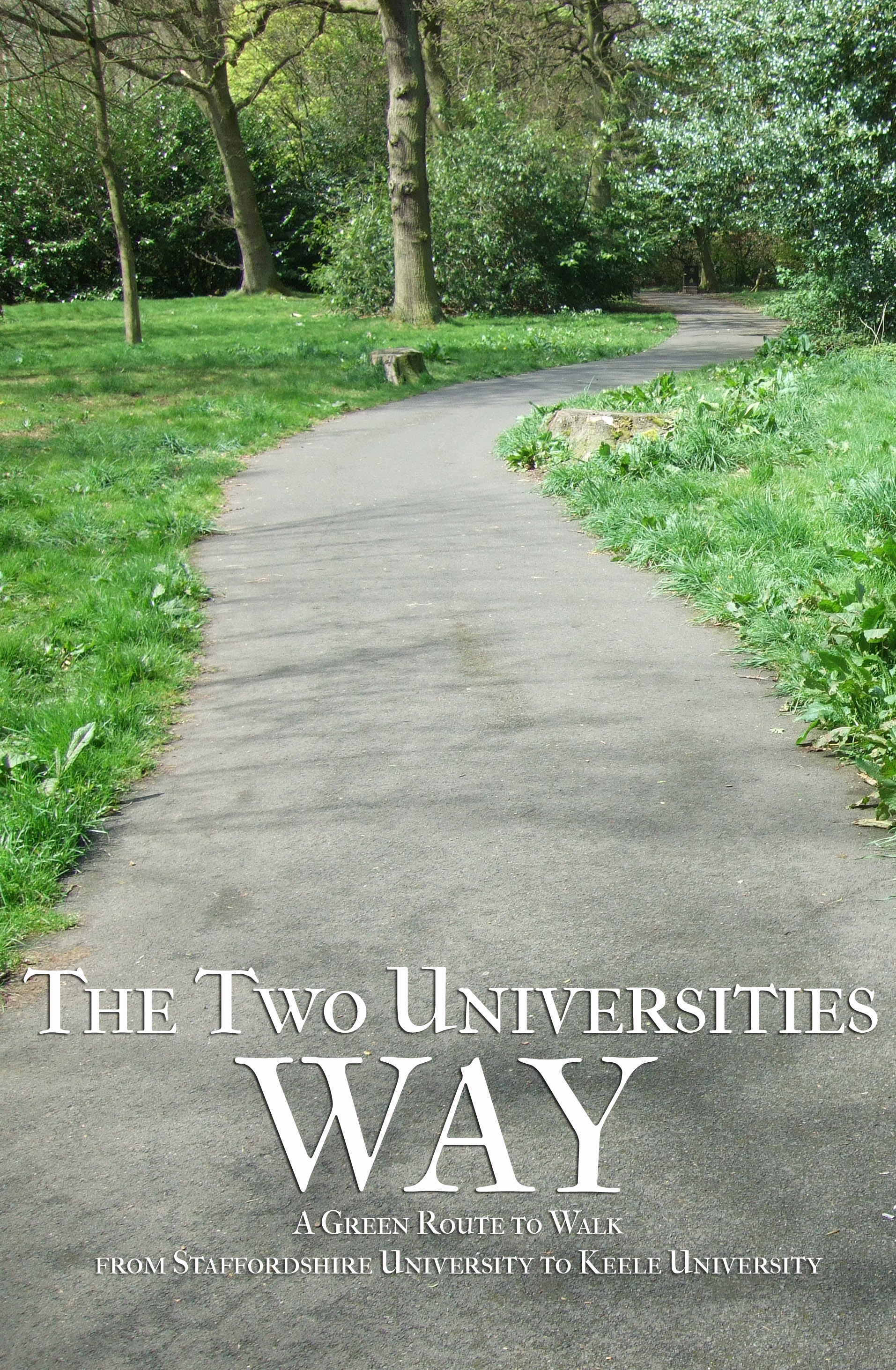
Update: Autumn 2024: The guide is getting on for 12 years old now, and may need updating in places.
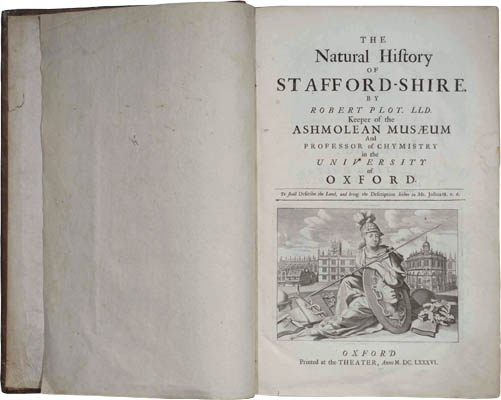
Plot’s Natural History of Staffordshire – digital facsimile available
Interested in reading a copy of Plot’s Natural History of Staffordshire (1686)? In 2012 there doesn’t appear to be an online PDF of this public domain work, but there’s a digital CD facsimile available for a reasonable £12, from Midlands Historical Data. It’s not just about birds and beasts and plants, it also has good deal on folklore and customs. Original copies of the book seem to fetch over £1,500 at auction.
Update, November 2017: now available online, The natural history of Stafford-shire by Robert Plot albeit without pictures.
Update, June 2023: now available online, at Archive.org in hand-keyed HTML.
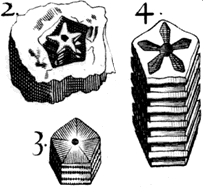
“Star Stones [seen above] were much discussed by the Oxford academic Robert Plot. Plot dutifully, and rather disdainfully, related how the commonfolk thought Star Stones came to be on Earth: “…the Stones [are] some way related to the Celestial Bodies, [and] descend next to such as (by the vulgar at least) are thought to be sent to us from the inferior Heaven, to be generated in the Clouds, and discharged thence in the times of Thunder and violent Showers…”.
Those who have read The Spyders of Burslem, and remember the “aetherstorm” and its curious hail may recognise a similarity. Also a link with one of the themes in the novel.
Also, note the book was “printed at the Theatre” in Oxford, which was founded by a man from North Staffordshire.
Family tree ebook now online
I’m pleased to say that an illustrated version of my family-tree book is now online. It might interest those working on family histories or novels set in the far reaches of South Staffordshire (specifically glass making in Kinver, Wordsley, Kingswinford, Oldswinford areas) during the 19th century, and also in north Birmingham (bicycle and motorcycle manufacturing in Hockley, Aston, Boldmere) during the late 19th and early 20th century. The online ebook omits about 20,000 words of microscopically detailed narrative family tree, and evidence footnotes. The basic tree is…
William Haydon? b. 1754?
|
Richard Haden (b. 1797 – d. 1843)
|
William Hamlet Haden (b. 1821 – d. 1866)
|
George Joseph Haden (b. 1851 – d. 1903)
|
Alfred Hamlet Haden (b. 1875 – d. 1940)
|
Sidney Francis Haden (b. 1901 – d. early 1970s)
Shropshire jibes
A few of the lighthearted jibes that Staffordshire folk used to make of their neighbors living over in Shropshire…
“The idea of going to live in Shropshire! Why, the Shropshire man threw down corn to [en]tice the weather-cock off the [church] steeple!” (Wednesfield, about 1890.)
“The Shropshire people put a frog in a cage, and thought it was a canary.” (F.T., gunner R.H.A., Whitsuntide, 1896.)
“That’s a Shropshire present, giving away what you don’t want yourself.” (M.N., Norbury, 1888.)
From Folklore: a quarterly review (The Transactions of the Folk-Lore Society), Vol. XX, 1909.
The latter perhaps relevant to Tolkien’s practice of giving “mathoms” in the Shire.
Majid Esmaeili
Majid Esmaeili’s virtual 3D sculpt of a faun, that gets close to how I imagined the character of Maddock in my new novel The Spyders of Burslem. Although with smaller horns.
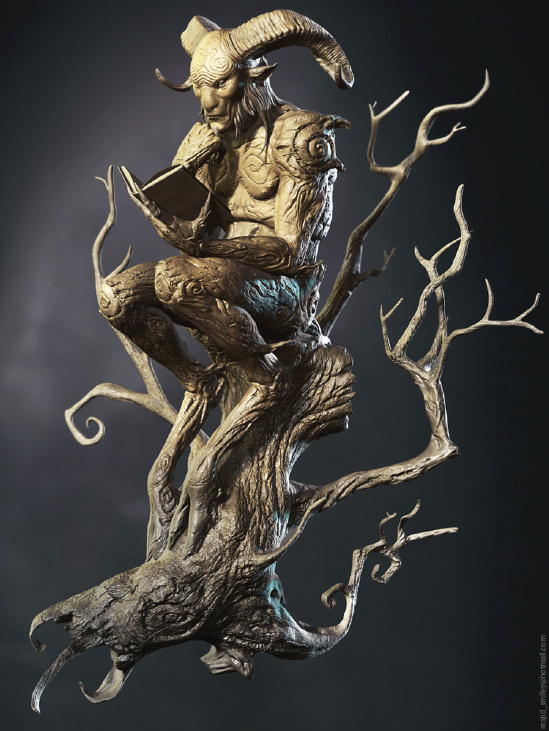
It’s a pity that Stoke-on-Trent could not have transitioned a tranche of the city’s talented ceramics model makers into virtual computer-based 3D sculpting and model-making, when we had the chance in the 2000s. We could have turned our city into a world-centre for virtual character and model creation/painting, building on centuries of tradition in the ceramics industry. Which, with new developments in 3D printing and bespoke vinyl toys, would by now have come full circle back to the creation of physical products. Sadly the public-sector farce that was ‘Worldgate’ seemed to make the city’s officials averse to production schemes that are ‘digital’ and ‘creative’ and that required significant public money. And the highly insular nature of the city seemed to create a blind-spot, about the potential of global sales of virtual goods over the Internet.
Animated pictures
Public domain photos, animated by Kevin Weir…
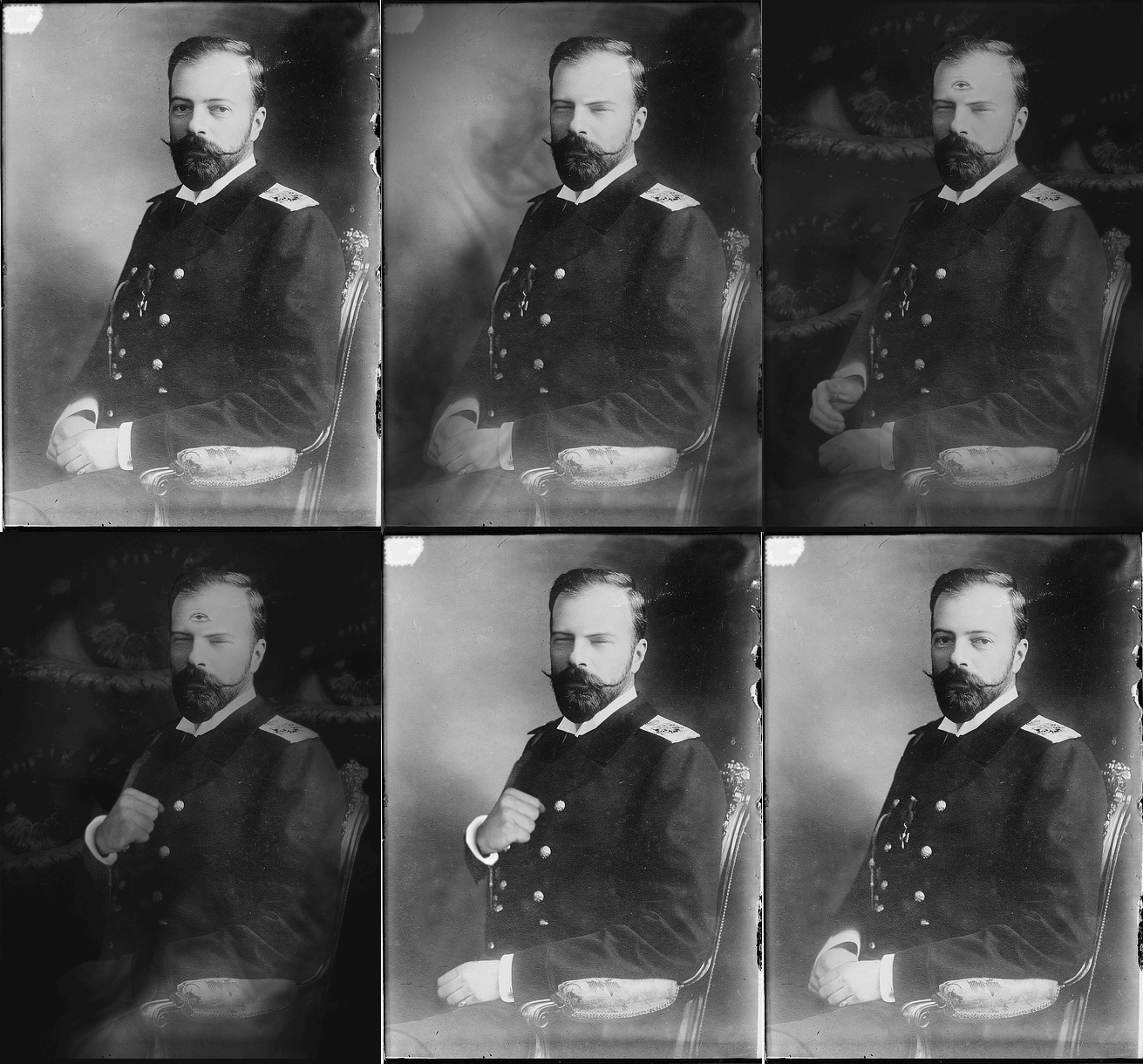
You’ll remember that one of the elements in The Spyders of Burslem is the expansion of photography into the realm of psychography, and that the psychograph of Rousseau changes when looked at.
Underground in Legend and Tradition: event in the Peak
“Underground in Legend and Tradition” is The Seventh Folklore Society Legendary Weekend, it will take place 1st-2nd September 2012 at Matlock Bath Pavilion, in Derbyshire Peak District. Flyer.
Cock measuring machine in Staffordshire
Dr. Plot’s Natural History of Staffordshire, written in 1686, makes mention of a machine then in use in this county for gauging the size of fighting-cocks. The writer designates this ingenious contrivance as —
“the nicest piece of art that ever I saw relating to the feathered kingdom, and, indeed, the ‘most curious was an instrument shown me by the Right Worshipful Sir Richard Astley, of Patshull, baronet, of his own invention to match game-cocks, discovering their size, both as to length and girth, to so great an accuracy that there cannot be easily the least mistake.”
[…] as a rule the lightest pair of cocks were fought first, then the next in weight, and so on till the heaviest pair were the last to be pitted.
— from Old English Sports.
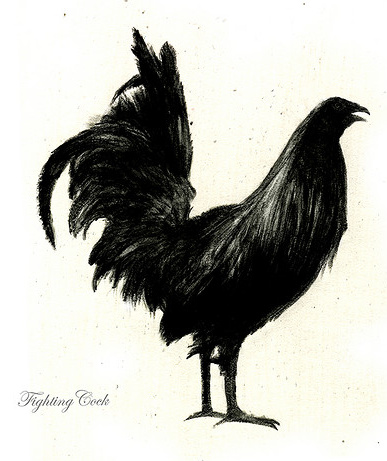
Illustration: Bill Mayer.
Death and wildfowl in North Staffordshire
Another interesting addition about my theory on the links between North Staffordshire and certain beliefs about wildfowl, as explored in the central section of my book A History of Burslem and the Fowlea Valley…
“A dying person should not be allowed to lie on a bed or pillow stuffed with feathers from pigeons or wild fowl.”
The source is unspecified, but is either The Folklore of Staffordshire, or Staffordshire Customs, Superstitions and Folklore.
North Staffordshire Field Club
Wikipedia page for the North Staffordshire Field Club, now with an outline of their many publications. Is there a full index of their published articles and books, to consult online? Sadly, it seems not. There’s a nice little retirement project, for someone. The easiest software to use to create an online catalogue would be Omeka.