Miss Keary rescues the North Staffordshire Halloween song

From Staffordshire Knots, 1895…


“I should be greatly obliged to anyone who could give me the whole of this “souling song” which I heard some Trentham school children singing only a few months ago and took down at the time. I understand that it used to be always sung in the neighbourhood [while going trick-or-treating] on [the eve, 1st Nov, of] All Souls’ Day but there used to be more to it.

“Soul, soul, an apple or two
If you have no apples, pears will do ;
Up with your kettles, down with your pans,
Pray, good missus, a soul-cake !

Souling-day comes once a year
When it comes, it finds us here.
The cock sits up in the yew-tree,
The hens came cackling by,
I wish you a merry Christmas,
And a good fat pig i’ the stye.

Peter stands at yonder gate
Waiting for a soul-cake ;
One for Peter, two for Paul,
Three for Him who made us all.”

So interesting a relic as this, which must have come down with little alteration from mediaeval times, certainly ought not to be lost.”


Elsewhere she writes…

“In the north of the county [of Staffordshire] we have the custom of Souling, or [children] begging for apples [at the doors of local homes] on the Eve of All Souls’ Day, November 1st.”


Miss Alice Annie Keary was the North Staffordshire folklore and folksong collector of the mid 1890s. She was the sister of Charles Francis Keary. Also the very good friend of the famous folklorist Miss Charlotte Sophia Burne, who until circa 1894 resided at Pyebirch, Eccleshall.

The final three lines are, of course, a Christianised version of the famous children’s magpie counting rhyme: “One for sorrow, two for joy, three for a girl, four for a boy… etc”.

An inspection of the Bridestones, 1895

THE BRIDESTONES (1895)

By J. T. Arlidge, B.A., M.D., F.R.C.P.

ON the southern slope of Cloud Hill, lying to the east of the town of Congleton, is a group of massive stones commonly known as the Bridestones.
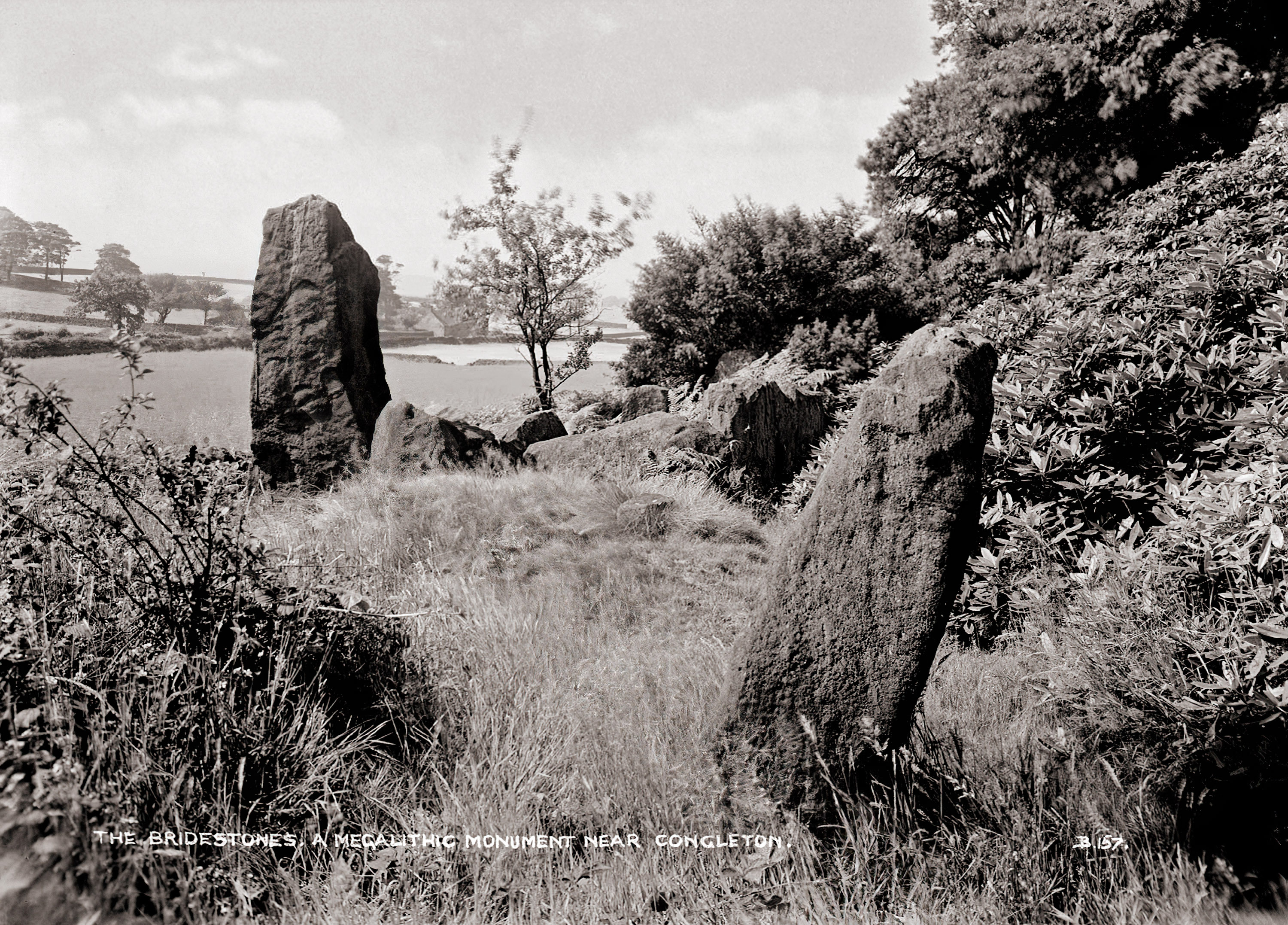
The greater part of the stones, composed of the millstone grit of the neighbourhood, are employed to form an oblong box, much like a gigantic coffin, 18 feet by 11 feet. In the interior, about a third from the east end, is a cross stone, only a little above the level of the soil. The side stones are of irregular flat shape, stood on edge, but seem to have been roughly cut so as to fit together at the angles of contact. This is well seen in one large side stone now prostrate, but which, if raised, would fit in and make up accurately the vacant gap. Ward states that the whole of this side of the Kistvaen was originally of one stone, but that owing to a bonfire made in the enclosed area it was split, and this portion fell outwards. On what authority this assertion is made I know not, and I am not prepared to receive it, at least in its entirety.

Near the north-east angle of the stone enclosure is the largest rock on the ground. It stands quite apart from the Kistvaen — for such is the structure described in the nomenclature of Druidical remains. This stone is about eight feet high, three feet wide, and a foot and upwards in thickness, and roughly hewn, and its upper edges are rounded at the angles by weather and by destructive visitors.

It might be compared to a great headstone of a grave, but it is not placed in line relative to the direction of the Kistvaen. This pillar-like block calls to my mind some stones found in Ireland, in the Isle of Man, Scotland, and elsewhere, which bear those very primitive and difficultly deciphered markings known as the Ogham characters. My examination of it was too hurried and superficial to enable me to say if any trace of such characters exist upon it. I fear, indeed, that if ever they did so the mischievous hands of ignorant visitors and the wear and tear of the elements have destroyed them.

Further away and to the north of this largest mass is a smaller rock set upright, and about four feet high, much damaged by weather and other causes of injury.

But the surface of the ground within the enclosure clearly indicates the existence of other stones, which it would be interesting to uncover. For it is clear that we have not before our eyes the whole of this interesting monument as originally constructed. In fact, I was told by the present owner of the locality, that some very large stones were removed many years since to cover a neighbouring culvert or drain in an adjoining field.

The name applied to this monument — the Bridestones — admits of no explanation other than it is a corruption of some ancient word. Legend, however, has found for it, as in many like instances, an explanation to suit the word, asserting that a bride was buried on the spot; or, according to another version, that, in ancient British times, marriages were celebrated at the spot.

Mr. Abner Dale, the present owner of the spot, called my attention to the existence of very numerous long mounds, resembling grave mounds, in the adjoining fir coppice. These mounds are placed all in the same direction, east and west, and in parallel lines. They certainly have not the look of accidental elevations, and Mr. Dale informed me farther that when dug into the soil was found to be a mixture, and not virgin soil ; also that, having on one occasion to dig into a rabbit burrow, he came upon an impression in the earth bearing the semblance of a human form, and especially of the chest and ribs. I could much wish that some archaeologist living not far from this region would, with the kind permission of the owner, carefully open up two or three of these mounds.
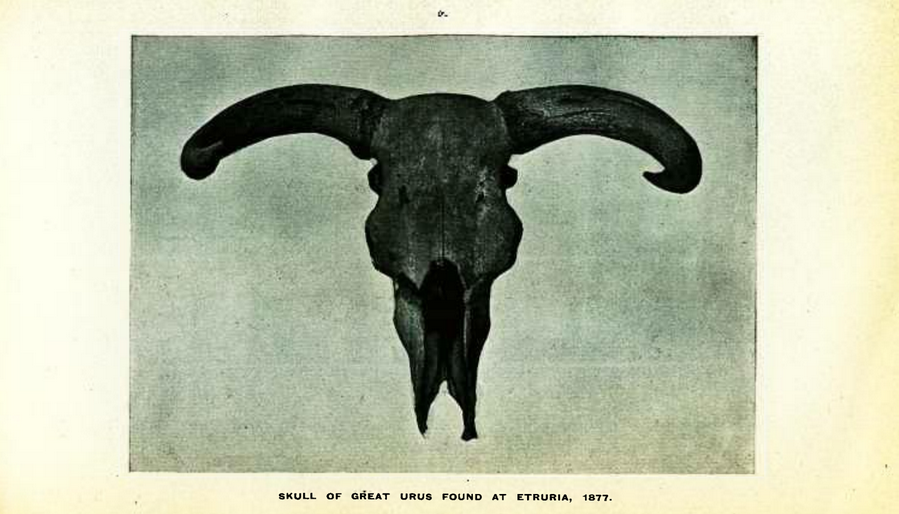
The Auroch Skull of 1877

etruria_stoke_1877

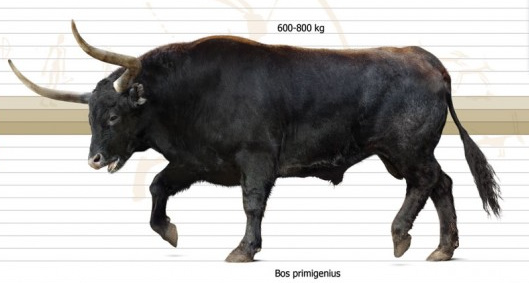
The sub-fossilised skull of an auroch (Bos primigenius), was found in 1877 during the major work on the foot of Basford Bank, Stoke-on-Trent, during which there was filling and levelling work done around the adjacent banks of the Fowlea Brook and the Etruria train station. Aurochs were giant wild cattle, which survived in Britain into the Roman period but which are now extinct. The skull was found… “buried 16 feet down in black clay, whilst making alterations to the course of the Foulhay [Fowlea] Brook near Etruria in Stoke-on-Trent.” Currently in the care of the Potteries Museum & Art Gallery.

The original environment would be the often-flooded water-valley of the Fowlea, wide and damp, but offering a rich flowery cud for cattle in the summertime. The original appearance of the beast would have been akin to this…

If anyone was thinking of a statue for the entrance to the final bit of development on Festival Park, bringing the auroch back all life-sized and hairy would be a suitable nod to the history of the valley.

Shadows

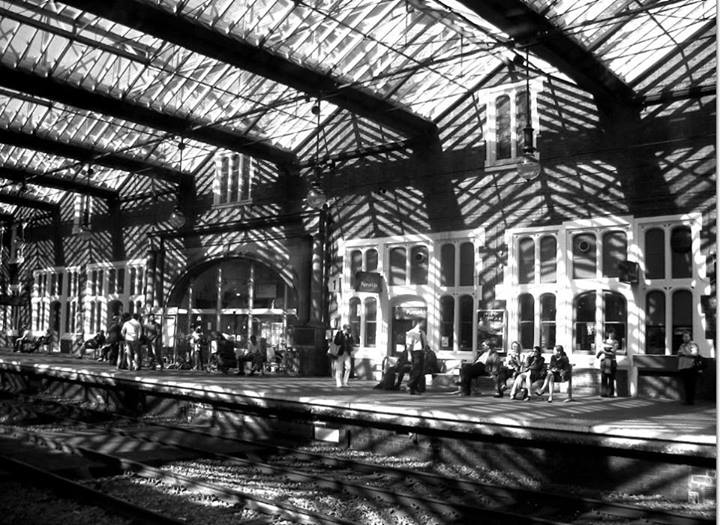
Great photo of the grid of shadows at Stoke-on-Trent railway station. I described these at the start of my novel The Spyders of Burslem.

alsagerexp

Promo image for Photographic Exhibition, Alsager Public Library, 9th-22nd November 2013.

Trick or treat

There was an anti-Halloween letter in The Sentinel recently, repeating the myth that..

“It’s only been the last 20 years or so that we have copied trick or treat from the Yanks.”

Actually it’s a very ancient and local tradition, as I’ve shown here previously

“In the north [of the Midlands] (and also in Cheshire and North Shropshire), the festival of All Souls, November 2nd, is celebrated [on the Eve, 1st Nov] by parties of lads and children going round to all the principal houses begging for apples — and formerly for cakes and ale — and droning out:

  “Soul soul, for a apple or two
  If ye’ve got no apples, pears’ll do,
  Up wi’ the kettle and down wi’ the pan.
  Give us a big ‘un, and we’ll be gone.”

There is also the line: “He speaks puling [whimpering], like a beggar at Hallowmas,” in Shakespeare (Two Gent.), from which we can infer that in Shakespeare’s time this was also a Warwickshire custom.

Penny for the Guy national survey

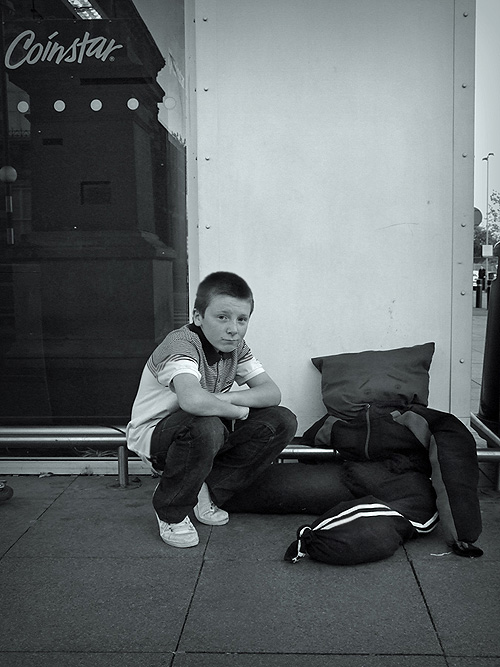
A new Penny For The Guy: The Penny For The Guy Spotting Project, running in 2013. This venerable tradition is very rare now, but it was once very common to see children making their own approximate Guy Fawkes mini-effigy out of stuffed old clothes and then asking for coins for it. They would either parade it around in an old pram, and/or then a lone kid or two might would prop it outside a shop for an hour or so. They usually appeared on fine days from early October on, but are most usually seen after Halloween (between 1st Nov and Bonfire Night on the 5th Nov).

Here’s my photo of an independent lad with his self-made Penny-for-the-Guy in Stoke town, Stoke-on-Trent, in 2012…

coinstar500px