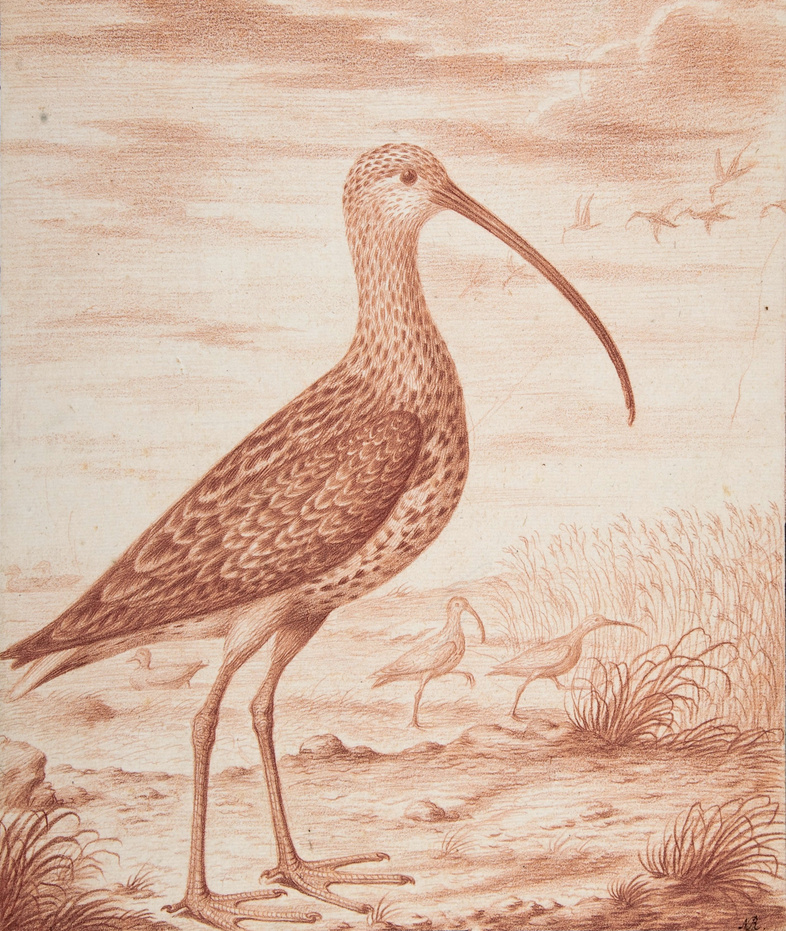
The Curlew is the iconic bird in north Staffordshire. Remembering last summer’s national campaign on the curlew in the UK, I recently became curious (as a non-birder and layman) about the bird’s conservation status in North Staffordshire. March is also the time when there’s a surge of sightings of the bird, as they come winging in from the coast.
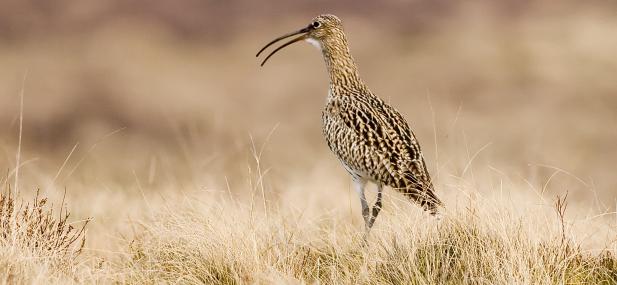
Yesterday I had a reply from Staffordshire Wildlife Trust, to my enquiry about the local conservation status of the curlew. They say that their North Staffordshire reserves at the Roaches and Black Brook… “are being managed to benefit Curlew and Snipe” and that on those sites these species are… “currently considered to be in favourable condition for breeding waders.”
So that sounds good, but it appears that the last time there was systematic field research locally was in the mid 1990s, which is 20 years ago now. The Trust told me that there was… “a decline of around 60% between 1985 and 1996 in the wider Staffordshire Moors area as a whole” (citing The New Birds of the West Midlands, 2005). But it appears to me that there’s now a need to fundraise for a spring 2018 local survey, to provide a twenty-year 1997-2018 re-survey.
That 60% level of decline would be congruent with the wider UK decline in such birds due to all the problems of the 1975-1995 decades, most of which were down to the move to intensive EU-subsidy farming and drainage installation, and possibly also to 1970s and 80s estuarine pollution of mudflats. The curlew over-winters around the estuarine coast of the UK, where the move toward mechanical dredging has apparently played a part in a recent 15% decline there. I’d also wonder what the huge increase in coastal dog-walking and estuarine walking paths / beach access in the last 20 years may have had, since the research suggests that regular dog-walking scares away a good proportion of all birds from an area. The same problem might be considered as a factor in the Moorlands during the nesting season. There has been a huge increase in the number of dogs on the UK in the last 20 years, and an increase in untrained/uncontrollable dogs. Combined with all the new paths, and with local councils nearly-always allowing dogs into what are supposed to be nature reserves, all those factors much surely have combined to have some effect on ground-nesting birds. There are multiple other ways in which dogs could be causing cumulative damage, especially in coastal and upland terrains. Splashing dogs churn up sediment in still waters, causing muddy turbulence and damaging fragile moorland plant-life in pools. Their fur-treatments for ticks, fleas and parasites wash off into watercourses, and are extremely toxic to invertebrates. Their shit and urine adds nutrients to moorland that should be naturally nutrient poor, causing a change in the flora. They may pass infections to wild animals.
The RSPB put the North Staffordshire curlew decline at a slightly more precise “decrease of 53% in the moorlands of north Staffordshire between 1986 and 1996”. So obviously 1985 was a good year for them, since its inclusion boosts the Trust’s figure from 53% to “around 60%”. But there’s probably a fairly wide margin of error on all such surveys. The RSPB also notes an additional factor for moorland decline: new and invasive species. Specifically being a rise in… “predation, particularly by mammals.” They don’t state the mammals concerned, but presumably they are involved in predation of the eggs and chicks from nests. Matt Ridley cites foxes and crows, though those are not alien species. They may however be ‘new to the areas’ because of the new woodland encroachment around moors that provides habitat for such egg-pilfering predators. This then raises the intriguing possibility that breeding pairs and nests will have become even harder to spot by humans, as the birds naturally adapt to avoid increased predation. Over-grazing by hill-farmers on moorland and high rough pasture during the nesting season may also contribute, leading to nest-trampling and reducing wind-cover by lowering the height of grass tussocks.
The fine blog Nature’s Parliament had a useful summer 2016 post on the history of the local study of the bird…
“The Birds of Staffordshire (1939) reported that Curlew were numerous on Morridge and the Roaches in the Staffordshire Moorlands during the summer”
I was also able to get a snippet of the 1982 edition of Birds of the West Midlands…
“Curlew. Numenius arquata. Fairly numerous breeding species and passage migrant; not scarce, but very local, in winter. Prior to about 1920 the Curlew was virtually restricted as a breeding bird to the moorlands of north Staffordshire.”
Nature’s Parliament was also able to peruse the later 2005 (third) edition…
“The West Midland Bird Club book The New Birds of the West Midlands (2005) reports that the largest concentrations of Curlew have been observed at two spring roosts in North Staffordshire where birds gather in March prior to returning to their breeding territories. … in the north Staffordshire Moors in 1985, 1992 and 1996 surveys of Curlew revealed 418, 280 and 173 pairs respectively”
In their comment to me the Staffordshire Wildlife Trust suggested that locally the 1975-1995 historic decline is now “likely” to be “slowly recovering possibly due to better management”. Presumably this includes not just conservation and reserves, but also the now much-reduced need for farming inputs, more set-aside, and a host of interlocking conservation measures alongside new small-scale water-land habitat creation on the Staffordshire lowlands.
This BTO graphic also suggests that there are breeding increases located somewhat outside of the Staffordshire Moorlands, on the far north-east side of the Peak District…
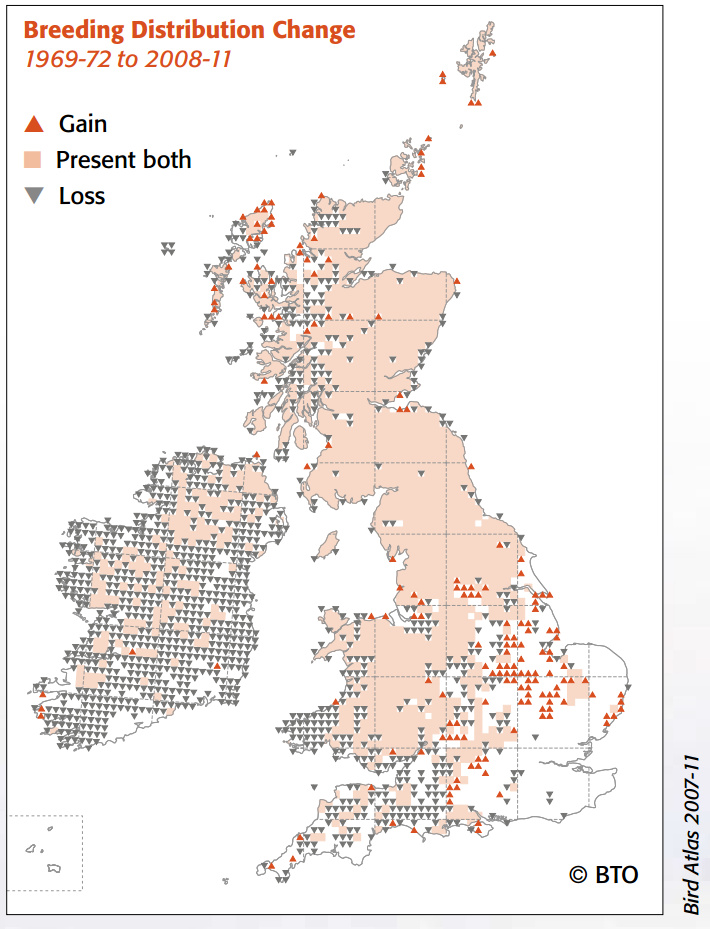
The use of the word “Loss” on this map is somewhat misleading. “Decline” would be a better word, since otherwise one might look at the map and think that the North Staffordshire curlews had been totally “lost” and gone, whereas they are actually still there — albeit with a decline in the breeding population by about two-thirds from the 1910s.
The Nature’s Parliament blog post also notes a historic seasonal use of “lowlands” (locally?) by the birds…
“The Birds of Staffordshire (1939) highlights the fact that Curlew retired from the hills towards the lowlands about midsummer or soon after with almost all departed by mid-August.”
Incidentally, I’m pleased to discover that The West Midland Bird Report is online for free in PDF at: Archives 1934-2013. It can be searched via Google Search:
site:http://www.westmidlandbirdclub.org.uk/download/ keyword
At the West Midland Bird Club site I also discovered that Nick Pomiankowski of Stoke has recently undertaken “An Analysis of Staffordshire Bird Records 2005 – 2014 – Waders” and that this research is online for free. His section for ‘Curlew’ suggests an increase to about twice as many bird report sightings of curlews during that period, but perhaps no great increase in local breeding pairs in the county…
“Curlew is a breeding bird in the county, with a good presence during the summer months. The most notable feature of the monthly breakdown is the huge spike in March. This is due to the birds using some reservoirs, particularly Tittesworth, as a staging post on their return from their wintering grounds to their breeding grounds. The total records by year shows an upward trend, but this will be due to more wintering / passage birds being present, since the corresponding totals for just May and June – i.e. the breeding population – shows a fairly static picture. This latter chart is encouraging in itself given the national decline in breeding Curlew numbers.”
So, 221 Staffordshire sightings in the breeding season in 2014. But presumably that’s individuals and not “breeding pairs” sightings on the Moorlands? Compare to the local “173 pairs” which were survey-recorded as breeding in 1996.
So, on a quick non-birder perusal of the available evidence, it seems: i) that our local reserves and conservation measures are having a local effect, but perhaps not as large a breeding boost as would be liked; and that ii) on the other side of the Peak District the curlew’s breeding numbers appear to be doing much better than they are here.