The British author John Buchan’s works appear to have fallen into the public domain in January 2011. But you might not know it, as many are still way too difficult to find in the public domain as good e-copies. Still less as free audiobooks.
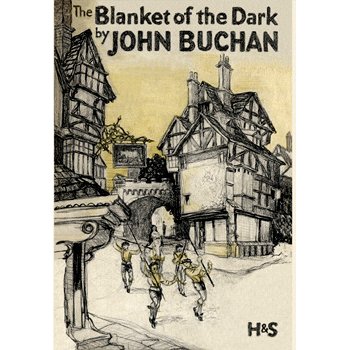
I’ve never really known anything about Buchan’s work, beyond the films of the famous The Thirty-Nine Steps. That brisk spy novel was apparently followed by two more, similarly set in the First World War, Greenmantle and Mr Standfast. So I had never thought of Buchan as anything but a rather dated spy novelist. But recently I read that a good case has been made that Buchan may have influenced The Lord of the Rings, via the historical novels The Blanket of the Dark (1931, Oxfordshire under a Sauron-like tyrant) and Midwinter (1923, a model for Strider and the Rangers), which are historical adventure novels set in olde England. For details of the seemingly well-founded claims see the recent way-too-expensive book of Tolkien scholarship Tolkien and the Study of His Sources: Critical Essays. So far I’ve only read the first chapter of The Blanket of the Dark, but it’s good and does have something of Tolkien about it. And yes, Tolkien read it. Like many intelligent people who work with text for a living, he did not care to relax with worthy-but-ponderous modernist slogs or the latest angst-filled wrist-slasher of a ‘socially-concerned’ novel. He preferred Haggard, Buchan, Chesterton, cozy detective mysteries, and in his later years he is known to have sampled science-fiction writers such as Asimov.
But what of Buchan? I now see that Buchan was an adventure novelist, military historian, supernatural tale-spinner, and generally a writer of vast scope. He died with over over 100 works to his credit, and was far more than just a spy novelist. A Scot, in historical adventure tales he seems to have followed in the tradition of Robert Louis Stevenson’s Kidnapped — long journeys through large landscapes, allowing full reign for Buchan’s talents in the description of landscapes. Such books were very popular at the time, pushing unadventurous boys and men into vast but precisely-realised wild landscapes beset by epic political intrigues. In America a similar approach was perhaps best exemplified at the time by Everett McNeil, who was the best-selling boys’ novelist of the time. McNeil was a follower of the similar and earlier Henty, and likewise sent boys on vivid epic journeys into the American wilderness and across the sea, in the company of famous explorers and soldiers. One can see how these sort of fresh and epic landscape-adventure novels, by the likes of Buchan and McNeil (and the earlier Henty), might have given Tolkien a star by which to steer The Lord of the Rings with.
Anyway, I thought I’d do a quick survey to see what is said to be most interesting among Buchan’s vast output.
First, the Scottish books seem to be ones to avoid as your ‘first taste of Buchan’. His first real novel, John Burnet of Barns (1898), is described as a novel of “doomed attraction across language and outlook”, and a lifelong rivalry that leads to… doom. Oh dear. It’s said by modern marketeers to be ranked alongside Kidnapped as a Scottish “adventure classic”, but frankly I never much liked Kidnapped as either book or film, and John Burnet sounds more of the same (only more gloomy and dour). John Burnet heralded a string of what sound like similarly depressing ‘Scottish local novels’ by Buchan, which one suspects are are probably now rather more fascinating to the Scots than to the rest of us. Buchan also edited an anthology of Scots vernacular poetry, The Northern Muse, if one wants to pile on some further misery.
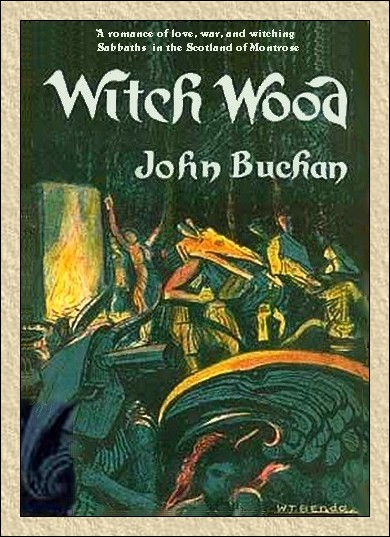
Buchan seems to find the most readers outside of Scotland when he inserts a fresh element or two into Scottish life. Buchan’s Witch Wood appears to be a firm favourite of many, for instance, being a 1927 novel of devil-worship and evil forests in seventeenth-century Scotland. Knowing some of the context from my work on H. P. Lovecraft, at a guess I’d say the novel was probably inspired by Andrew Lang and/or by Margaret Murray’s The Witch Cult in Western Europe? At first I suspected that the devil worship would be of the tedious Wheatley-esque kind, very uninteresting to those used to the vivid Solomon Kane stories of R. E. Howard and the richly weird work of H. P. Lovecraft. But Witch Wood is apparently rather more subtle and interestingly macabre than the usual mumbo-jumbo, and was influenced via Blackwood and Machen. Buchan’s earlier supernatural story “The Watcher by the Threshold”, more ethnographic and found in the story collection of the same name, was apparently a forerunner of the novel Witch Wood. Be warned, however, that according to S.T. Joshi “The dialogue portions of John Buchan’s enormously long novel Witch Wood are almost entirely in Scots dialect”. Oh dear.
Other notable ‘weird’ novels are said to include The Dancing Floor and Sick Heart River.
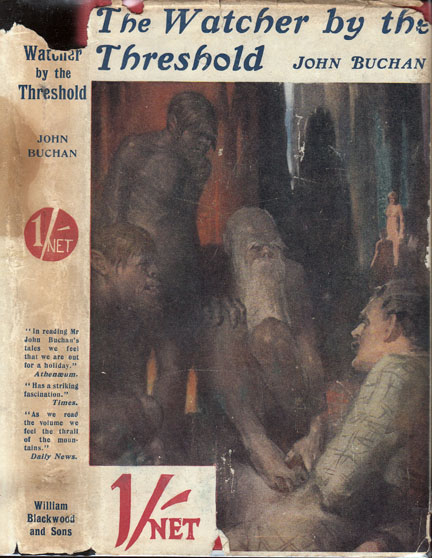
Readers seeking similarly supernatural Buchan tales might look at Buchan’s story-and-poems collection The Moon Endureth: Tales and Fancies (1912, seemingly abridged in the American version), which came a decade after The Watcher by the Threshold. It has a manageable early sampling of his supernatural and mystery fiction including “The Grove of Ashtoreth” (Africa, haunted grove, ancestral taint) and some interesting historical-mystical poetry. His other two most notable supernatural stories can be found collected in the The Rungate Club book of club stories (1928). In this, his “The Wind in the Portico” (1928) sounds very similar in setting to Lovecraft’s famous “Rats in the Walls” of 1924. “Skule Skerry” (1928) has a scientist who encounters vast forces on a barren island, and it sounds similar to Blackwood’s famous “The Willows” of 1907.
His pamphlet-essay “The Novel and the Fairy Tale” (1931) isn’t online, but may interest those who enjoy Tolkien and the supernatural, and it seems that the essay was read by Tolkien in the 1930s. Update: It’s now online.
There is also a good deal of uncollected journalism by Buchan, who was also very much involved in political and military life, which in 2015 was surveyed by a a UWE PhD thesis. Novels such as his Prester John (1910) fit in here. It is not, as one might expect, a tale of the Crusades. Instead, it’s an early adventure novel set in Africa, which was published in the American ‘slick’ pulp magazine Adventure in 1910-11.
Lastly the Huntingtower has also been cited as a possible influence on Tolkien’s The Hobbit. It is apparently a lightweight boys’ adventure/spy tale and is another favourite of many Buchan fans. Like Buchan’s Witch Wood, an unusual element is inserted into Scottish rural/coastal life in Huntingtower. A band of unofficial self-organised Boy Scouts have come out to Galloway from the slums of Glasgow to camp, and they and the reluctant hero come into conflict with spies.
So, in conclusion, the ‘starter Buchan’ seems to come in three distinct clusters:
1) For the spy-novel fans, The Thirty-Nine Steps and its follow-on novels Greenmantle and Mr Standfast. All are on Librivox as free audio books.
2) For the fans of Blackwood-esque supernatural fiction, “The Watcher by the Threshold”, then the novel Witch Wood. Then his other main supernatural stories: “The Grove of Ashtoreth”; “The Wind in the Portico”; and “Skule Skerry”. There are no free audiobook readings of these, that I could find.
3) For the lovers of The Lord of the Rings, the novels Midwinter (1923) and The Blanket of the Dark (1931). Sadly there are no free or other audiobooks for these, and they’re only available as books from Project Gutenberg in Australia as .txt files. You’ll need to convert them for the Kindle ereader etc, via Calibre or Send To Kindle. I’d suspect that someone is still fussing around with a dubious copyright claim on these, which is presumably preventing their appearing on Archive.org and Hathi.

It should be added that several Tolkien fans who have read these through can be found remarking that the similarity does not seem too great to them. Possibly the academic who was making the connections was seeing things in them that a general reader would miss.