Newly online:
* Ryszard Derdzinski (Juliusz Zebrowski trans.), “On J.R.R. Tolkien’s Roots in Gdansk“, November 2017, PDF online March 2018.
Tolkien knew about the Polish line in his family tree, since he mentioned it in a major speech in 1955…
“I am not a German, though my surname is German … I have inherited with my surname nothing that originally belonged to it in language or culture, and after 200 years the ‘blood’ of Saxony and Poland is probably a negligible physical ingredient” — Tolkien in English and Welsh (1955).
The Saxony bit seems dubious now but is explained by a family tradition, as explained by Carpenter in the 1977 biography…
“Opinion differed among the Tolkiens as to why and when their ancestors had come to England. The more prosaic said it was in 1756 to escape the Prussian invasion of Saxony, where they had lands.”
A 1938 letter by Tolkien (Letters, No. 30) states…
“My great-great-grandfather came to England in the eighteenth century from Germany.”
But according to the new article the paternal line can be traced back to many generations in “Kreuzburg, East Prussia” (aka Kreuzberg, now Slavskoye, Russia). Then in the nearby port city of Gdansk (which “was then Lithuanian”), from where they took ship to London as Lutheran emigres skilled in the furrier trade.
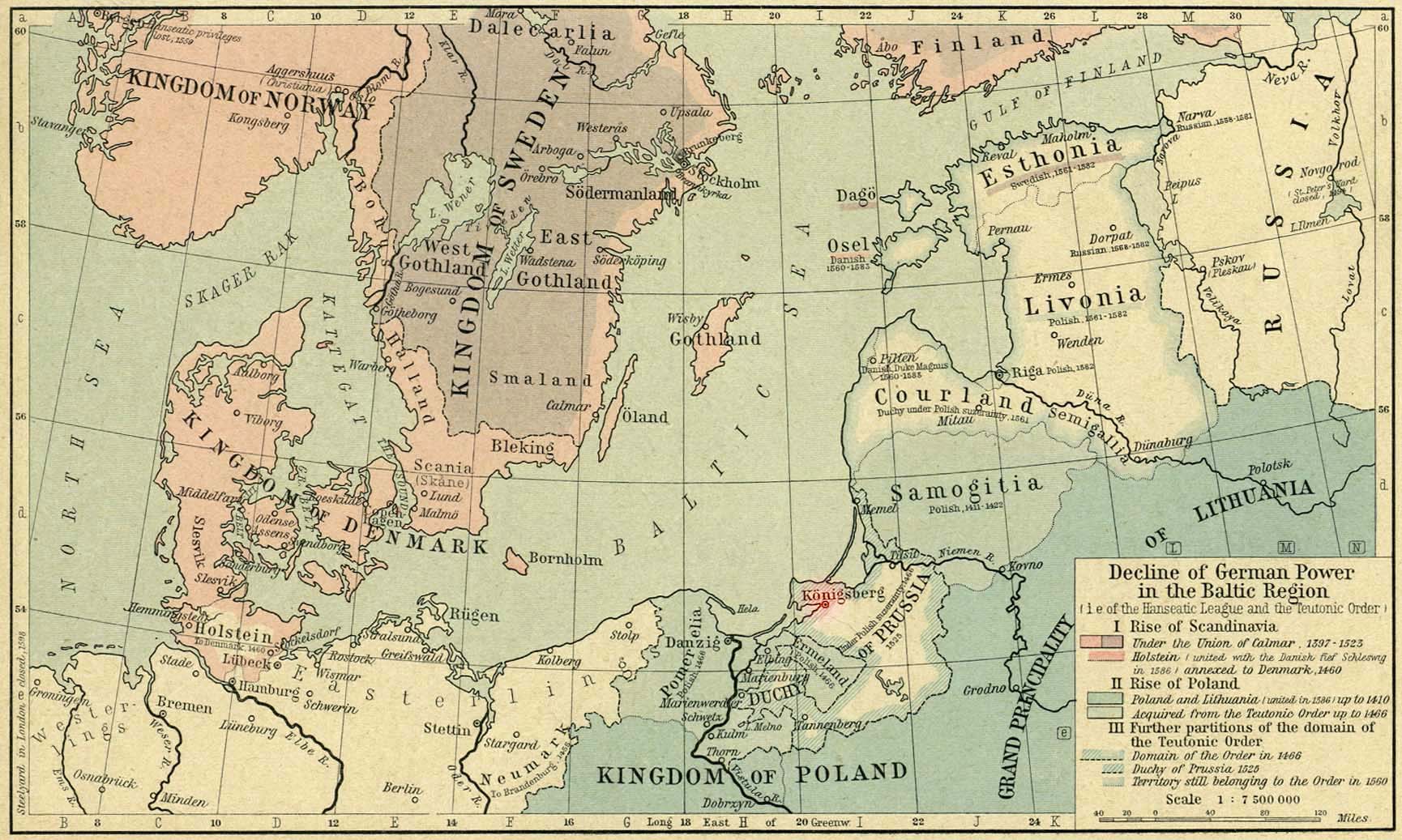 Map: Königsberg is marked with red and Kreuzburg was about 20 miles east of it, about under the “erg” bit of its name label.
According to various historical maps of the tribal migrations, and current thinking on the origins, Kreuzburg was ‘ground zero’ for the bulk of the Gothic tribes. Which at first glance may seem to explain Tolkien’s early interest in them. Either that, or the Polish dimension to his family tree later (circa 1939-55?) came as a wonderful surprise to him — that the Goths who had fascinated him since boyhood emerged into history from exactly the place where his father’s family had originated.
On the other hand, perhaps the surprise of Poland wasn’t found to be very wonderful. Or maybe he never really knew much about or trusted the Poland connection that he evidently knew about in the 1950s. Because he firmly rebuts a late claim that his ‘Saxony’ surname actually originated from Poland…
Letters, No. 349. From a letter to Mrs E. R. Ehrardt, 8th March 1973:
I do not understand why you should wish to associate my name with TOLK, [meaning] an interpreter or spokesman. This is a word of Slavonic origin that became adopted in Lithuanian (TULKAS), Finnish (TULKKI) and in the Scand. langs., and eventually right across N. Germany (linguistically Low German) and finally into Dutch (TOLK). It was never adopted in English.
Thus his boyhood interest in the Goths was not spurred by knowing early on that his paternal family-tree went back to Kreuzburg. This is confirmed by his 1955 letter to Auden stating that his discovery of both Gothic and Finnish were accidents which happened while he was browsing through books out of sheer curiosity…
“I learned Anglo-Saxon at school [in Birmingham] (also Gothic, but that was an accident quite unconnected with the curriculum … Most important, perhaps, after Gothic was the discovery in Exeter College library, when I was supposed to be reading for Honour Mods, of a Finnish Grammar. It was like discovering a complete wine-cellar filled with bottles of an amazing wine of a kind and flavour never tasted before. … [the fascination with it proved] nearly disastrously as I came very near having my exhibition [i.e. course funding] taken off me if not being sent down [i.e. expelled]. Say 1912 to 1913 [for the first interest in Finnish].” — Letters, No. 163.
The Gothic book had been purchased in error by a Birmingham schoolmate who thought it might help him with his Bible studies, circa 1908-09. It didn’t help, and thus Tolkien — realising what it was — took the book off his hands for a modest sum. One imagines that the first word the tree-loving Tolkien looked up in it was “Tree”. He would have found that in Gothic this was bagyms, and that “the Germanic congates vary in their final syllable”. Old Swedish having Bagyn. Baggins, if you like.
Further reading: “The Realms in Exile: A Historical Origin?”, Amon Hen #204. Discusses the fate of the English exiles after the Norman conquest, who sailed a fleet to Byzantium and established a large and long-standing English colony on the northern shores of the Black Sea. Tolkien would have known of this via the Icelandic Edwardssage (aka Edward’s Saga, or Játvarðarsaga). Not discussed, but looking possible to me, is that after the fall or decay of this colony circa the 14th Century exiles from it may have travelled north to Kiev along the river, and from there to Kreuzburg hoping to take ship back to England. If they only made it that far, and settled there… then the Tolkiens might even have come, in a roundabout way, from English Anglo-Saxon stock.
[…] * “The ‘Polish Inkling’: Professor Przemyslaw Mroczkowski as J.R.R. Tolkien’s Friend and Scholar”. May have something relevant, re: exactly when Tolkien first discovered his true ancestry. […]