Is there much left of Tolkien’s Birmingham?
There’s not much architectural coherence left of the ‘old pre-1914 Birmingham’ around the site of Tolkien’s New St. school, though the city centre still retains a few moments of ground-level charm: the Waterstones bookshop; the northern part of Corporation Street around the Law Courts, the Cathedral (though its grounds have changed, judging by an Edwardian postcard I saw); the BM&AG museum. I’ve always assumed that the young Tolkien often nipped around the corner to this local museum, to see the world-class Pre-Raphaelite collection of paintings and wall tapestries. Though I’ve never seen proof of that.
But much of Birmingham was destroyed in the 1960s and 70s by cars and by socialist-brutalist so-called ‘planners’. Also largely gone is the previous “give it a go” friendly capitalism, which Tolkien echoes in the city of Dale in The Hobbit, when he portrays Edwardian-style free-trade as engendering trust and generosity and interconnections with trading neighbours. Also the delight in small inventions and metalwork (both Birmingham and Dale thrived on the “toy trade”).
Today the best three-hour circular stroll from New St. station, keeping to the most interesting Victorian and Edwardian bits, would be: Exit Birmingham New St. station by the Stephenson Street entrance, and turn right. Cross over the road and walk through the Burlington Arcade to reach New St. Turn right, and visit the Waterstones bookshop. Exit Waterstones and turn left up New Street, and then cut up Needless Alley (for a faint taste of the old dark ‘n grungy Birmingham, though it was sadly half-heartedly gentrified in the late 1980s) to Temple Row and the Cathedral. From the Cathedral walk up Colmore Row, then cut down to the top of Edmund St. and then around to the Museum (BM&AG) for the Pre-Raphaelite and Burne Jones collections (allow at least an hour, and also be prepared to navigate past various fashionable political impositions) (update. Nov 2022: now closed until “sometime in 2024”). On exiting the Museum, turn left and then swing hard around the corner along the front of the Council House, and then strike off down Waterloo St. Then down Bennett’s Hill to return to New St. Half way down New St., turn right into Lower Temple St. to return to the train station via the Stephenson Street entrance.

This is roughly how Tolkien might have navigated on foot or bicycle from school — Cornish’s — up to museum — over to the CoE Cathedral (for the surrounding grounds and benches — it would have been a pleasant stop on the way to walk over from his school toward the Catholic Cathedral, or for some fresh air after a feast at the long-lost Barrows’ Stores tea-rooms nearby on Corporation Street).
The site of his old school on New Street isn’t passed by the above walking route, as it was in the lower part of New St. and it’s now long-gone. The site is just not worth seeing today, and Tolkien called its desecrated site “ghastly”. It still is, despite recent changes. But one corridor of the old school was reconstructed on the school’s new site, when it moved. This is now used as a Memorial Chapel in Edgbaston.
Likewise Corporation St. is missed out by the above route. Barrow’s at 74 Corporation Street is gone, the site being today a Poundland store in a wasteland post-modern row of retail-horror. Not even worth a glance. Today you’d have to take the train 40 minutes north-away to the main Soup Kitchen tea-rooms at Stafford, to get something of the same experience.
Waterstones on New Street is probably as close as you’ll get today in flavour to the old Tolkien favourite of the Cornish Brothers (“Cornish’s”) bookshop on New Street, where he “explored for books on Philology” (Reader’s Guide). Cornish’s was at 37 New St. Cornish’s was not the bookshop where Tolkien so fatefully encountered his Gothic grammar book. But it may have been where the book came from. The Gothic book had been purchased in error by a schoolmate who thought it might help him with his Bible studies, circa 1908-09. It didn’t help, and thus Tolkien — realising what it was — took the book off his hands for a very modest sum.
I’m unaware of the former locations of any other city-centre second-hand bookshops he might have frequented in the city centre, though they would likely have been in backstreet places near to Cornish’s such as Needless Alley, or in places and covered arcades now totally swept away. In the 1960s and 70s Needless Alley certainly had a large second-hand record shop, a second-hand bookshop, and a stamp collector shop. But possibly there were others. There used to be some second-hand bookshops around the old Bull Ring markets, or down in the south of the city and serving the University crowd.
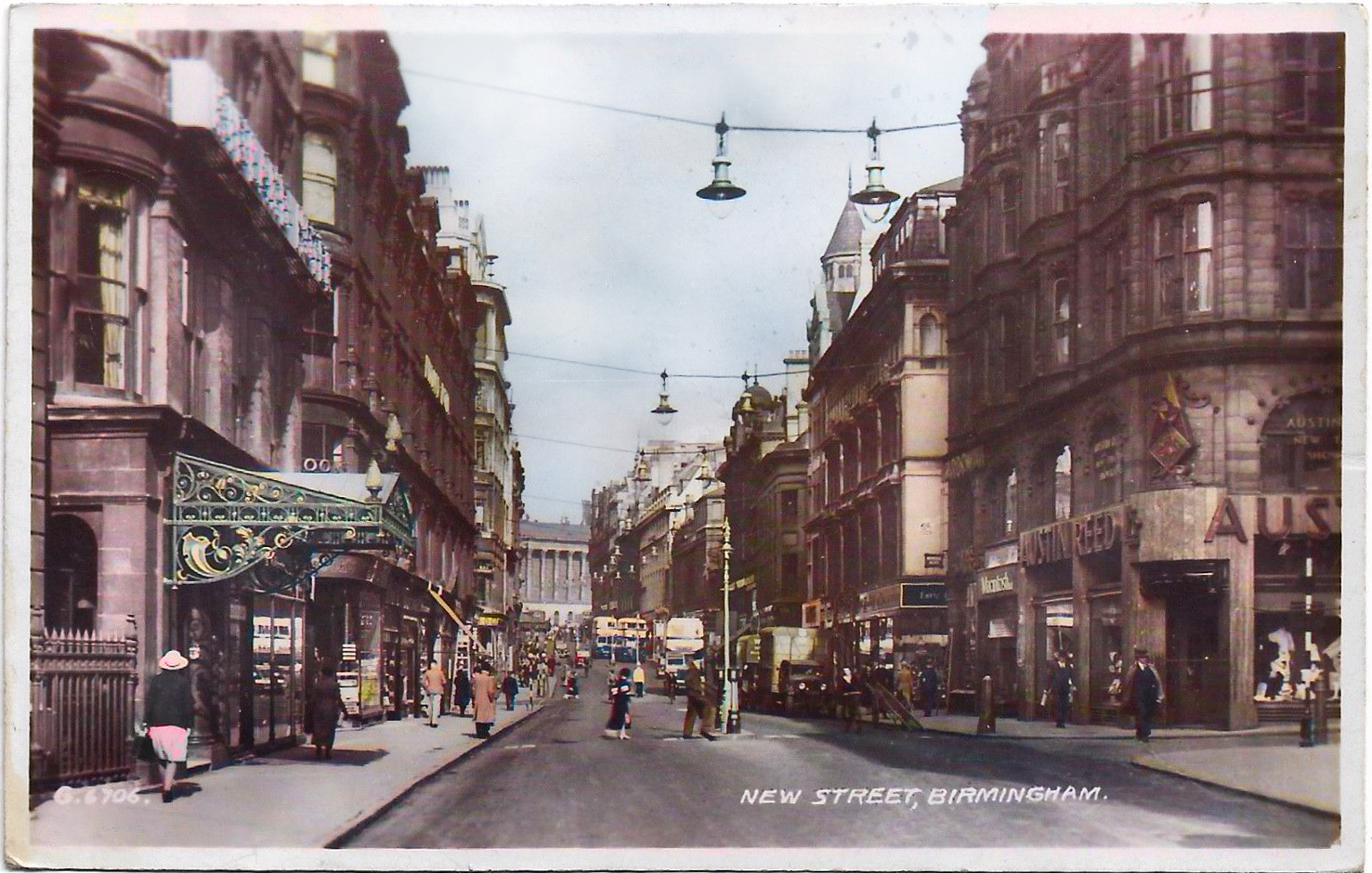
Looking west up New St., probably 1930s. The Midland Hotel (now Waterstones bookshop) on the left with the green iron canopy. Opposite, “Cornish’s” bookshop was. Follow the sight-line of the Austin Reed sign along the shopfronts a little, to glimpse the oblong street-sign plaque indicating Needless Alley. Postcard newly colorised.
If you’re especially interested in Tolkien’s early religious observance and you have another 90 minutes to spare, then the above walking route can be extended from the CoE Cathedral via Colmore Row and Weaman St. to reach the Catholic Cathedral. I don’t know of any hard evidence that he often frequented the Catholic Cathedral, but it was the church of the fathers at the Oratory. As such it seems impossible to imagine he never, over nearly a decade, accompanied the fathers there to take part in major events such as Easter and Christmas. I have found one mention that he “served Mass daily” as a boy in Birmingham, but that was perhaps at the Oratory.
Apparently the less grand church of Saint Anne in Digbeth, to the south of the city centre was his initial church from 1900 — the Chronology has: “St Anne’s Church, which Tolkien, his mother, and his brother attended for a while”. It was on the four-mile walking route home to Moseley from the city centre (in 1900 aged 10 he couldn’t afford the tram fare, though he later bicycled everywhere), and then appears to have served a mostly Birmingham-Irish population. But today Saint Anne’s exterior and unsavoury neighbourhood have little to recommend them, and it’s a long and tedious walk from the city centre. It may be worth visiting by taxi if you can arrange an interior viewing, however.
About a year or so later the family moved to Kings Heath and started to worship at the nearby and very humble Roman Catholic church of St. Dunstan, “then a building of wood and corrugated iron on the corner of Westfield Road and Station Road” (Reader’s Guide). This little church was totally destroyed by a German bomb, in a wartime air-raid on Maundy Thursday, 1941.
Then there was another house move or two and it seems the Oratory itself became their church for several years circa 1902-04. It’s very difficult to definitively 100% pin down if the Tolkien brothers attended the Oratory daily to serve in the church, or only served on special days. But the Oratory remained a ‘home place’ while he was living at various lodgings nearby during 1905-1911. Today seeing the Birmingham Oratory on foot involves a trek up the hideous Broad Street from the city centre, and then way out beyond Five Ways on the Hagley Road. Contact the Oratory for details of access.
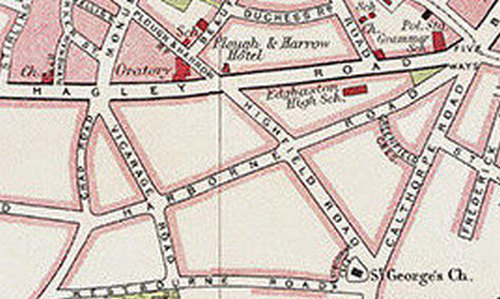
Hagley Rd., Highfield Rd, Oratory, Plough & Harrow pub
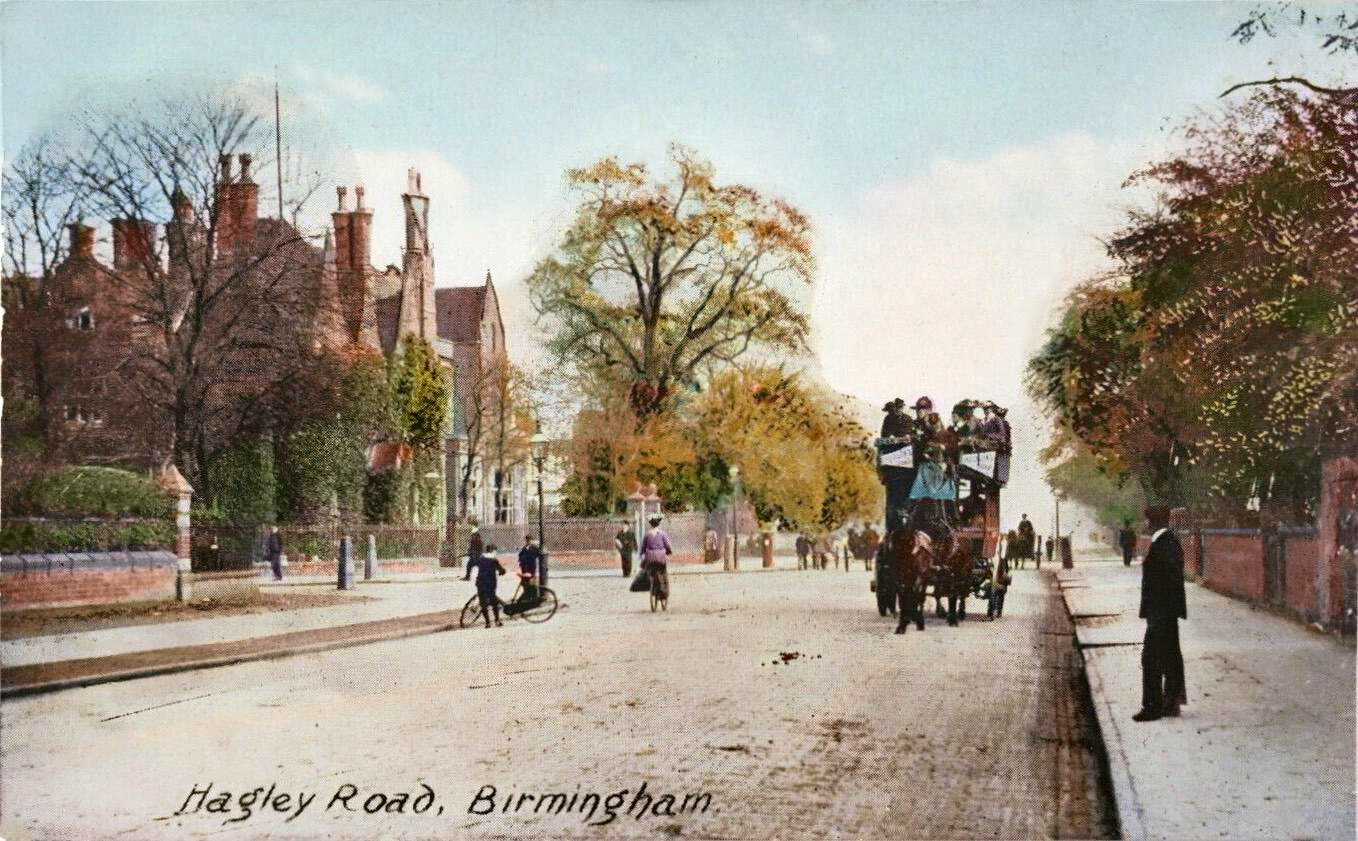
Plough & Harrow on the left. Probably circa 1904. Newly married, Tolkien and Edith stayed at the hotel in June 1916 while visiting. It is the site of a heritage Blue Plaque.
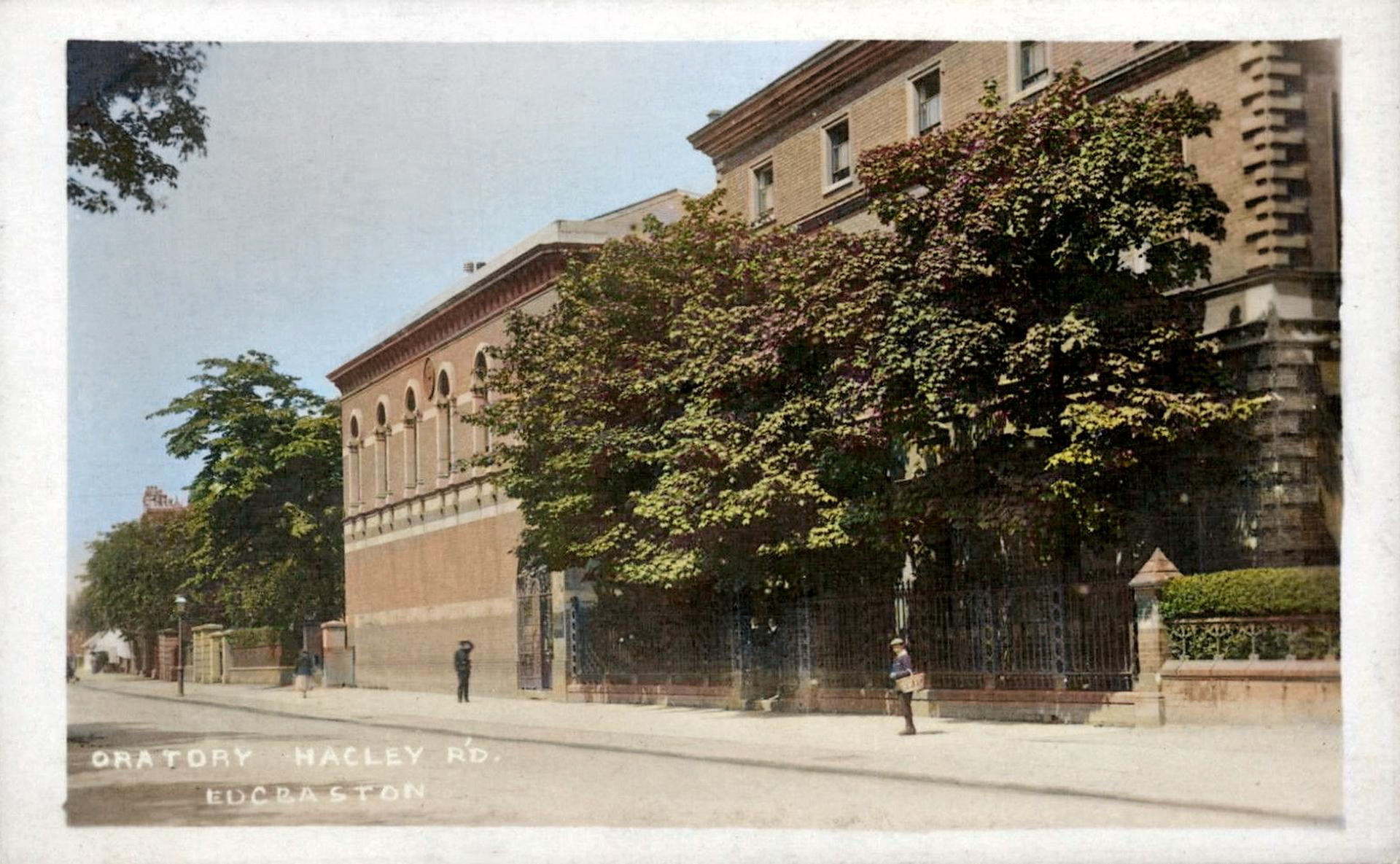
The Birmingham Oratory.
As such it’s not pleasantly walk-able from the city centre, unless you can stand having traffic in your ears and lungs all the way. Nor is it reachable on foot along the canal towpaths, even if these were safe to walk once you get outside the city centre. However, if you’re there by taxi, note that he lived almost within sight of the Oratory at 4 Highfield Road, Edgbaston, from 1909-11 — at which location Google Street View shows this evocatively tree-ish ruin and gate today…

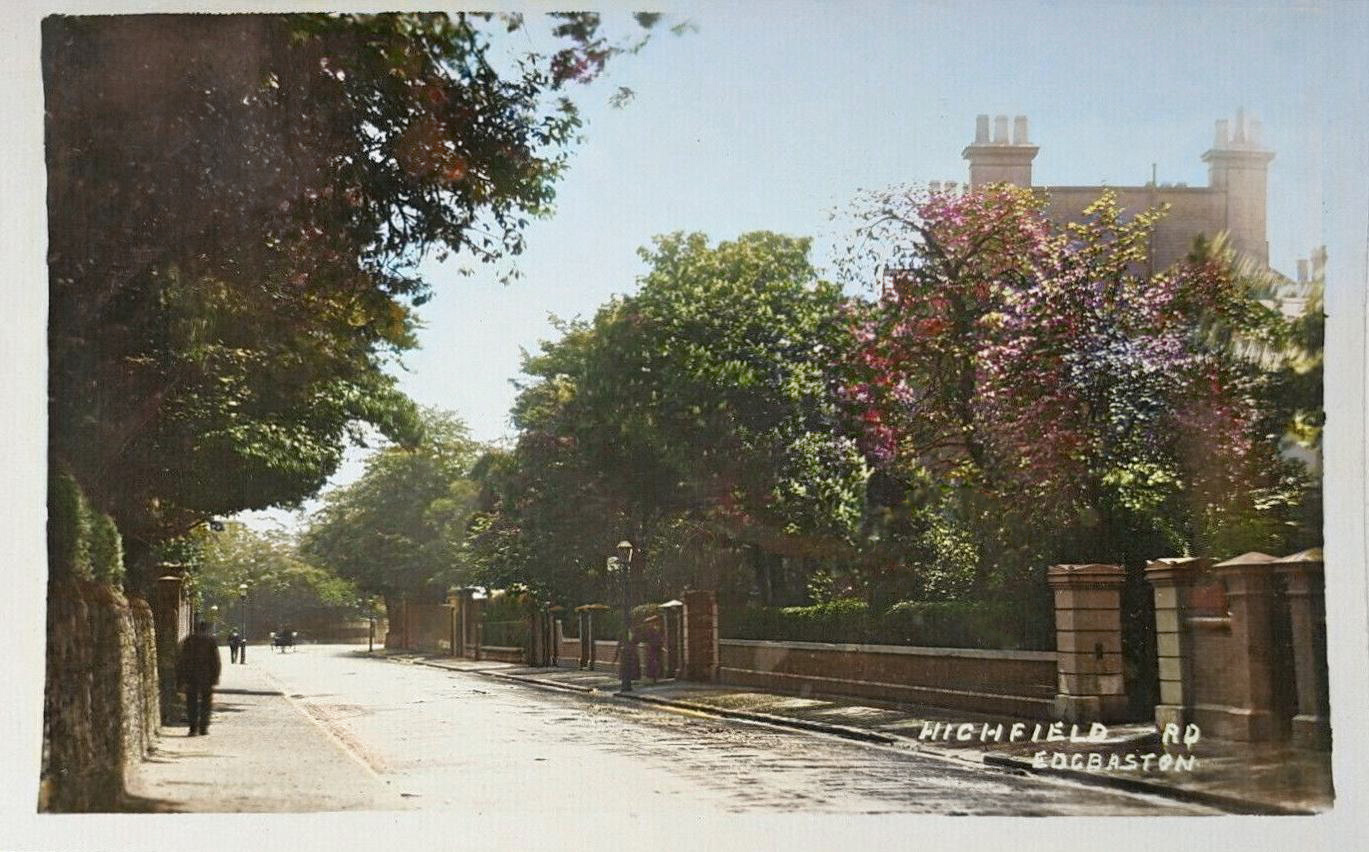
Highfield Road in better days.
Further south in Edgbaston and into Moseley, be warned that there is a lot of local touristy blather about places in south Birmingham and its environs. Some of it misleading, and local tourist and city heritage centres are not to be relied on. For instance I can find no evidence that he ever visited Kinver Edge, on the southern outskirts of the city, despite the city’s heritage centre having a video on this and Tolkien. Nor is there good evidence that the ‘Two Towers’ were inspired by tall towers to be seen in Edgbaston, though they are dramatic structures. Sarehole is today a very different from the rustic place in which Tolkien spent part of his childhood, though the Mill has a fabulous pond in summer and is now a place to take small children.
Further south there is The Birmingham Oratory’s ‘Retreat’, though that surely remains private today. North there is the village of Great Haywood, up into mid-Staffordshire, and some may also be interested in the site of his Army training camps nearby on Cannock Chase.
Further reading:
* The J.R.R. Tolkien Reader’s Guide. (See index for entry “Birmingham and its Environs” and sub-entries).
* “Tolkien’s Birmingham”. (A 42-page spiral-bound booklet from 1992, long out of print. I’ve never been able to find a review or even anyone who’s seen it).
* Robert S. Blackham, “Tolkien’s Birmingham”, Mallorn 45 (Spring 2008). (A general three-page introduction to certain sites. The article is followed in the same Mallorn issue by “John Ronald’s Schooldays”, also on Birmingham, which in the following issue of Mallorn is followed by the related “The Battle of the Eastern Field”).
* Robert S. Blackham, The Roots of Tolkien’s Middle Earth. (Small heavily illustrated book with 200 pictures in some 140 pages, and focused on the parts of the childhood spent in the then rural and semi-rural suburbs of south Birmingham).
* Keith Brace, “In the Footsteps of the Hobbits”, The Birmingham Post newspaper’s Midland Magazine, 25th May 1968. (Feature article derived from an interview with Tolkien, with a second half on his memories of Birmingham and its outskirts and also the author’s evocation of the state of those places in the late 1960s).
[…] Early morning train from London to Birmingham. Walk from Birmingham New St. station to the Birmingham Museum & Art gallery for the Pre-Raphaelite […]
[…] “Tolkien in Birmingham” post has updated. Defunct details of the biopic filming removed, expanded text, new postcards […]