It’s interesting to learn that there are new text-to-speech Sapi5 voices, available in regional British variants:
* Welsh voices, Geraint and Gwyneth for text-to-speech as either Welsh-accented English or Welsh. Free, but an email request is required — registered blind people can request the voices directly from the RNIB.
* Scottish Voices, Heather and Stuart, plus Ceitidh for Gaelic. Educational non-commercial use only, and free — but registration is required.
* There are no other free accented voices, such as Cornish or Brummie, so far as I can tell. But as the cost of developing a Sapi5 TTS voice comes down, via automation of the process, and as the systems that drive the voices make them sound less robotic, I foresee a future in which some distinctive British regions and cities develop and offer their own ‘voice’. (Update: there’s now a Black Country voice and even a Glasgow voice).
There’s also Microsoft Hazel, a free British voice and better than the previous Microsoft British variants. This voice shipped as standard with Windows 8 and 8.1. The quickest way to tell if a Windows 8 user has it seems to be to install the best genuinely freeware TTS reader for Windows, Balabolka.
If you don’t have Microsoft Hazel you may be able to get it from Windows Control Panel: Language Pack | Add a Language | Select | the wait until you see the “Download is ready…” link appear. (You can apparently also get a free French-accented Sapi5 voice, Hortense, this way. Just download the French language pack for Windows).
Balabolka’s “Direct Speech” and XML tags markup option can help you set up a stage-play -like script, in which there are different voices speaking in the same document. So you could, theoretically, have a Scot talking to someone from the Black Country. Here is an example of a coded script containing a few lines from A Midsummer Night’s Dream, and showing voice changes, pauses and pitch/speed shifts…
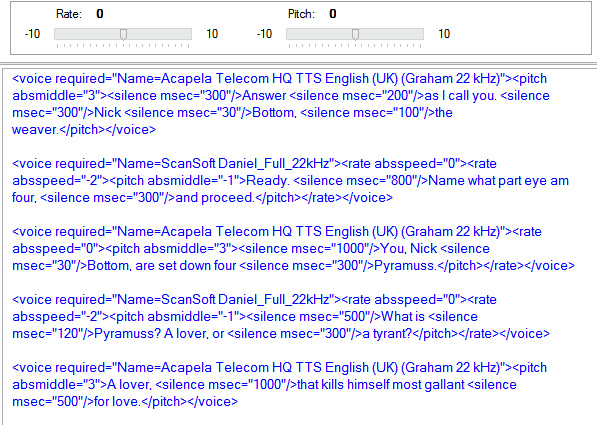
Keep in mind there are different markup tags, and some will work with some voices and not others.
Note that spelling needs to be fixed to get some voices to pronounce properly, for instance for to four,and I to eye. Overall it’s a bit of a laborious process, and — until we can get some AI-automation onto it — you might do better to hire some actors on Fiverr or rent a local music studio if you want to make a short audio play.
If you do want a few commercial British voices, then the following are recommended and are effectively abandonware today:
* IVONA 2 Amy and Emma (aka 1.6, but they’re actually 2) (32-bit)
* IVONA 2 Brian (aka 1.6, but they’re actually 2) (32-bit)
* Voiceware VW Bridget (shows up in the lists as American, but is British, upper-class) (32-bit)
32-bit will run on Babaloka (32-bit) on 64-bit Windows.