Here is Chesterton’s epic poem “The Ballad of the White Horse” (published summer 1911), in the best free audio reading I could find. The clear steady British voice of Malcolm Guite, Chaplain of Girton College Cambridge, carries the poem far better than Librivox’s worthy-but-flat American reader. Guite kindly offers .mp3 downloads.
If you have $15 there’s also a commercial reading for the American Chesterton Society, “Mackey’s Ballad of the White Horse”, which is by a long-time Chesterton scholar.
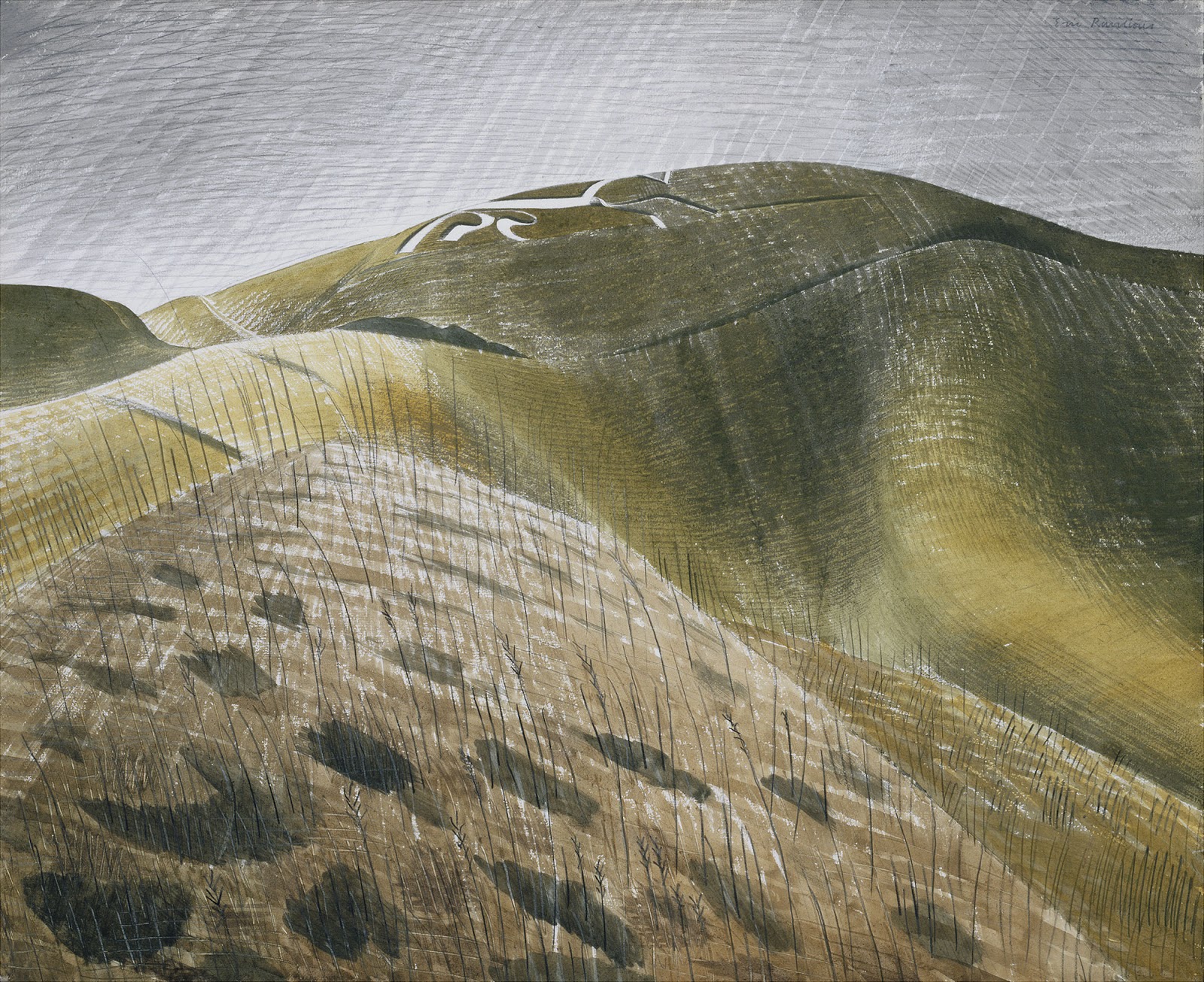 Picture: Eric Ravilious, “Uffington White Horse”, 1939.
“The Ballad” is a grandly ambitious poem and is said by some to have been a possible inspiration for the general structure and tone of The Lord of The Rings. Tolkien was certainly in tune with Chesterton’s religious and political and localist stances. He had enjoyed and been swept up in the poem as a young undergraduate shortly after publication, which would mean circa summer 1911 – summer 1912. He then appears to have read the poem again in the wartime atmosphere of the early 1940s, when he found he was rather more critical of it. In 1944, re-reading it again with his daughter, he mused in passing that Chesterton’s “Ballad” clearly… “knew nothing whatever of the ‘North’, heathen or Christian” (letter of 3rd Sept 1944). He probably meant here the old Norse/Germanic ‘North’, but I also sense the implication that a sophisticated London man like Chesterton lacked the grit and deep regional knowledge needed to really ground his poem in the Englishness that Tolkien knew from his background in Birmingham and the West Midlands.
“The Ballad” had an equally inspiring literary influence on Robert E. Howard (author of the Conan stories), from 1927 onward. The opinion of R.E. Howard’s friend H.P. Lovecraft on “The Ballad” is unrecorded, though doubtless Howard would have mentioned it favourably to the Anglophile Lovecraft. In his youth Lovecraft had certainly admired Chesterton’s incisive and knowing wit and his keen observations on aesthetic matters, as well as a few of Chesterton’s better detective stories. But Lovecraft later found Chesterton’s rejection of Darwin’s science, as late as 1920, to be risible (“when a man soberly tries to dismiss the results of Darwin we need not give him too much of our valuable time”). In early 1930 Lovecraft had the opportunity to hear the elderly Chesterton speak in New England, but he didn’t bother. He felt that Chesterton had turned his back on the unsettling discoveries of the emerging modern world and had become an old fossil trapped in the pungent amber of 1920s Catholicism (“synthetic Popery”) and a fading late-Victorian arts-and-crafts tradition (a “crazy archaism”) which claimed the 13th century to have been the pinnacle of civilisation.